A Fold, a Frenzy and a Fortune: Inside Apple’s Business of Desire
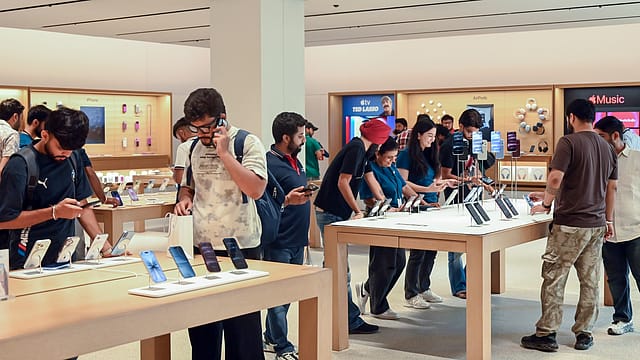
Queues in major cities, pre-orders selling out and buyers willing to spend several lakh rupees on a new device: Apple's latest launch has all the ingredients of a familiar spectacle. But this time, the object of desire is not just another iPhone. It is a foldable, a category in which rivals have spent years trying to convince consumers that a phone can do more by becoming bigger.
Priced between ₹2,99,900 and ₹4,49,900, Apple's first foldable iPhone features a 7.6-inch inner display and promises the convenience of a larger screen in a device that can still fit in a pocket. The proposition is part smartphone, part compact tablet—and entirely premium.
At Apple's Saket store in New Delhi, one buyer told ANI that the device offered features “that haven't been available on any other iPhone until now”. His first impression was “really good”, and he was particularly impressed by the interface. The camera, he acknowledged, might be less powerful than the iPhone 18 Pro Max's, “but otherwise, it is just amazing”.

Losing Memory
16 Oct 2026 - Vol 05 | Issue 42
The making of a medical and social emergency
Multitasking stood out. “You can do two different things on the same screen at the same time,” he said, adding that he had not seen the feature on any other phone. He believed the device would catch on with young consumers, although “the price is definitely a factor”. He had purchased the 512GB model for around ₹3,24,000.
The buyer's response captures both sides of Apple's proposition: the excitement of a new experience and the financial commitment required to access it. For the company, the foldable is more than a new product. It is a test of how far its brand can stretch consumers' willingness to pay.
THE BUSINESS OF DESIRE
Apple's success has never depended on selling the cheapest device in the market. It has built an ecosystem in which hardware, software and services reinforce one another. For many customers, buying an iPhone is not simply a decision about specifications; it is also a choice to remain within that ecosystem.
In the financial year ended September 2025, Apple reported revenue of $416.2 billion, with the iPhone contributing $209.6 billion. The smartphone remains central to the company's fortunes, even as its services business has grown.
A foldable could help Apple extract more value from customers already willing to pay for its products. The larger display may appeal to professionals working on documents, people who multitask and users who consume substantial amounts of video on their phones. It could also encourage existing iPhone owners to upgrade to a more expensive model.
But a high price needs a compelling justification. Messaging, browsing, photography and video streaming remain possible on conventional smartphones costing a fraction of the foldable's price. The challenge is to persuade buyers that the new screen changes how they use their phones, rather than merely how they look at them.
A LATE ENTRY INTO THE FOLD
Apple enters the foldable market after competitors such as Samsung and Huawei have spent years refining the category. Hinge mechanisms, screen durability, thickness and software optimisation have been persistent challenges.
The late entry gives Apple the opportunity to learn from those experiments and bring its software ecosystem to the format. Yet novelty alone may not be enough. Consumers can already choose from rival foldables, and Apple must explain why its version deserves such a substantial premium.
Durability will be central to that argument. The buyer at Apple Saket also highlighted the cost of a protection plan, which he considered essential for a foldable screen because damage to the screen would be covered under the plan. “It's best to get it,” he told ANI, “but that means an additional expense for you.”
The extra cost illustrates the challenge facing Apple: buyers must weigh not only the purchase price but also the expense of protecting and maintaining a more complex piece of hardware. Early enthusiasm is an important start, but the real test will come when the novelty subsides and consumers decide whether the experience justifies the expense.
INDIA'S SMARTPHONE MARKET TELLS ANOTHER STORY
The launch spectacle is unfolding against a more difficult backdrop in India. Smartphone shipments fell 20 per cent year-on-year in the July–September quarter of 2026, reaching their lowest level in a decade, according to Counterpoint Research's Monthly India Smartphone Tracker.
Rising memory prices, softer demand and efforts by manufacturers to control channel inventory contributed to the contraction. The pressure was particularly severe in the affordable segment: shipments of smartphones priced below ₹20,000 declined 47 per cent year-on-year, as price increases pushed some models into higher brackets and consumers delayed upgrades.
Counterpoint expects India's smartphone market to shrink by around 13 per cent in 2026. Further price increases could follow the festive season, making no-cost instalments, exchange offers and retailer promotions increasingly important.
The market, however, is not uniformly weak. Samsung led Indian smartphone shipments in Q3 2026 with a 17 per cent share, followed by Vivo at 16 per cent. Oppo and Xiaomi each held 12 per cent, according to Counterpoint. Apple also recorded initial sales of its iPhone 18 Pro series in India nearly 20 per cent higher than those of the iPhone 17 Pro series.
Counterpoint Research Director Tarun Pathak believes the foldable could expand the category initially in terms of revenue rather than sheer sales volume. “Overall, we believe that the iPhone Duo is set to expand India's foldable segment by value rather than volume initially and bring the spotlight on the foldable segment,” he said.
That distinction matters. Apple may not need mass-market sales to make the device commercially significant. But the enthusiasm for a phone costing several lakh rupees should not be mistaken for evidence that the broader market is recovering. While some buyers are prepared to pay for the latest technology, rising costs are forcing others to postpone their next upgrade.
AFTER THE FRENZY
For Apple, the immediate spectacle is valuable. It reinforces the company's ability to turn a product launch into a cultural event and positions the foldable as a new flagship of its technological ambition.
But queues and pre-orders alone cannot establish whether the product will succeed over time. Sustained sales, customer satisfaction and repeat demand will provide a clearer measure. The device must demonstrate that its larger screen and multitasking capabilities become essential to users, rather than remaining expensive novelties.
Apple has turned a new phone into a global talking point. The harder task is converting that excitement into lasting demand. In a market where some consumers are queuing for a luxury device while others are postponing upgrades, the foldable iPhone captures two competing realities of the smartphone business: the enduring power of desire at the top end, and the growing pressure of affordability everywhere else.