11 Months In, Vivek Abrol Wants to Triple Luminous. His Bet Is Solar
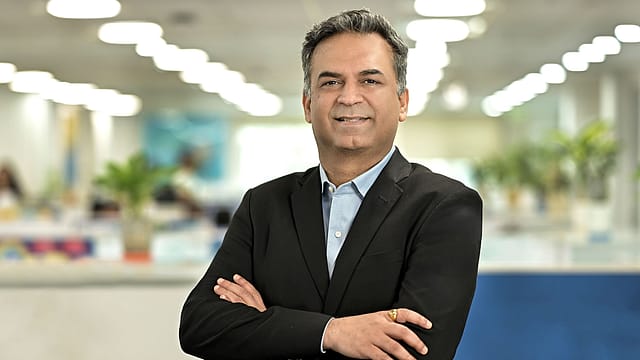
Eleven months. ₹2,000 crore. One audacious ambition: to make Luminous a name that stands not just for keeping the lights on, but for powering the future of Indian homes.
Vivek Abrol has wasted little time in setting out the scale of his ambition for Luminous Power Technologies. As Managing Director and CEO, he wants to take the 38-year-old company beyond its familiar territory of inverters and batteries and build it into a formidable force in solar and integrated energy solutions. He is betting on a combination of manufacturing muscle, lithium technology, hybrid inverters and intelligent energy management to get there. The target is to triple the business and have solar contribute 70 per cent of its portfolio by 2030.
Fair to say, it is a defining assignment for Abrol. Luminous already has the reach, brand recognition and distribution network that many newer solar companies would envy. The challenge is to convert that legacy into leadership in a market that is expanding rapidly and attracting formidable competition from established to new players. Abrol is also building on work begun before his tenure: his predecessor, Preeti Bajaj, led the company through its Luminous 3.0 transformation. Bajaj is now EVP, Home Solutions Business Division at Schneider Electric and serves as a Luminous board member and vice-chairperson.

The Wealth Issue 2026
06 Nov 2026 - Vol 05 | Issue 45
Portraits of Dreamers and Doers under 35
Now Abrol is putting his own stamp on the next phase. The company has unveiled a new brand identity, ‘Har Soch Mein Power’, and the ‘Solar Wali Soch’ campaign featuring Sachin Tendulkar. It is more than a change of logo or tagline. Luminous wants to change the way consumers think about the brand, from a solution they turn to during a power cut to a partner in how they generate, store and use electricity.
In an interview with OPEN Digital, Abrol speaks about the ambition behind the ₹2,000-crore investment, the bets he is making on solar and the business challenge of turning a household name in power backup into a leader in the next phase of India's energy transition. (Edited Excerpts)
Q. Luminous has announced a new brand identity and the tagline ‘Har Soch Mein Power’. What is the thinking behind this exercise? Is this a continuation of the company's earlier transformation, or does it represent a more fundamental shift in how Luminous sees itself?
A. The overall mandate has been to grow the solar business because that is the future, and that is where we have been focusing. Looking ahead to 2026 and beyond, there will obviously be a strong focus on solar. At the same time, we will not lose sight of power backup because that business has a long runway as well.
The larger vision of Power IQ and the ambition to grow threefold are not changes to an existing mandate. This is a personal ambition of mine, and I believe it is quite feasible if we get the execution right.
To make this happen, we need to go the extra mile. We need a stronger proposition, different business models, and investments in marketing and go-to-market capabilities that can facilitate this growth.
Q. Until now, consumers have largely associated Luminous with inverters and batteries. What exactly do you want them to associate the brand with now?
A. The positioning itself is changing. Until now, consumers have largely perceived Luminous as a power backup inverter and battery company. Some consumers know that we are also in solar, but a significant number do not.
We want to change that perception. Luminous is not just about power backup; we are also a solar power company. This is why we are moving towards a solar-first positioning. We want to be recognised as a solar brand as well.
The new identity brings our different energy businesses under one cohesive brand vision. The tagline, ‘Har Soch Mein Power’, captures our belief that every new thought in energy can unlock a new possibility to power people's lives. We want to anticipate changing consumer needs through innovation, technology and solutions that make everyday living smarter.
Ultimately, the transformation is not just about the ₹2,000 crore investment or spending more on marketing. It involves our go-to-market strategy, technology, product development and positioning. Technology, in turn, is not limited to hardware; it also includes software.
All these elements have to come together. It requires a 360-degree approach to building the business and achieving the scale we are targeting. Our ambition is to become the number one player by 2030.
Q. You have spoken about an overall market opportunity of around ₹80,000 crore. How much of this market are you looking to capture?
A. Currently, we have approximately 8–10 per cent market share across solar and power backup. In the home power backup segment, we are the market leader. However, we are not yet the leader in solar.
Our ambition to grow threefold is linked to our vision of becoming the number one player. We are aspiring to reach somewhere close to 25 per cent market share by 2030.
Q. You have been in the role for 11 months. What were the first things you identified that needed to change? Was it the product portfolio, the distribution network or the company's technology capabilities?
A. When I joined, I visited the markets and interacted with consumers. A few things became very clear. First, we needed to raise our game in terms of the product portfolio. We cannot afford to fall behind the pace at which the market is evolving.
We have made progress in building an ecosystem of products over the last few years. However, the market and the competitive landscape are also evolving. Lithium technology, for instance, needs to be accelerated. We also need to accelerate the development of hybrid systems and hybrid inverters. Policy developments, including the next phase of the PM Surya Ghar scheme, make the storage business increasingly important.
Our investments have to be aligned with these developments. Some capital expenditure has already been sanctioned, and these investments need to be put in place. It is not just about solving a front-end consumer problem. We also need to address the technology curve and the cost curve to make the business profitable.
My first priority over the last 11 months has been to understand the business. It is not about coming in and immediately changing everything. It is about understanding the nuances of the industry, the categories we operate in and what the existing team brings to the table. We also need to recognise what we have achieved over the last three or four years, which has been a successful journey.
The next phase of growth requires transformation across three dimensions. The first is investment. As I mentioned, we are looking at ₹2,000 crore in capex. The second is technology. This is not just about hardware but also software. We are developing Power IQ, which was not part of our proposition earlier. The idea is to make a meaningful difference to the consumer. The third is marketing. Historically, our marketing investments and efforts have been relatively limited.
Q. A large part of your ambition rests on solar. What will the ₹2,000-crore capital expenditure plan actually go towards, and how much of your targeted growth will come from these investments?
A. I would say that these investments will contribute up to 70 per cent of the growth. A large part of the ₹2,000 crore capex is going into the solar business because that is the ecosystem we are building.
This includes solar cell manufacturing, which accounts for a significant portion of the capital expenditure, as well as additional manufacturing capacities for lithium batteries and hybrid inverters.
By 2030, solar is expected to contribute approximately 70 per cent of our total business. That is where we are placing a larger bet.
Q. Luminous already has a strong presence in smaller towns and rural markets through its power backup business. How do you intend to translate that distribution strength into solar?
A. What we are doing in solar is similar to what we did when we built our power backup business. We identified markets and districts where there were white spaces and then worked towards strengthening our presence.
We are now undertaking a similar market-wise and district-wise assessment for solar. We want to understand where the opportunities are, where the white spaces exist and where we need to build our presence quickly.
This means strengthening our go-to-market strategy. Do we need more distributors? Do our existing distributors need to cover more markets? Where do we need additional system integrators? These are some of the questions we are addressing.
The second aspect is the supply chain. We need to assess the location of our warehouses and service centres and ensure that the entire ecosystem is in place.
We already have around 400 service centres across the country, which support our power backup business. We want to leverage this existing infrastructure as we expand our presence in solar.
Q. Your new campaign, ‘Solar Wali Soch’, featuring Sachin Tendulkar, talks about understanding household needs rather than simply selling solar panels. What is the consumer proposition you are trying to build?
A. The idea is to move beyond individual products and bring together solar generation, energy storage and intelligent energy management into an integrated ecosystem.
Power IQ is an intelligent system where we bring together the solar panel, battery and hybrid inverter. It is designed to make these components communicate and work in unison.
We are working towards offering a promise of 20 per cent higher power generation through this integrated system. Naturally, this proposition will come at a premium because of the technology and the USP we have developed.
Whether the improvement will be 20 or 25 per cent is something we are still evaluating. A few pilots are underway, and we also want to understand consumer acceptance.
There will be a premium, but we want to take away the complexity for the consumer. Instead of the consumer having to constantly monitor the number of solar units generated and track the system's performance, we want to take responsibility for delivering on the promise. This also includes monitoring the units generated and the associated performance metrics.
Q. For a household considering rooftop solar, the initial investment and the complexity of installation can be deterrents. What kind of costs should consumers expect, and how will Luminous make the process easier?
A. First, if a consumer wants to install a basic solar system at home, the prices are more or less standardised, with variations of around 5 per cent either way. The consumer ultimately pays a fairly similar price. The differences are largely at the intermediary level.
The second proposition is Power IQ. This is an intelligent system where we bring together the solar panel, battery and hybrid inverter into an integrated ecosystem. As I mentioned, there will be a premium for this proposition.
The first step is to simply call us. Once a consumer contacts us, we will assign a relationship manager who will guide them through the entire process, from the first interaction to the final stage.
The relationship manager will visit the consumer's home, assess the electrical load and understand the appliances being used. Based on this assessment, we will explain what is feasible, what the most suitable system would cost and what kind of return on investment and payback period the consumer can expect.
The third stage is installation. Once that is completed, the fourth stage is servicing and ongoing support.
So, from the initial call to the final stage of monitoring whether the system is generating what we promised, we want to manage the entire experience. I would say there are very few players currently offering this kind of end-to-end service. This is where Luminous can play a larger role.
Q. There is a lot of talk about AI in consumer technology, but Luminous has chosen to foreground intelligence and connectivity rather than explicitly market its products as AI-powered. Is that a conscious decision?
A. Our innovations are increasingly using AI, not just in consumer-facing applications but also in how we use data and AI to develop more innovative products.
We are also working on a new inverter that will be more AI-driven. However, it is still at a stage where we are learning more about the technology and its applications. We want to understand it better before communicating extensively about it.
Having said that, we are definitely using AI. When we talk about Power IQ and intelligent systems, there is an AI-driven layer embedded in the technology. We may not explicitly call it AI, but it is part of the system.
Q. Schneider Electric is an important shareholder and partner. How does that relationship strengthen Luminous' technology capabilities, particularly in areas such as lithium batteries and battery management systems?
A. Schneider has been a very important partner and shareholder for us. We have been learning from its ecosystem and understanding how different technologies can be interfaced.
Schneider operates across several countries. Some of these markets have made greater progress in areas such as lithium technology and battery management systems. We have been able to learn from these experiences, including the software capabilities and systems used in other markets.
It provides software and helps us understand certain systems related to battery management. It also facilitates the development of these systems in collaboration with us. All of this is part of the partnership.
Q. Solar is central to your next phase of growth. What are your sustainability commitments as you expand manufacturing and the supply chain?
A. Solar is among the most sustainable businesses one can operate in. We are working towards reducing our environmental footprint through our business models and operations.
We are looking at carbon emissions not just at the manufacturing level but also across the supply chain, including transportation. We are examining how much carbon is emitted across these activities and how we can reduce that footprint.
I would prefer to share the quantified numbers separately because I want to ensure that the information is accurate. We are doing considerable work on this, and we can share a more detailed update.