Ten Years, Not Ten Minutes: The Gaurav Manchanda Story
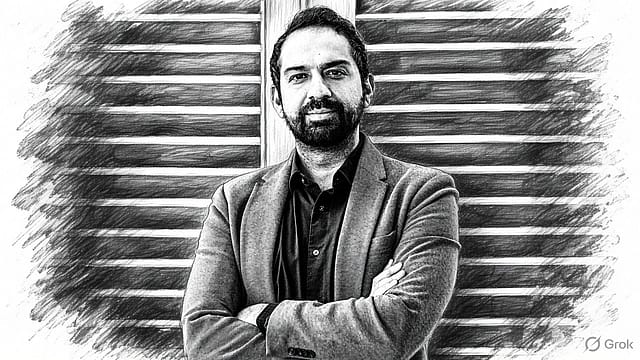
Five minutes into the call, the fan becomes a problem.
It is a little after five on an October afternoon. I am in another city, leaning into my screen. Gaurav Manchanda is in Bengaluru, and somewhere above him, out of frame, a ceiling fan is turning.
“Gaurav, I’m not able to hear you clearly.”
He leans closer to the microphone. Talks louder. It doesn’t help. The fan keeps chopping his sentences into pieces.
He looks up at it. Then he says, mildly, as if it has only just occurred to him:
“Maybe it’d be much better without the fan, honestly.”
A click. The whirring winds down and stops.

The Wealth Issue 2026
06 Nov 2026 - Vol 05 | Issue 45
Portraits of Dreamers and Doers under 35
Silence.
It is a small thing. I didn’t think much of it at the time. It was only later, playing the recording back, that I realised it was the most revealing thing he did all hour. Because that is what Gaurav Manchanda does for a living. He decides what gets into the room, and he switches off the rest.
Stores, Unique List & Not In Our Aisle
His stores have a list. It is called Not In Our Aisle.
Walk into any of the thirty-odd The Organic World stores across Bengaluru and Hyderabad and you are walking through that list. High-fructose corn syrup: not in our aisle. Artificial colours and flavours: not in our aisle. TBHQ, the preservative that keeps biscuits and nuggets “fresh” for months: not in our aisle. Parabens, sulphates, phthalates, the harsh acids in floor cleaners. Popular, cheap, in every Indian kitchen I have ever stood in.
Not in our aisle.
What is in the aisle tells its own story. Vegetables that were in the ground yesterday, because they reach the shelves within twenty-four hours of harvest. Brands that got in only after they agreed to the list. And what doesn’t sell isn’t thrown away: unsold fruit and vegetables go back to the farms as cow fodder. Even the leftovers have somewhere to go.
I have walked into a lot of founders’ offices in twenty years. Most of them want to show you what they have built. Very few want to show you what they have refused.
What I didn’t know, when the fan went off, was that the man who wrote this list keeps a second one. A personal one. Things he has decided not to let in.
Getting him to read it out loud was another matter.
The Punch That Never Came
I should tell you what I believe, because it matters to this story.
In twenty years of telling other people’s stories, I have come to think talent is the most overrated idea in business. Only grit matters. When you have nothing else, grit is what you hold on to.
So I went straight for it.
“You need courage most when you are down in the dumps,” I told him. “When the cage is gone and the tiger is right in front of you. Tell me about the lowest moment of your life.”
He thought about it. Then he reached for someone else’s line.
“Mike Tyson put it very well. Everyone has a plan until they get punched in the face.”
“So let’s talk about a couple of punches on your face,” I said. “And I’ll keep cutting in. Don’t take it otherwise.”
“Okay. So maybe I can give you some context.”
And he did. He gave me context. Bangalore schools. An engineering degree from BMS. A stint in the US, telecom, a startup, consulting. Store formats. Expansion plans. Warehousing in Mysore.
He did not give me a punch.
A Boy in a Hurry
Before the stores, there was a boy in a hurry.
Bangalore, 1995. A thirteen-year-old with a massive HCL computer in his room, the kind of machine most families in the city didn’t own. He played games on it, but mostly he built things. When the computer wasn’t enough, he went to a café where you could get online, and went back so religiously that he took lessons there. He loved the feeling, he told me, of being plugged into the whole world at once.
Around the same age, he went into business.
It was a kids’ club in the basement of his building. A lending library for the neighbourhood. He stocked it with every book and magazine he could gather, arranged them on shelves, worked out who could borrow what and when it had to come back. A real operation, run by a child, for children.
Then came the question every founder eventually runs into. What about the licence?
A twelve-year-old cannot get a commercial licence. The library closed. It was a friend, years later, who reminded him it had ever existed.
“That itself was a learning journey,” he said, and moved on.
I noticed that. He is not a man who lingers on a closed door. Most founders I meet tell you their failure story with relish, because the Indian startup world has taught them that failure is a badge. Gaurav tells his like a footnote. It happened. He learned. Next.
What he wanted, all through those years, was speed. Engineering, then an MBA from Boston University. I teased him about it. In twenty years, I told him, I haven’t met a single engineer who didn’t go on to do an MBA, and most of them admit they did it because they had no idea what else to do.
He didn’t laugh along.
“No. It wasn’t the why not. It was always a plan.”
Then strategy consulting in America, for AT&T, Sprint and Verizon. And all the while, a private ambition. Much later in our conversation, almost in passing, he told me what his biggest fear of missing out had been back then. He wanted to build a global tech company. “Something like Instagram.” Out of college he built a travel social network, a place where people could share their trips.
It didn’t become Instagram.
What happened to it, he didn’t say. I didn’t get the time to ask. I regret that.
What India Forgot
In Boston, though, something else had got under his skin.
He had always looked after himself: exercise, food, meditation. In America it was easy. Whole Foods. Trader Joe’s. Organic food on every corner, priced for ordinary people. In 2016 he came home to Bangalore and went looking for the same thing.
He couldn’t find it.
What he found instead was a question. People asking, what is organic? Why should we pay for it?
He found that strange, and so do I. My grandmother never bought a vegetable sprayed with anything. Every family in this country once had a patch of land behind the house, in Punjab, in Kerala, in Karnataka. We didn’t need to discover organic. We had forgotten it, somewhere in the last forty years.
In 2017, he opened a pilot store in JP Nagar.
An engineer and Boston MBA, back from advising American telecom giants, now selling vegetables. I asked him what everybody around him must have said. Didn’t they think he had lost his mind?
He wouldn’t take the bait. There was always support, he said. It was early days.
The first store worked. Customers came. So he opened a second, with all the pomp of a man who believed he had cracked it.
And then the city started building a road on top of it.
The Road Outside Store Number Two
He didn’t call it his lowest moment. He didn’t call it anything. It came out sideways, while he was still talking about the business.
The second store sat in Ejipura. Soon after it opened, construction began on an elevated road that was supposed to be done in a couple of years. Barricades went up. The road outside turned to dust and diversions. Parking vanished. Traffic seized.
Customers who wanted to come simply couldn’t reach the door.
“Not because of the offering,” he said, “but because access to it was very hard.”
When he told me this, in October 2026, that road still wasn’t finished. Bengaluru has spent years making jokes about it.
He didn’t shut the store. He held on for a couple of years and learned from it. Then he moved it. Today, he says, it does far better.
That was all he gave me. No sleepless nights. No row with a landlord. No three-in-the-morning doubt. A store, a road, two years, a relocation.
So I tried again.
“We have digressed a lot. I am still waiting for that lowest moment.”
A pause. Then he laughed, a little apologetically.
“Sorry. I realise I’m still on the business side of things.”
He tried. He talked about the psychology of not giving up. About competition arriving in waves, hyper-funded, hyper-aggressive, and how “over the years, they tend to collapse.” About tight margins and staff churn and the daily chaos of running shops.
And then, quietly, the closest thing to a confession I got all afternoon:
“You keep doubting yourself. Because I don’t come from the retail world.”
For a man who chooses every word, that was a lot.
The Second List
Here is the second list, the one he never writes down. I had to assemble it from what he refused.
Venture capital. Not in his aisle. The Organic World is bootstrapped. When I asked why, he didn’t sneer at investors the way some self-funded founders do. “There’s merit in both,” he said. Then: “I didn’t want to grow for the sake of growing.”
Quick commerce margins. Not in his aisle. While India learned to expect groceries in ten minutes, he kept roughly eighty-five per cent of his sales in physical stores, because handing the apps the margins they demand would, as he has put it, make his unit economics meaningless.
Hurry. Above all, not in his aisle.
Let me step out of his story for a moment, because this is the part I keep thinking about.
We have built a startup culture in this country that worships speed. Blitzscale. Burn. Capture the market, worry about the business later. Ten-minute delivery became a national personality trait. And I have watched, over the years, how many of those sprinters run out of road. Grocery players with deep pockets have shut shop. Farm-to-fork startups that raised tens of millions are gone.
Against that, a man who says he is happy to build over twenty or thirty years sounds almost eccentric. In our ecosystem, patience is the most contrarian bet of all.
By its own account The Organic World made about ₹35 crore in FY24, and in 2025 it won the Responsible Retail award at the India Food Forum.
Slow. Steady. Still standing.
When I called his bets on organic food, and on football in a cricket-mad country, contrarian, he gently refused that word too.
“I didn’t look at it as contrarian. I was waiting for the market to catch up.”
I have heard a hundred founders call themselves contrarian. He is the first to turn the label down. And he is right. Contrarian is just the word we use for early, after the fact.
What Got Him Here
But let me not turn this into a hymn. Patience is a virtue. It is not a strategy on its own.
Organic grocery is one of the hardest businesses in Indian retail, and Gaurav knows it better than I do. He called it “operationally complex, transactionally high, tight margin” in a single breath. Fresh produce rots. Certified supply is thin, because only a small sliver of India’s farmland is organic. Every product costs more than its conventional twin, and every customer still has to be convinced the premium is worth paying. He believes that gap will shrink as the market grows. Until it does, every shelf is an argument.
Then there is scale. He said publicly that he wanted a hundred stores by 2025. He has a little over thirty. Now he wants to double the count within a year, and take the brand to Chennai and, eventually, Delhi. That means warehouses, cold chains, franchise partners who will guard the list as fiercely as he does, and managers who will stay. Staff churn was one of the few frustrations he named without my asking.
And the market he waited for has finally arrived, which brings its own problem. Clean labels are everywhere now. The same shoppers he educated are being courted by every app on their phones, delivering “no nasties” snacks in ten minutes. Being early was his edge. It will not stay his edge for ever.
I will admit my own doubts here, because a profile without them is a press release.
More than once, listening back, I asked myself whether “patience” is simply a kinder word for missing your own targets. Every founder who falls short has a story about the long game. “India’s largest organic chain” is true, but at thirty-odd stores it is the biggest fish in a pond that is still small. And for a man who preaches focus and the long view, Gaurav runs a remarkable number of things at once: the stores, a snacks brand, a home-care brand, a farm, a football club, an investment arm. Patience in one business can look a lot like distraction across eight.
He would say, I think, that each of them is the same bet made in a different aisle. Maybe. The next three years will tell us which reading is right.
The patience that got him here kept him alive. Getting to the next place will take something else: speed without hurry, and scale without breaking the list. That is a harder balance than anything on his shelves.
Plant Something. Wait.
The football is where the patience shows best.
In 2018 he set up a club, FC Bengaluru United, in the second division of a football league in a country that worships a different ball. A strange thing for a grocer to own. Then, in January 2021, Sevilla FC came calling: the Spanish club, more than a century old, with European trophies in its cabinet. They signed a five-year partnership with his second-division side. His players now wear Sevilla’s red and white.
He talked to me about academies, about kids on the field, about health. The same instinct as the stores. Plant something. Wait.
The Instagram Question
Halfway through the hour, I tried a provocation. It is a theory I have held for years.
“Organic never needed consumers,” I said. “What organic needed was Instagram. What’s your take?”
Silence.
Not a pause. A real silence, long enough that I checked whether the call had dropped. I realised afterwards what I had done. I had offered him Instagram, the very thing he once wanted to build, as the reason his life’s work had succeeded.
“Okay,” he said finally. “I think you are right.”
Then, carefully, he took it back.
Social media helps, he agreed. People see their peers eating clean and they try it. But organic isn’t new. It is the grandmother’s garden. “So it’s going back to tradition.”
Instagram, in other words, gets credit for the reminder. Not for the idea. I’ll concede the point.
So I tried another turn. Wasn’t there a positive FOMO now? A fear of missing out on eating well?
“Actually,” he said, “flip it.”
He meant JOMO: the joy of missing out. And suddenly he was animated, more than at any point in the hour. Gen Z, he told me, is drinking less and sleeping by nine-thirty. Up at five to meditate, to work out, to have one calm hour before they go out to fight the world: the traffic, the work, the air.
“You can’t control the traffic outside. You can’t control even the air in some cities. But what you put in your body is absolutely in your control.”
It was the clearest he had been all afternoon, and he wasn’t talking about himself at all. Or perhaps he was.
What does he enjoy missing now?
“I rarely watch TV,” he said. Music. Workouts. His kids.
Fifteen years ago, his FOMO was a tech empire. Today his JOMO is an evening with no screen in it.
The Advice He Would Have Ignored
Near the end, I asked him what advice he would give his younger self, and which piece that younger self would refuse.
He knew the answer to the second part at once.
“Be patient.”
His younger self would have dismissed it, he said. “There were a lot of things happening in the tech sector.” The boy with the HCL computer. The basement library with no licence. The social network that was going to be Instagram. That boy wanted everything now.
And the advice he would take?
“Self-belief. Go in as if there is only one option. Failure is not an option. Head down. Fight it out.”
Patience and fight. He has had to learn both, and it isn’t hard to guess which came first.
Fan Off
The call wound down. Thank-yous. A promise of coffee and football the next time I am in Bengaluru. He said it had been a different kind of interview, more free-flowing. That perhaps he had said something nobody had heard before.
Had he?
He never gave me the punch. He never named the lowest moment. He kept the whole hour on his side of the aisle, the way he keeps the TBHQ out of his biscuits. Some of that, I suspect, is a man who has been media-trained by his own caution. A founder that careful with his words is either very sure of his story or very protective of it. I left the call unsure which.
But I came to that call looking for grit. I have spent twenty years believing it is the only thing that separates the founders who survive from the ones who don’t, and I still believe it. I had always pictured grit as the man on the canvas getting back up before the count of ten.
Gaurav showed me another kind. The kind that keeps a store open for two years while the city digs up the road outside. The kind that says no to the money everyone else is taking, and no to the speed everyone else is chasing, and then waits for the world to come around.
Grit, it turns out, isn’t always getting up after the punch. Sometimes it is refusing to be hurried into one.
Whether that refusal carries him from thirty stores to three hundred, I genuinely don’t know. Neither, I suspect, does he. But I know which founders I would bet on to still be standing in ten years, and they are rarely the ones in the biggest hurry.
Somewhere in Bengaluru the fan is still off, and the room is quiet, and that’s the story.
He was once a boy in a hurry. Then he built a business on refusing things: the wrong chemicals, the easy money, the ten-minute delivery. The last thing he added to the list was the hardest.
Hurry. Not in his aisle.