Tata Play Wants You to Lose the Dish. Not Its Number
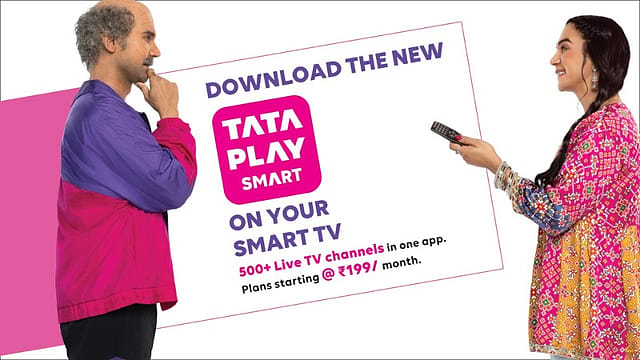
The daughter has changed the television connection. The father needs convincing.
Fortunately for Tata Play, both are Rajkummar Rao.
In its new campaign, the actor plays a father and daughter arguing over a change in the household’s viewing arrangements. The resolution introduces Tata Play Smart, an app that delivers live television without the familiar dish and set-top box. Conceived by Ogilvy and directed by Advait Chandan, the casting supplies the comedy. The missing equipment supplies the more interesting advertising story.
A business associated with putting a dish on your roof now has something to sell you when you would rather do without one. It must explain why the apparatus is dispensable while the company remains useful.
Customers need to remember Tata Play and reconsider what they remember it for.

Zeroing In on ECI
09 Oct 2026 - Vol 05 | Issue 41
Constitutional legitimacy versus political opportunism
Marketing and branding experts reckon that the challenge for an established brand is that its strongest association can become a limitation. People remember the dish, while the company wants to be remembered for making television easy. "The campaign has to transfer that familiarity from the equipment to the experience,” says Ashita Aggarwal, professor of marketing at SP Jain Institute of Management & Research.
Meanwhile, Airtel would be happy to discuss the broadband bill.
DAD CAN STAY. THE BOX CAN GO.
The family argument gives a technical change a recognisable setting. One generation introduces a different way of watching television; the other needs reassurance that the change will preserve something it values.
The promise is continuity. The technology moves on. Dad can still find his programmes.
Tata Play’s app listing emphasises channel numbers, a television guide and quick switching between channels. Its proposition brings familiar viewing habits to an internet-connected screen.
There is a useful consumer insight here. An upgrade becomes easier to accept when it does not arrive with homework.
For a viewer who knows where the news, cricket or evening serial lives, navigating several apps can feel like receiving a promotion with additional responsibilities. More choice is pleasant. Finding it repeatedly can become a job.
The campaign makes modernisation feel manageable. The younger person changes the connection so the older person can keep the habit. But a father–daughter argument is also an accommodating advertising environment. The brand writes the objection and supplies the answer. Actual households may have questions that require more than a clever reveal. The first is what they will pay.
THE RIVAL IS ALREADY ON THE BILL
Tata Play Smart starts at ₹199 a month for one language, with an additional language costing ₹99. A two-language household therefore reaches ₹298 before its separate broadband expenditure. The headline price buys a television subscription; the internet connection remains another purchase.
That is where Airtel enters the story.
Its broadband offerings combine connectivity, television channels and streaming benefits. More significantly, Airtel’s IPTV requires an Airtel broadband connection at the same location. It is selling the household a combined arrangement.
Tata Play Smart can operate over an existing internet connection from another provider. The viewer can choose the television service without changing the broadband company.
Will enough households value that independence to pay separately for it?
For someone satisfied with a local broadband provider, the answer could be yes. For someone whose existing package already covers the channels and streaming services they want, another subscription may look like duplication.
This makes the rivalry more interesting than a comparison of advertised prices. The household is deciding how many relationships it wants to manage, which programmes matter, and what extra convenience deserves an extra payment.
Airtel does not need to mock the film to challenge the proposition. Its bundle can do the arguing.
The battle is for a place on the household’s recurring-expenses list. Rajkummar Rao can get the meeting. He cannot approve the budget. When entertainment comes bundled with broadband, a separate subscription has to work harder to justify itself. Familiarity can get Tata Play considered, but the household still needs to see what improves. "Removing the box is an easily understood benefit. Becoming another monthly bill is the harder conversation,” says Aggarwal.
THE DISH WAS NEVER THE WHOLE BUSINESS
The backdrop gives the campaign urgency.
India’s active pay-DTH subscriber base fell from 56.07 million in June 2025 to 48.56 million in June 2026. Tata Play accounted for 14.84 million subscribers at the end of that period. The company is developing its internet-delivered offer while the satellite category contracts.
It would nevertheless be too convenient to turn this into an obituary for DTH.
Households have different budgets, connectivity and viewing requirements. A useful service for an urban home with reliable broadband need not replace the preferred arrangement everywhere else.
Harit Nagpal, Tata Play’s managing director and CEO, describes the business in broader terms: “We have always been in the business of aggregating content and making it easy for customers to access and consume it.”
That is the strategic argument the advertising must make tangible.
The customer should recognise a continuing benefit even as the delivery mechanism changes. Otherwise, the brand risks appearing to sell a fresh wrapper around an arrangement the customer has already reconsidered.
There is also an uncomfortable distinction between removing a purchase barrier and recovering a lost customer.
Someone unable or unwilling to install a dish has an obvious reason to consider an alternative. Someone who stopped paying because television no longer felt worth the money presents a harder problem. A tidier cabinet will not necessarily change that verdict.
SKY HAS ALREADY LOST THE DISH
There is a useful global precedent.
In October 2022, Britain’s Sky introduced Sky Stream, delivering television over Wi-Fi without a satellite dish or an engineer’s installation visit. It worked with any broadband provider. Customers still needed a small device connected to their television, making it different from Tata Play’s app-based approach.
The branding challenge was recognisable: preserve the appeal of a familiar television service while changing the means of receiving it.
Sky’s offer combined channels, programmes and apps through a common interface, with Netflix included in its launch packages. Satellite television remained available through Sky Q. The company offered different routes into its entertainment proposition.
The lesson for Tata Play concerns what must survive the disappearance of the dish.
A distribution brand needs to make finding and watching entertainment sufficiently convenient that customers continue to choose it. Once the equipment stops identifying the service, the experience has more work to do.
That experience must also be distinctive. “Everything in one place” is an attractive promise with plenty of potential claimants.
An aggregator can save the viewer time. It can also become one more app the viewer must remember to open.
THE REMOTE STILL BELONGS TO THE CUSTOMER
Tata Play’s film has a sound advertising task: make a changed service easy to understand without turning the commercial into a technical demonstration.
Its family setting helps. So does the decision to preserve familiar viewing behaviour rather than require every household member to become a streaming enthusiast.
The scepticism belongs further along the purchase journey.
Does the package contain the channels this family actually watches? Does it work reliably on their connection? Does the interface make evenings easier? Is the additional bill justified by something their existing subscriptions fail to provide?
Those questions will determine whether the campaign’s domestic truce becomes a commercial relationship.
Tata Play needs a persuasive reason to be chosen by the households its model serves well. Independence from the internet provider, familiar navigation and convenient access to live channels could provide that reason.
They have to become experienced advantages, rather than a list of features. The father and daughter can settle their argument within the commercial. The brand’s argument continues every month. The box can disappear. The reason to pay cannot.