Sole Searching: Why PUMA Put 40 Buddhist Monks in Running Shoes
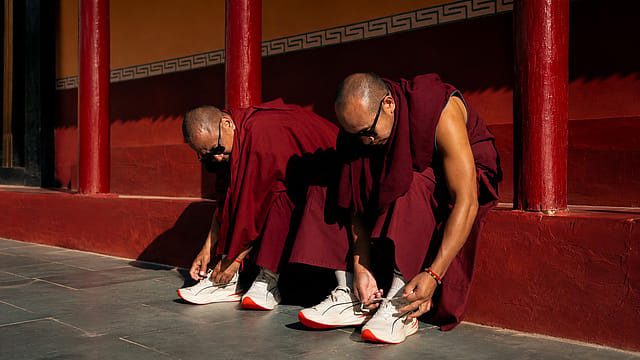
At Thiksey Monastery in Ladakh, desire has arrived in a shoe box.
The robes remain maroon. The monastery remains rooted in a tradition that has survived for centuries. Across six campaign frames, however, 40 Buddhist monks are wearing PUMA’s Deviate Pure NITRO running shoes.
The shoes cost ₹14,999.
PUMA calls the campaign “Meditation in Motion”. Running and meditation, the company explains, demand focus, discipline and the ability to remain present. The visual series arrives ahead of the Ladakh Marathon, where PUMA is the exclusive sportswear partner. Its centrepiece is the Deviate Pure NITRO, a 220-gram running shoe made with evolved NITROFOAM, engineered mesh and PUMAGRIP traction.
Zeroing In on ECI
09 Oct 2026 - Vol 05 | Issue 41
Constitutional legitimacy versus political opportunism
Every detail is precise. The cushioning has a name. The outsole has a trademark. Even natural speed has a product page. Only desire is pretending to have left the room. The photographs are arresting because they force two worlds into the same frame. Buddhist monastic life is associated with loosening attachment.
Advertising survives by intensifying it. A monk is trained to examine desire. A marketer is paid to create it. PUMA has put a logo on detachment.
From Inner Peace to Consumer Desire
There is a legitimate idea here. Long-distance running can become meditative. Breath acquires rhythm. Repetition silences distraction. At the Ladakh Marathon, the link becomes stronger. Its 122-kilometre Silk Route Ultra begins in Nubra Valley at 10,700 feet and climbs to Khardung La at 17,618 feet. At that altitude, the mind is as important as the legs.
Thiksey Monastery also belongs to the landscape. PUMA has been associated with the Ladakh Marathon since at least 2024 and supplies race-day apparel and specialised gear. The brand has not flown in a convenient spiritual prop from an unrelated geography.
That context deserves respect. It does not dissolve the commercial transaction happening inside the pictures.
The monks supply stillness, restraint, authenticity and centuries of spiritual association. The shoe receives those meanings. Its foam does not become softer. Its grip does not become stronger. Its cultural aura becomes richer.
"Symbols transfer meaning faster than product claims can,” says Ashita Aggarwal, professor of marketing at SP Jain Institute of Management & Research. The monks bring discipline, stillness and spiritual integrity into the frame, and the shoe receives some of those associations. "The test is whether PUMA’s relationship with Ladakh and the marathon makes that transfer feel earned, or whether consumers see sacred imagery being used as premium packaging,” she says.
Consent matters enormously. Monks can wear running shoes. They can participate in advertising. A monastery is not a museum display and Buddhism is not a performance of poverty staged for outsiders. When spirituality improves a sneaker’s desirability, who is borrowing credibility from whom?
Can the Monks Make PUMA a Running Brand?
PUMA’s business explains why those 40 pairs of shoes are working so hard.
The company remains formidable in India. It reportedly generated revenue of approximately ₹3,200 crore in FY26 and sold just under 11 million pairs of footwear. It has around 400 stores after shutting 20 to 25 outlets during a reset. Online channels contribute roughly half its business and 75 per cent of its products are now made in India.
Scale is not the problem. Credibility is the unfinished race.
In 2024, PUMA’s then India managing director said sports-performance products supplied roughly one-quarter of sales. He wanted that contribution to rise to one-third. The logic was revealing: PUMA needed greater credibility in sport to strengthen everything it sold around sport.
The latest numbers suggest movement. Running now contributes almost 30 per cent of sales in PUMA’s retail stores. New managing director Ramprasad Sridharan has placed running, hybrid fitness, sports style and team sports at the centre of the next phase. The company is reducing discount-led business and betting on consumers willing to pay more for better shoes.
The Deviate Pure NITRO belongs directly to that plan. It is a performance trainer launched globally in June 2026, positioned for tempo runs and sold at a price that forces it into comparison with specialist running shoes. PUMA must now persuade runners to judge it by the shoe rather than the cat.
ASICS Already Owns the Sound Mind
The sharpest irony is printed inside a rival’s name.
ASICS is an acronym derived from Anima Sana In Corpore Sano: a sound mind in a sound body. The Japanese company has built its identity around the positive effect of movement on mental wellbeing since its founding.
PUMA’s “Meditation in Motion,” therefore, enters territory that ASICS has occupied for decades. The connection between running, mental focus and inner balance is not an occasional campaign device for ASICS. It is the brand’s founding philosophy.
ASICS remains far smaller than PUMA in India. Its FY25 revenue stood at ₹556 crore after growing 30 per cent from ₹428 crore. It has since forecast Indian sales of approximately 12 billion yen, around ₹700 crore at recent exchange rates, following another rise of nearly 30 per cent.
The size gap should prevent easy exaggeration. PUMA is not being overtaken by ASICS in total India revenue.
Look at the running track, though, and the distance contracts. Running supplies around 60 per cent of ASICS India’s business. The company has hosted an Ekiden relay, sponsored large marathons, cultivated running clubs and used in-store treadmill analysis to generate individual foot reports. Its shoes priced between ₹22,000 and ₹28,000 have sold out rapidly. At the 2025 Tata Mumbai Marathon, ASICS claimed that nearly one-third of runners wore its shoes. The company wants India’s top premium-running position by 2029.
PUMA has around 400 stores. ASICS has 138. The revenue gap makes PUMA the much larger consumer brand. They do not automatically make it the more convincing running brand. PUMA owns more of the wardrobe. ASICS is trying to own the starting line.
“Scale gives PUMA distribution, visibility and the ability to recruit culture,” says Aggarwal. Serious runners build trust differently. They look for product proof, specialist expertise, community presence and repeated experience. "ASICS has spent years accumulating that authority," she adds. A powerful campaign can open the door for PUMA, but the product and the running ecosystem must carry the brand through it.
That turns “Meditation in Motion” into more than cultural theatre. The monks are being asked to help PUMA enter a conversation its rival practically owns by name.
A Global Brand Searching for Its Pace
The pressure extends beyond India. PUMA’s global sales fell 8.1 per cent on a currency-adjusted basis in 2025 to €7.3 billion as the company cleared inventory, reduced undesirable wholesale distribution and began a strategic reset. It recorded a net loss of roughly €645 million. In the second quarter of 2026, sales declined another 9.4 per cent, although running and training delivered strong growth.
That final qualification matters. Running is one of the few places where the company can see momentum while much of the larger machine is being repaired.
India offers PUMA scale, a young fitness market and consumers increasingly willing to pay ₹15,000 or ₹25,000 for specialised footwear. Nike and Adidas remain powerful. ASICS owns specialist authority. Hoka and On are increasingly visible among affluent runners. Virat Kohli, PUMA’s most recognisable Indian sporting partner for eight years, ended the relationship in 2025 and invested in Agilitas Sports.
PUMA is, therefore, fighting rivals, insurgents and part of its own former family. Forty monks can generate attention. They cannot run that competitive race on the company’s behalf.
The Report Card Is Outside the Monastery
As advertising, the campaign has cleared one hurdle. It is difficult to ignore. The contrast between traditional robes and technical running shoes turns six still frames into a provocation.
None of those outcomes proves that the work sold the shoe or strengthened PUMA’s running credentials. “The easiest report card will count reach, reactions and appreciation for the visuals,” reckons Aggarwal. The more demanding test is branded search for Deviate Pure NITRO, trials among committed runners, premium conversion and repeat purchase. "If people remember only the monks, PUMA has created culture without creating consideration,” she adds.
That is the risk at the heart of borrowed symbolism. Viewers may remember Buddhism, Ladakh, robes and serenity, then buy the running shoe already trusted by their club, coach or feet.
PUMA deserves the benefit of doubt. Its Ladakh Marathon partnership is real, the connection between running and meditation is coherent and the Deviate Pure NITRO is a genuine performance product.
The campaign’s strategic task remains formidable. PUMA must turn visual distinction into product consideration, product trial into trust and trust into repeat kilometres. It must do so in a category where ASICS has made the sound mind and the moving body its corporate scripture.
So, can the monk sell what PUMA could not?
The fairer question is whether the monk can make PUMA look like the serious running brand it is still trying to become. The photographs can create desire. They can borrow calm. They can place a ₹14,999 shoe inside a centuries-old frame and make the collision look beautiful. They cannot establish cushioning, comfort or credibility over 500 kilometres. Only the runner can do that.
The monks are searching for freedom from desire. PUMA hopes the pictures create some.