Rolex, 0:07 & James Bond: The Ad Nobody Ordered at the US Open
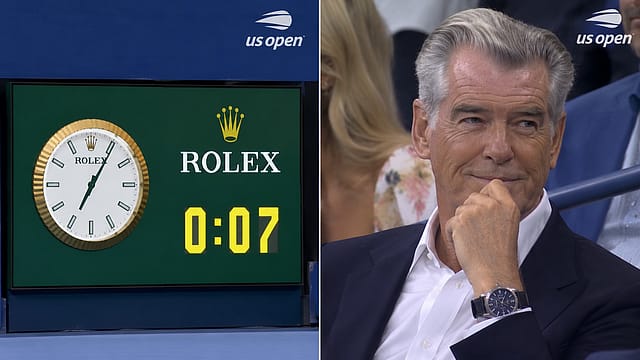
The clock said 0:07. Then James Bond appeared.
There was no gun-barrel sequence. No Aston Martin. Tuxedo was missing. There was no martini waiting to be shaken, stirred or invoiced by an advertising agency.
Just Pierce Brosnan sitting in the stands at Arthur Ashe Stadium, watching Alexander Zverev and Ben Shelton contest the US Open final.
For a few seconds, however, somebody in the television production room stopped directing tennis and started directing cinema. The broadcast showed the courtside clock. ROLEX. Below it: 0:07.
Then the picture cut to Brosnan. That was it. Three ingredients. Rolex. Bond. The audience supplied the copy.
The US Open subsequently shared the sequence on social media. Viewers immediately understood what the director had done. No explanatory caption was required. Brosnan had played James Bond across four films beginning with GoldenEye, and the transition from 0:07 to his face completed the gag.
The Modi Years
02 Oct 2026 - Vol 05 | Issue 40
A Nation Rebuilt
It was beautifully timed. Almost suspiciously beautifully timed. Someone in that production gallery had presumably spotted both the clock and the former 007 sitting in the stadium and waited for the two to collide.
Advertising agencies spend months searching for what marketing decks like to call an “ownable cultural moment”. A television director found one between points. And somewhere in Switzerland, somebody at another watch company could reasonably have wondered whether to laugh or call marketing. Because Pierce Brosnan’s James Bond did not wear a Rolex. He wore an Omega.
Welcome to one of the finest Rolex advertisements Rolex never made. And possibly the funniest one Omega never bought.
The Wrong Bond, The Right Watch
Rolex paid to be there.
That distinction matters. Rolex has been the US Open's Official Timekeeper since 2018. Its clocks sit courtside as part of one of sport's most prestigious sponsorship relationships. Brands pay heavily for precisely this sort of environment. The clock. The signage. The hospitality. The television visibility. The association with elite sport. The ability to attach decades of brand meaning to a tournament watched around the world.
But sponsorship normally works through repetition. The logo sits there. Again. And again. And again. Until the viewer stops consciously noticing it.
At 0:07, somebody made viewers notice. Not by enlarging Rolex. Not by having a commentator mention Rolex. Not by putting a celebrity ambassador beside the clock. The director gave the clock a punchline. 0:07. Brosnan. Ahhh.
That tiny moment of recognition is what makes the sequence such an interesting piece of advertising. Nobody needed to write 007. The clock did it. Nobody needed to write James Bond. Brosnan's face did it. Nobody needed to say Rolex. The sponsorship did it. And nobody needed to explain the connection. The consumer did that.
That's why the story becomes much bigger than an amusing television cut.
Marketing and branding experts reckon that act of consumer participation is precisely what gives moments like this unusual power. “The consumer is completing the advertisement in his or her own head," says Ashita Aggarwal, professor of marketing at SP Jain Institute of Management & Research. That is very different from a brand explicitly telling you what association it wants you to make. There is discovery, recognition and then the little reward of getting the joke. "That participation can make the memory considerably stronger than another conventional piece of brand exposure,” says Aggarwal.
There was only one problem with the memory being activated. It belonged partly to somebody else.
Omega Walks Into the Rolex Ad
Rewind to 1995.
Brosnan was making his first appearance as James Bond in GoldenEye. On his wrist was an Omega Seamaster Professional 300M.
It was the beginning of one of cinema's longest-running luxury-product associations. GoldenEye officially lists the Omega Seamaster laser watch among Bond's gadgets, while Omega says Bond has worn one of its watches in every film since 1995.
Brosnan wasn't simply another Bond who happened to wear an Omega. He was the Bond with whom the Omega era began. That's what makes the US Open sequence gloriously mischievous. Rolex owns the clock. Omega owns the modern Bond-watch association. Brosnan owns the face. Bond owns 007.
The television director borrows everything.
For a second, Rolex receives something its US Open sponsorship agreement could hardly have promised: the cultural memory of Pierce Brosnan as James Bond.
Omega doesn't appear anywhere in the shot. It doesn't have to. Indeed, the deeper the viewer's Bond knowledge, the funnier the Rolex frame becomes.
Hang on. Brosnan's Bond wore Omega. Even online, viewers quickly spotted precisely that contradiction. And that creates one of those rare marketing situations in which both rivals can claim something from the same frame. Rolex owns what you see. Omega owns part of what you remember. Try entering that into a media-value spreadsheet.
Except Rolex Was Bond Too
There is another complication. Rolex isn't exactly trespassing in Bond's universe.
Long before Omega took over the modern cinematic association, Rolex had its own Bond history. Early screen Bonds were associated with Rolex, particularly the Submariner era.
So the US Open moment does something even more entertaining than putting the “wrong” watch beside Bond. It compresses decades of luxury-watch mythology into one television edit. Bond's historic watch heritage. Bond's modern watch partner. Today's US Open timekeeper. Yesterday's Bond. One clock. Seven minutes.
No agency could deliberately pile all of that into a conventional advertisement without someone eventually asking whether the idea was trying too hard.
Here, none of it needed explaining. At the simplest level: 0:07 → Brosnan → funny.
At another: Rolex + 007 → Bond. At another: Wait. Omega. And beneath all three sits the question: Who owns an advertisement when the brand didn't make it?
The Advertisement Nobody Ordered
Modern advertising has a peculiar problem.
Consumers understand advertising extremely well. They know the celebrity was paid. They know the influencer's supposedly spontaneous affection for the face serum probably arrived with a brief. They know the cheeky brand tweet may have survived four people on Teams before acquiring its personality. They know “real-time marketing” frequently has an approval matrix. Even spontaneity has become organised.
The Brosnan sequence reverses the machinery.
The tournament existed already. Rolex was already there. Brosnan was already there. The clock was already running. Bond had existed for more than six decades. Omega had spent more than three decades building its modern association with him. The director simply recognised that several pieces of culture were about to occupy the same second.
Then: Cut.
The resulting communication feels delightful because the viewer encounters it first as wit rather than advertising. There is no proposition. No call to action. No product demonstration. No celebrity endorsement. No hashtag desperately requesting participation. It is advertising created by juxtaposition. And that is precisely why brands should be careful about learning the wrong lesson from it.
We Need Our 0:07 Moment
You can already imagine the meeting.
Someone puts the clip on the conference-room screen. Everyone laughs. The CMO says: “Can we do something like this?”
And somewhere, an agency dies a little. Because once everybody starts manufacturing accidents, the accident becomes advertising again. A planned viral moment is one of marketing's great contradictions. The consumer can usually smell the plan.
Aggarwal sees an important distinction between manufacturing these moments and creating brands culturally strong enough to benefit when such moments occur.
Brands should not look at something like this and conclude that they need to manufacture a viral coincidence. The lesson is almost the opposite. Rolex, Bond and Omega all bring enormous reservoirs of memory into that one frame. The moment works because those associations already exist. "You cannot manufacture decades of cultural memory in a social-media war room on Monday morning,” she says.
That may be the most uncomfortable lesson in the entire episode. Advertising increasingly worships speed. Post quickly. React quickly. Meme quickly. Hijack quickly. Respond before the conversation disappears.
But the thing that made 0:07 valuable wasn't speed. It was memory. The director needed perhaps one second to create the joke. The brands had spent decades making that second understandable.
The Ghost of Omega
Omega may actually demonstrate the power of memory better than Rolex does. It isn't visible. Yet it enters the conversation. That is extraordinary brand equity.
Most marketers spend enormous amounts of money ensuring that the logo appears. Here, Omega's absence almost proves the strength of its association. To say: “But Bond wears Omega” is to remember Omega.
Brosnan made four Bond films—GoldenEye, Tomorrow Never Dies, The World Is Not Enough and Die Another Day. The Seamaster became part of the Brosnan Bond identity and the Omega relationship continued into the Daniel Craig era.
Twenty-four years after Brosnan's final Bond film, a television director can show 0:07, cut to his face and expect the audience to understand immediately.
That is not merely celebrity recognition. That is compressed cultural memory. Brands spend fortunes trying to reach that state. A sound. A shape. A colour. A number. A face. And the consumer supplies everything else.
Omega, therefore, suffers the nicest possible defeat. Rolex gets the screen. Omega gets remembered because it isn't on it.
There is another advertising professional hiding inside this story. Except he may not work in advertising: The television director.
Sports broadcasters operate one of the world's most powerful real-time creative machines. They decide which celebrity appears. Which fan reaction becomes tomorrow's meme. Which sign enters millions of homes. Which child crying in the stands becomes an image shared around the world. Which sponsor happens to sit beside which human face.
Most of these decisions disappear immediately. Occasionally one escapes the broadcast. 0:07 escaped. And the director did something that advertising creatives have always done. He created meaning through juxtaposition. A Rolex clock displaying seven minutes is not a story. Brosnan watching tennis is not much of a story either.
Put one immediately after the other and a third idea appears that existed in neither image independently. James Bond. That is editing. That is comedy. And for Rolex, whether it asked for it or not, that is advertising.
Let's Call it Reverse Ambush
Sports marketing has long had a name for brands trying to borrow attention from properties they do not officially sponsor: Ambush marketing.
Companies have spent decades finding ingenious ways to attach themselves to major sporting occasions without paying for the primary sponsorship rights.
But the US Open moment is almost the inverse. Rolex isn't ambushing anything. It is the official timekeeper. Omega isn't ambushing anything. It isn't even there. Brosnan isn't endorsing anything. He is watching tennis. And yet the expensive sponsorship property of one watchmaker accidentally activates decades of brand memory belonging to another.
Call it reverse ambush marketing. Omega didn't crash Rolex's party. Its ghost did. And the ghost arrived wearing a Seamaster.
Please, Rolex, Do Nothing
There is one final temptation. Monetise it.
Brands are trained to squeeze every drop from attention. Turn the clip into an ad. Get Brosnan involved. Make a commemorative social post. Run something around 0:07. Perhaps write: TIMING IS EVERYTHING.
Please don't. Definitely don't write: LICENCE TO TIME.
The internet has already finished the campaign. Anything more risks explaining the joke until it stops being funny. Sometimes the smartest piece of real-time marketing is recognising that the real-time marketing has already happened. Rolex sells precision. This makes the final irony almost too neat. One of the most perfectly timed pieces of Rolex communication at the US Open wasn't created by Rolex. The clock merely did what clocks do. It reached seven minutes. A director did what good directors do. He saw the next shot. Brosnan did almost nothing.
And somewhere between those three events, decades of cinema, sponsorship, luxury watches and popular memory collided.
Rolex had bought the time. Omega had bought the modern Bond association. The US Open had Brosnan. The director had 0:07. The audience had the joke. For one glorious second, everybody owned the advertisement.
Then the tennis resumed.