Google Pay Wants Your Spending. Google One Sweetens the Deal
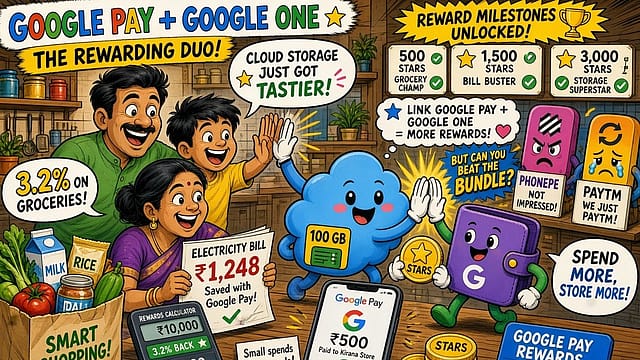
Your cloud subscription would like a word about your grocery bill. The electricity payment, too. And perhaps the next food order.
Google is bringing these household expenses into a proposition that reaches beyond the payment itself: a subscription becomes more attractive because it improves spending rewards, while those rewards give customers another reason to return to the payment app.
Storage helps sell spending. Spending helps sell storage.
For Google Pay, the interesting contest begins before a customer scans a QR code. Which card comes to mind? Which app gets opened? And what might make that choice feel automatic next time?
A reward can win a transaction. A bundle attempts something more ambitious: making several purchasing decisions reinforce one another.

Zeroing In on ECI
09 Oct 2026 - Vol 05 | Issue 41
Constitutional legitimacy versus political opportunism
THE HOUSEHOLD BUNDLE
Under the revised Flex structure, eligible Google One members earn 3.2% on qualifying cycle spending after crossing ₹15,000, against 1.6% for non-members. Below that threshold, the respective rates are 1.6% and 0.8%. Spending under ₹100 in the previous cycle halves those rates.
Membership also unlocks category milestones: ₹450 in Stars for ₹3,000 of qualifying bills and recharges, and ₹250 for ₹5,000 of eligible food-and-grocery UPI payments. Total cycle rewards are capped at ₹1,500.
That puts recurring household expenditure at the centre of the pitch.
A customer may occasionally need to think about cloud storage. Groceries demand attention more frequently. Bills return with dependable regularity. Connecting them gives a digital subscription a place in the monthly household calculation.
The marketing opportunity is clear: membership can become easier to justify when its usefulness appears across several expenses. “A subscription becomes easier to justify when consumers can connect it with something they already pay for regularly," reckons Ashita Aggarwal, professor of marketing at SP Jain Institute of Management & Research. The marketing opportunity is to make membership feel useful throughout the month, so its value is reinforced through everyday behaviour.
The word doing the work here is “already”.
The strongest version of this proposition fits expenditure that would have happened anyway. Customers who rearrange existing payments may find a useful benefit. Customers who manufacture extra purchases to reach a milestone could turn an attractive reward into an expensive pursuit.
Google’s challenge is to make that distinction easy to understand while keeping the proposition appealing.
THE REWARD HAS A RETURN ADDRESS
Stars are worth ₹1 each, but cannot be cashed out or redeemed outside Google Pay. They can fund eligible Flex payments or voucher purchases through the app. Earning can extend to other payment apps; redemption brings customers back.
That distinction makes the design revealing. The reward has a destination. Google Pay gets another opportunity to become part of the next purchase. For a customer who already prefers the app, that may be convenient. The benefit appears where the customer intended to spend anyway. For someone who prefers freedom over where to redeem, the same structure may feel restrictive.
Both responses are commercially significant. A loyalty programme must offer enough value to make its boundaries acceptable. Consumers judge a reward through the experience of using it. An attractive earning rate can create interest, but easy redemption builds confidence. "If people have to work too hard to understand or use the benefit, the programme risks weakening the convenience it promises,” adds Aggarwal.
The strategic ambition is a repeat visit. Whether that visit produces loyalty depends on how useful it feels. A balance waiting to be redeemed can encourage another transaction. It cannot, by itself, establish that the customer prefers the brand.
GOOGLE’S RIVAL HAS A FAMILIAR PLAYBOOK
Amazon offers a useful parallel. Its Amazon Pay ICICI Bank credit card gives Prime members 5% back on eligible Amazon.in purchases, compared with 3% for non-members, subject to the card’s conditions. Membership improves the shopping proposition; shopping supplies another justification for membership.
Google is applying a related logic across a different combination of services.
The broader contest is between companies capable of making one relationship support another. A subscription, a card and a payment app can each help make the others more attractive.
That changes the competitive question.
A rival payment app may deliver an excellent checkout experience. Google can also ask whether a customer’s existing subscription should influence the choice at checkout.
The potential advantage lies in having several benefits to assemble into one proposition. Each addition creates another opportunity to explain why staying within the ecosystem makes sense.
For PhonePe, Paytm and bank-card programmes, the strategic challenge would be to make their own value equally apparent. Simpler rewards, flexible redemption or useful partnerships could provide an answer. A customer who understands an offer immediately may prefer it to a richer proposition that requires more calculation.
The revised terms establish Google’s offer. They do not establish that customers are switching from rivals.
WHEN VALUE NEEDS A CALCULATOR
Google One family-group members and subscribers billed through third-party partners are excluded from the membership rewards. The enhanced benefits currently run until October 15, 2027, subject to extension.
These conditions matter because the headline invites a quick judgment: membership earns more. The household decision takes longer.
Does the customer qualify? Would the subscription be useful anyway? Do existing purchases fit the eligible categories? Will the rewards be redeemed? What would another card deliver on the same spending?
A meaningful comparison needs the subscription and applicable card costs alongside the incremental benefit. Gross rewards alone cannot settle whether the arrangement improves a household’s finances.
There is also a branding tension. Bundling can make several services feel more valuable together, while making the value of each harder to isolate.
A customer might keep a subscription partly because it improves card rewards, then keep using the card partly because the subscription improves them. The arrangement may be worthwhile. It also gives the customer more relationships to reconsider before changing any one of them.
The strongest bundles, Aggarwal reckons, make the combined value obvious. Consumers should be able to explain what they gain without having to decode the programme every month. "Complexity may get people to enrol, but clarity gives them a reason to stay,” she underlines.
That is Google’s real execution test: turning an interconnected offer into a simple household reason to choose.
WHO BECOMES THE DEFAULT?
The marketing idea has an everyday intimacy.
A company selling a digital subscription has found a way to enter the conversation about dinner, groceries and electricity. Those expenses can help make membership feel productive. Membership, in turn, can influence which card and payment app gets used.
For existing users whose spending fits, the arrangement could provide useful savings. Its commercial strength will depend on whether enough customers can recognise and realise that value without changing their behaviour excessively.
Google has built several reasons for its products to recommend one another. The customer still has to decide whether the recommendation pays.
The customer earns Stars. Google gets another reason to remain the default.