GIVA Hired Kriti Sanon. Kangana Ranaut Got Final Cut: Welcome to Outrage-Era Advertising
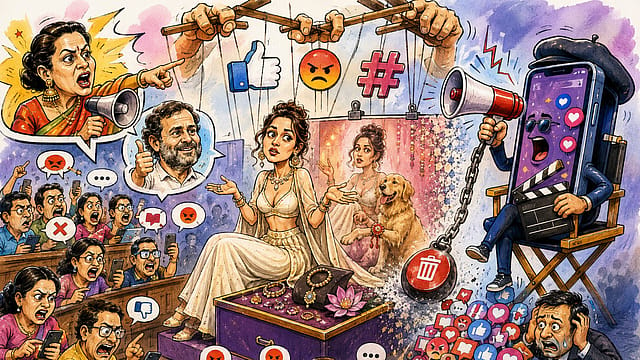
GIVA made an advertisement. Kriti Sanon appeared in it. Kangana Ranaut criticised it. Rahul Gandhi defended Sanon. The internet conducted the trial. GIVA deleted the evidence.
Advertising has acquired a new creative director. It works for nobody, attends no meetings, sees no storyboard and approves nothing in advance. It arrives after the campaign has been released, armed with screenshots, hashtags and an inexhaustible supply of outrage.
Its feedback is rarely subtle. Change the advertisement. Apologise. Or prepare to be boycotted.
GIVA chose the delete button. The jewellery brand withdrew its Raksha Bandhan advertisement featuring Sanon after parts of social media objected to her outfit and the film’s inclusion of a pet dog in the ritual. In its statement, GIVA said it held Indian culture, traditions and festivals in the “highest regard” and had removed the advertisement from all media “out of respect”.
The Modi Years
02 Oct 2026 - Vol 05 | Issue 40
A Nation Rebuilt
The withdrawal came a day after Sanon publicly defended the campaign. “The essence of festivals is not in the clothes you wear,” she wrote. “It is in the emotions and meaning you hold for the traditions.” She also asked when society would stop telling women what to wear and added that culture and tradition reside in a woman’s heart, “not in her neckline”.

The celebrity stood behind the communication. The advertiser quietly stepped away from it.
Welcome to the strangest brand-ambassador relationship in Indian advertising. The ambassador supplies conviction. The brand supplies the delete button.
The Rakhi That Tied Everyone in Knots
The 35-second film was intended to promote GIVA’s festive and pet-rakhi collection.
Sanon, dressed in an ivory bralette-style blouse, cape and draped skirt, ties a rakhi to her brother. She then extends the ritual to the family dog. The idea is simple enough: affection and protection can include pets because pets are family too.
The clothes attracted more attention than the jewellery.
Some users called the outfit inappropriate for Raksha Bandhan. Others objected to a rakhi being tied to a dog. Ranaut described the advertisement as “intentionally creepy” and questioned why anyone would tie a rakhi while dressed in what she compared to a bikini or undergarments.
The dispute rapidly escaped the marketing department. Sanon’s sister Nupur defended her. Rahul Gandhi supported a woman’s right to decide what she wears. A jewellery commercial had turned into a national argument about culture, clothing, feminism, festivals, pets and political identity. GIVA, the company that had paid for the entire production, became almost incidental to the conversation.
That is the first lesson of outrage-era advertising: a brand may create the campaign, but it cannot control what the campaign becomes.
Who Owns an Advertisement After It is Released?
Traditionally, the client approved the idea. The agency produced it. The celebrity performed it. The media distributed it. Consumers decided whether to buy.
That chain has been broken. Consumers can now demand changes to the communication itself. A sufficiently loud constituency can become an unpaid focus group, censorship board, wardrobe department and media planner.
The brand’s creative team may have spent weeks selecting the script, styling, jewellery, celebrity, lighting and edit. The internet can reject all of it before lunch.
The problem is not that consumers respond to advertising. Advertising exists to produce a response. The problem begins when every response is interpreted as a referendum and every boycott hashtag is treated as a market-research report.
Were those objecting to GIVA’s campaign representative of its customers? Did the controversy threaten sales? Was the anger widespread or merely loud? Did the company discover a genuine cultural misjudgment, or did it discover that standing behind its own campaign had become uncomfortable?
The withdrawal answers none of these questions. It merely proves that pressure worked.
Branding and marketing experts reckon that a brand has every right to reconsider communication that it believes is insensitive or poorly judged. “But repeated withdrawals can also teach pressure groups that outrage is an effective way to control advertising," says Ashita Aggarwal, professor of marketing at SP Jain Institute of Management & Research. The real test is whether GIVA discovered a flaw in the campaign or simply discovered that courage becomes expensive once controversy begins.”
India’s Great Advertising Retreat
GIVA is hardly the first brand to discover that festive advertising can become combustible.
Tanishq withdrew its Ekatvam film in 2020 after a depiction of an interfaith family provoked vicious trolling and boycott calls. The company referred to hurt sentiments and concern for the well-being of employees, partners and store staff.
Dabur removed a Fem advertisement showing a same-sex couple celebrating Karva Chauth. Sabyasachi withdrew a mangalsutra campaign after its imagery was criticised as culturally offensive. Manyavar’s Kanyamaan film, featuring Alia Bhatt, attracted anger for questioning kanyadaan, although the campaign survived.
The template has become familiar. A brand takes a festival. It adds a contemporary interpretation. The interpretation offends somebody. The debate becomes political. The product leaves the room. The apology arrives.
There are occasions when withdrawal is entirely justified. Pepsi’s Kendall Jenner advertisement, which appeared to suggest that a soft drink could dissolve tension between protesters and police, was widely condemned for trivialising real political struggle. Pepsi pulled the film and acknowledged that it had missed the mark.
But every disputed advertisement is not Pepsi. Some campaigns contain insensitive creative choices. Others merely encounter audiences who dislike the world they portray. Treating both situations identically allows offence to become a permanent veto over imagination.
When Brand Values Become Removable Jewellery
GIVA’s decision creates an especially awkward contradiction. The campaign tried to expand the idea of family by including a pet. Sanon then expanded the argument further by defending women’s agency, sibling equality and the freedom to interpret tradition personally.
Those ideas may be debated. But they were not accidents secretly inserted into the film after approval. GIVA approved the wardrobe. GIVA approved the dog. GIVA approved the ritual. GIVA approved Sanon.
Then the comments arrived. A brand is allowed to change its mind. It must also accept what such a retreat communicates. If modernity remains in the advertisement only while everybody is comfortable, it is styling rather than positioning. If inclusion disappears at the first boycott call, it was probably a campaign accessory. If the celebrity is expected to absorb the controversy while the advertiser retreats, the partnership starts looking surprisingly one-sided.
Celebrity endorsement is supposed to transfer meaning from the star to the brand. In this case, the opposite may have happened. Sanon displayed more brand conviction than the brand.
There is, admittedly, another side. Standing firm is easy advice to offer when one does not run stores, employ front-line workers or answer to investors. Tanishq explicitly cited concern for its employees when it withdrew Ekatvam. Online anger can move offline. A marketing principle looks considerably less romantic when retail staff may face threats.
Withdrawal can, therefore, be risk management rather than ideological surrender.
But risk management also creates future risk. Every deleted campaign tells the next pressure group that the fastest way to enter a brand’s boardroom is through a hashtag.
The Brand Paid. The Internet Directed
GIVA began with a commercial intended to sell jewellery and pet rakhis. It ended with Kangana Ranaut, Rahul Gandhi, the Sanon sisters and thousands of strangers debating who gets to define Indian culture.
Nobody appears to have discussed the jewellery very much.
That may be the most expensive irony. GIVA earned extraordinary attention, but not necessarily the kind that builds product desire. Then, by withdrawing the advertisement, it allowed the controversy to become the campaign’s permanent memory.
The film is gone. The screenshots remain. So does the larger question: when a brand approves a provocative or progressive creative choice, is it prepared to defend that choice once the audience notices?
GIVA hired Kriti Sanon to appear in its advertisement. It accidentally hired the internet to approve her wardrobe. And Kangana Ranaut, without attending a single production meeting, appears to have received final cut.