First Tie the Rakhi. Then Read the Health Warning: When Pan Masala Started Giving India Moral Lessons
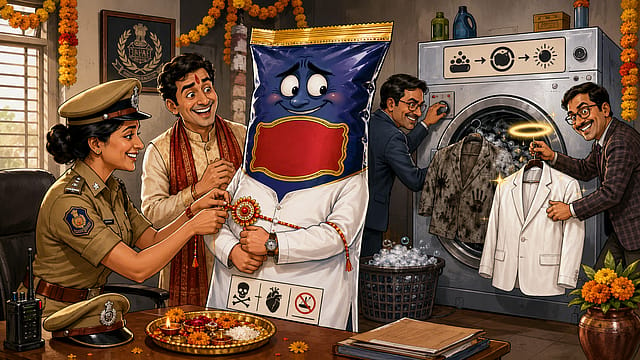
A brother walks into a police station. His sister is missing. Raksha Bandhan is approaching. He needs the police to find her immediately.
The inspector is sympathetic but practical. Perhaps the young woman is participating in the Gen Z-led protests against the government. Perhaps she will return when the demonstrations end. Perhaps the brother should wait. He refuses. The matter is urgent. The inspector finally asks why. Because she has not tied his rakhi. The missing-person investigation suddenly turns into a family drama. The brother produces the ceremonial plate and asks the inspector to perform his sister’s duties.
Then comes the twist. The police officer is his sister. The complaint was an elaborate act of sibling revenge. She skipped the festival. He invaded her workplace. The police station becomes a Raksha Bandhan celebration. The brother offers his wrist. The sister ties the rakhi. The audience smiles.
And then Shikhar Pan Masala enters.
The Modi Years
02 Oct 2026 - Vol 05 | Issue 40
A Nation Rebuilt
For almost three minutes, the brand stays away from its own advertisement. There is no product demonstration, consumption occasion or persuasive argument about the product. Shikhar waits until affection, surprise and family values have made the room respectable.
Then it puts its name on the door. Watch the Shikhar Pan Masala Raksha Bandhan commercial. The film has discovered a curious method of selling pan masala. First, make the audience feel warm inside. Then show them the packet carrying the health warning.
The Respectability Extension
This is not conventional surrogate advertising.
Nothing legal is visibly pretending to be something prohibited. There is no soda performing the duties of whisky, cardamom keeping a pan masala name alive or music CD preserving an alcohol brand’s cultural presence.
Shikhar Pan Masala identifies itself. The surrogate here is emotional. The product does not require another product to lend it legitimacy. It borrows legitimacy from a festival, a sibling relationship, a female police officer and a story about family reunion.
Call it respectability extension. A controversial brand can extend into bottled water, mouth freshener, soda or music. It can also extend into virtue. The Rakhi film does not explain why anyone should consume pan masala. It explains why the brand should be allowed inside a loving Indian family. That is a far more ambitious conversion.
Shikhar is not trying to change the product. It is trying to change the company the product keeps.
The advertisement separates the emotional experience from the consumption experience, reckon branding and marketing experts. “The audience spends almost the entire film responding to sibling affection, humour and surprise," says Ashita Aggarwal, professor of marketing at SP Jain Institute of Management & Research. By the time the brand appears, those positive feelings have already been created. The product benefits from an emotional context it did not earn through product performance.
The sister’s police uniform performs additional work. She is authoritative, independent and socially useful. The brother is affectionate enough to turn a missing-person complaint into a Rakhi ambush. Everybody in the story is good. The brand arrives hoping some goodness remains available for transfer.
Pan Masala’s Social-Service Department
Shikhar has borrowed from an established category playbook.
Rajshri Pan Masala has repeatedly produced long-form advertisements around water conservation, blood donation, road safety, adoption and other social causes. Actor Annu Kapoor has often appeared as the genial storyteller guiding audiences towards the lesson. The brand may sell pan masala. The commercial wants to improve society.
That contradiction produces attention. Viewers are left wondering why this particular advertiser is asking them to save water or donate blood. The mismatch becomes the media strategy. A conventional corporate social responsibility message from a bank may disappear unnoticed. A social sermon from a pan masala brand creates friction. The category appears to have understood something important about modern advertising: when the product story becomes uncomfortable, change the subject. Do not discuss ingredients. Discuss national responsibility. Do not demonstrate consumption. Demonstrate compassion.
Do not enter through the mouth. Enter through the heart. Indian liquor advertising perfected another version of this manoeuvre. Bagpiper and McDowell’s No.1 used soda and music extensions. Imperial Blue built a comic universe around “Men Will Be Men”. Kingfisher spread into packaged water, calendars, fashion, aviation and sport. The restricted or regulated product could leave the screen while the master brand continued collecting fame.
Pan masala has found an additional route. It can retain the name while replacing consumption with culture. Rakhi supplies affection. Road safety supplies responsibility. Water conservation supplies conscience. The advertisement converts a health-warning category into a temporary moral authority.
Virtue is the New Surrogate
Globally, controversial industries have long used social good to soften corporate reputations.
Tobacco companies have funded youth smoking-prevention programmes, even while public-health groups questioned whether such initiatives genuinely discouraged consumption or helped the companies present themselves as responsible participants in the debate.
Philip Morris International used Mission Winnow around Ferrari’s Formula One team, describing it as a platform for innovation and transformation. Critics and regulators questioned whether the initiative preserved the tobacco company’s visibility after cigarette branding disappeared from racing.
Alcohol companies regularly run responsible-drinking campaigns. Betting platforms warn consumers to play responsibly. Fossil-fuel companies advertise renewable-energy ambitions. Fast-food chains discuss exercise and balanced living.
Some of these interventions may produce genuine public benefit. Their strategic usefulness is equally obvious. The brand acquires a second identity. It is no longer merely the company selling the controversial product. It becomes the company urging restraint, responsibility, safety or social progress.
The fox does not leave the henhouse. It sponsors an awareness workshop on poultry protection.
Does the Trick Work?
Emotion transfers. That is among advertising’s oldest bargains. A product does not need to cause the emotion shown in the commercial. It needs to stand close enough when the emotion arrives. Soft drinks borrow friendship. Jewellery borrows marriage. Insurance borrows parental anxiety. Pan masala borrows Raksha Bandhan.
Repetition can gradually make the brand feel familiar, culturally embedded and less dissonant. Consumers may never consciously conclude that a company is admirable because it produced a touching festival film. Advertising rarely operates through such neat declarations.
It works by altering the emotional weather around a name. A brand associated with controversy becomes associated with a memorable sibling twist. Its colours and logo appear beside affection rather than risk. The packet has not changed. Its cultural surroundings have. “Purpose can become a reputational shortcut when it has little relationship with the company’s conduct or product,” reckons Aggarwal. The test is not whether the film promotes a good value. The test is whether the brand is willing to apply the same concern for people to the consequences of the category in which it operates.
That is the question Shikhar’s film avoids beautifully. The brother wants his sister’s protection thread. The brand says nothing about protecting the brother from the product.
The Flip Side
A difficult category does not lose its right to make an entertaining advertisement.
Nor must every pan masala commercial discuss disease, regulation or public health from beginning to end. Advertising sells through stories, humour and cultural recognition. Chocolate brands do not spend every film discussing sugar. Cars do not continually explain road fatalities. Alcohol companies are not forbidden from speaking about friendship merely because alcohol can cause harm.
The Shikhar film is also competently constructed. The missing-sister setup creates urgency. The revelation rewards attention. The female police officer avoids the familiar picture of a sister waiting at home for her brother. The Rakhi connection is recognisable without becoming another predictable gifting commercial.
And pan masala without tobacco occupies a complicated legal and advertising space. It may be advertised, although packages carry statutory warnings and the category attracts scrutiny because areca nut consumption has been linked to serious health risks. It should not automatically be confused with every tobacco-containing product sold under similar or adjacent branding.
The criticism, therefore, cannot simply be: controversial brand makes emotional advertisement. The sharper issue is proportionality. If nearly the entire communication budget is spent building cultural warmth while the product remains a logo at the end, the company is not primarily explaining what it sells. It is manufacturing a feeling about who it is.
The Brand Ties Itself a Rakhi
The Raksha Bandhan setting adds one final irony.
A rakhi symbolises affection, responsibility and protection. Shikhar uses that symbolism to introduce a category that must carry a health warning. The festival and the product, therefore, pull the advertisement in opposite directions. One promises protection. The other requires caution. That tension is why the film deserves more than a routine campaign report.
Brands from controversial categories once hid behind surrogate products. Now they can hide behind good intentions. They need not place the product at the centre of the story. They can let an emotional cause occupy the screen, appear during the closing seconds and collect whatever respectability remains after the credits.
Shikhar did not use Raksha Bandhan merely as a festive occasion. It used the festival as character certification. The sister ties a rakhi around her brother’s wrist. The advertisement attempts to tie virtue around the brand. One knot looks considerably more convincing than the other.