Don't Be Salty: Reyansh Jaggi & Daryaganj's Fourth-generation Recipe
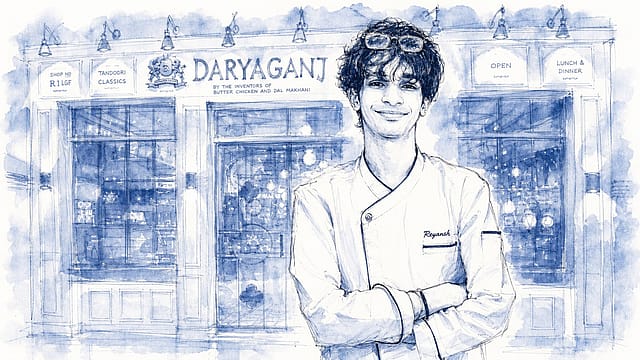
In a family whose story is bound up with butter chicken and dal makhani, Reyansh Jaggi began his own culinary exploration with something he had to limit: salt.
A childhood diagnosis of nephrotic syndrome put him on a strict low-sodium diet. Food acquired another set of considerations. A meal could be something to look forward to, but it also required thought about what he could eat.
For a young member of a family so closely associated with hospitality, there was something particularly instructive in that experience. He knew what it meant to have a connection to food. He was also learning how easily a dietary restriction could complicate enjoying it.
Initially, the task was personal: make his own meals satisfying. Herbs, spices, aromatics and citrus became subjects of experiment. So did texture, roasting and different cooking techniques. Limiting salt made him more attentive to everything else that could give a dish depth.

Zeroing In on ECI
09 Oct 2026 - Vol 05 | Issue 41
Constitutional legitimacy versus political opportunism
“I think it happened when I stopped seeing it as a limitation I had to live with and started treating it as a puzzle I could solve,” he says, describing the point at which managing his diet became a creative interest.
Eventually, he made something that worked.
“It was full, satisfying and had depth, and the fact that it was low in sodium was almost an afterthought.” What he remembers is the discovery: a meal could be enjoyable on its own terms. That sent him back to experimenting, keeping track of what worked and what did not, and asking why something tasted good.
The curiosity has since taken the shape of his first cookbook, 'Don’t Be Salty,' which brings together low-sodium recipes across breakfast, pasta, Indian-inspired dishes, chicken and snacks, alongside elements of his experience.
Its larger ambition is contained in a sentence that also explains how he is beginning to look at the family business. “I want people to see that a dietary restriction does not have to mean a restricted relationship with food,” he underlines.
THE GUEST WHO HAS TO ASK
Reyansh is the great-grandson of Kundan Lal Jaggi, whose culinary legacy is the foundation of Daryaganj’s brand identity. The family traces its association with butter chicken and dal makhani to Jaggi’s work in post-Partition Delhi.
For Reyansh, that inheritance comes with pride and responsibility. It also comes with a question: what can his generation add?
His answer begins with a diner whose experience he understands. “When you live with a restriction, you become very aware of the small things,” he reckons. You notice when a dish feels like an afterthought, when a server is unsure about what can be served, or when you feel like your request is creating extra work for the kitchen.
Those details can determine whether someone feels comfortable at a table. A guest may have come out to celebrate with family or friends, yet find themselves occupied with explanations and uncertainty.
Reyansh’s observation is precise: Taking something out of a dish is not the same as making a guest feel included.
The distinction gives his story a purpose beyond the familiar introduction of another generation into a family enterprise. He is learning to examine hospitality from the position of someone who cannot simply order what everyone else is having.
His concern is with the quality of that person’s experience: a menu that communicates clearly, a server who understands the request, a kitchen confident about what it can offer.
Reyansh’s attention to diners with different needs opens a larger question for a brand built around heritage: how does it give a new generation something meaningful to contribute?
A heritage brand gives the next generation a story people already recognise. "Its future depends on what that generation notices about customers today,” says Ashita Aggarwal, professor of marketing at SP Jain Institute of Management & Research. Reyansh’s experience gives him a particular sensitivity to diners who have to negotiate their way through a meal. "That can become a useful source of innovation,” she adds.
THREE SUMMERS, THREE VIEWS
Growing up with the family story gave Reyansh one view of Daryaganj. Working in it has given him several more.
A student at Bergen County Academies in New Jersey, he has spent the past three summers learning different parts of the restaurant business, alongside virtual involvement and time working closely with cofounder Amit Bagga.
In 2024, he worked with the front-of-house team. The dining room taught him to pay attention to different expectations, guest requirements and the coordination between service and the kitchen.
Hospitality, he discovered, often means noticing a detail before someone has to ask. The next stint took him into the numbers. He spent weeks examining profit-and-loss statements, food and labour costs, pricing and margins. A dish had an economic reality as well as a recipe.
In 2026, he moved into the kitchen, working on preparation, food safety, portioning and recipe standardisation. Here, consistency became a daily discipline.
The progression matters. A guest experiences a meal as a whole. Within the business, that experience depends on several teams getting their part right. “One of the biggest things I learned is that a restaurant may be remembered for one iconic dish, but it is built every day by hundreds of small decisions,” he says.
That lesson is especially relevant to Daryaganj. Its family history reaches back decades, but the current restaurant company is relatively young. Raghav Jaggi, Reyansh’s father, and his childhood friend Bagga launched it in 2019.
The business honours Kundan Lal Jaggi and the culinary traditions of Punjabi refugees who rebuilt their lives in Delhi after Partition. Its claim to the invention of butter chicken and dal makhani became the subject of a dispute with Moti Mahal that reached the Delhi High Court in 2024.
That contested history forms part of the brand’s public story. Reyansh’s learning concerns the work of running a restaurant today: earning trust through what arrives on the plate, how it is served and whether the business can sustain the experience.
BETTING ON THE CLASSICS
The business Reyansh is learning has a wager of its own.
As diners explore Korean, Thai and other global cuisines, Daryaganj has built its identity around dishes many Indians already know: butter chicken and dal makhani. The opportunity is to make familiar food worth choosing again, even as the range of alternatives grows.
The changing market supports both appetites. Swiggy and Kearney’s How India Eats 2025 report identifies the mainstreaming of global Asian flavours alongside a revival of regional and heritage Indian cuisines. Discovery and familiarity can share the same customer.
That makes Daryaganj’s strategy more interesting than a simple stand against food trends. A diner can want an unfamiliar flavour on one evening and a dependable North Indian meal on another. The competition is for the occasion, the group’s preference and the decision to return.
Daryaganj is not alone in pursuing that customer. Punjab Grill occupies a neighbouring position in premium North Indian dining. Its menu includes buttery black lentils, paneer makhani and butter chicken kulcha. In July 2026, its parent Lite Bite Foods announced openings of Punjab Grill and pan-Asian YouMee at the same West Delhi destination, DLF Midtown Plaza.
Curries and tandoori specialities at one restaurant; sushi, ramen and dim sums at another. The two formats illustrate how restaurateurs are pursuing different dining moods within the same market.
For Daryaganj, the task is to give its version of the classics a recognisable identity. Butter chicken is widely available. A family association with its history can attract attention, but the meal still has to justify the journey, the bill and the next visit.
The brand’s co-founder Amit Bagga has publicly recalled scepticism about launching a classic Delhi-Punjabi cuisine brand in 2019. In a post marking seven years of Daryaganj, he said some people had predicted it would fail. He also described the company’s focus on doing a few things well and improving them consistently.
The bet has shown commercial traction. In October 2025, Daryaganj announced Anicut Capital as its first institutional investor. At the time, the company reported annual revenue of approximately ₹100 crore, double-digit corporate EBITDA margins and 14% same-store sales growth. Deliveries contributed 26% of revenue.
The same-store figure matters to the argument. Expansion can increase revenue by adding restaurants; growth at existing outlets suggests the business is also generating more sales from locations already serving customers. It supports the case for the classics, although it does not establish which dishes, pricing changes or customer behaviours drove that growth.
Familiarity also raises the bar. Customers arrive with expectations shaped by meals elsewhere and preferences developed over years. A restaurant has to give them a reason to choose its butter chicken again.
“Familiar dishes can make a restaurant easy to understand, but they also make it easy to compare,” says Aggarwal. The brand has to earn preference through taste, consistency and the experience around the meal. "A strong signature gives customers a reason to remember you; sustained execution gives them a reason to return,” she adds.
The opportunity for the fourth generation lies within that challenge. Reyansh need not reinvent the dish that made the family story famous to contribute something worthwhile. He can help the business understand the people deciding whether to eat there.
HOW MUCH CAN CHANGE?
Daryaganj has already begun changing the setting around its food.
Its first overseas outlet opened in Bangkok in May 2025 under the premium Daryaganj Gold format. Gold subsequently came to GMR Square, Aerocity, in Delhi. The move into Thailand gives the North Indian proposition another market in which to prove itself.
In a recent interview, Bagga described the Aerocity Gold outlet as a 150-seat restaurant, offering room for larger groups and private dining. The core brand would continue to drive expansion, he said, with Gold introduced selectively where the location suited it. The distinction is useful: a restaurant can evolve through space, service, presentation and the range of occasions it accommodates. Every change need not begin with replacing its signature food.
Reyansh participated in research and trials for Gold. His understanding of authenticity leaves room for that evolution. “The legacy is in the recipes, the techniques, the stories and the values behind the food,” he says. “Those are things we have to protect.”
How people discover food, communicate and experience a restaurant, however, changes across generations.
“For me, authenticity does not mean standing still,” he adds. “It means knowing what is non-negotiable and having the confidence to evolve everything else.”
That is a useful position for someone studying in the United States while learning within an Indian family business. He can observe how people encounter Indian food without having to treat every change as a departure from the family story.
His role remains one of learning and contributing. He is still exploring what he wants to do.
A MENU THAT BUILDS CONFIDENCE
At a restaurant brand whose calling card is butter chicken, a dedicated vegetarian menu carries particular meaning. The signature dish may bring one diner through the door. What makes the vegetarian beside them feel equally welcome?
Reyansh advocated for a dedicated vegetarian menu and clearer communication of Daryaganj’s vegetarian practices. He says the restaurants already maintained separate vegetarian and non-vegetarian kitchen sections and tandoors.
Daryaganj already has a vegetarian signature in dal makhani. The opportunity is to give vegetarian diners the confidence and breadth of choice that make the whole meal feel considered.
That has a business implication too. Restaurant choices are often negotiated by groups. The person who wants butter chicken may be dining with someone whose dietary needs determine where everyone can comfortably eat. Attention to that second diner can matter to the entire table. “For a lot of Indian guests, being vegetarian is not simply a preference,” he says. “It can be connected to belief, family and the way they live every day.”
His own dietary experience had made him attentive to the uncertainty of wondering whether a kitchen understood a guest’s needs. That sensitivity informed his push for a menu in which vegetarian diners could see their experience had been considered.
The brand’s pledge against cross-mixing vegetarian and non-vegetarian food is, in his account, intended to reinforce that reassurance.
Vegetarian separation and medically required diets involve different requirements. What connects them in Reyansh’s thinking is the need to understand a guest’s concern and communicate honestly about what the restaurant can deliver.
The dedicated menu also brings an existing kitchen practice into the dining-room conversation. Customers can't see everything a restaurant does behind the scenes. "Clear menus and confident staff help turn those practices into trust,” says Aggarwal. For a vegetarian diner or someone with a dietary restriction, reassurance is part of the experience. "The promise has to be supported by what the kitchen and service team can consistently deliver,” she adds.
MAKING THE TABLE BIGGER
The low-sodium cookbook is Reyansh’s personal project, while his restaurant contributions so far include the vegetarian-menu initiative and work on Gold. His experience nevertheless gives him a direction to explore. It has led him to think about how food can retain pleasure when someone has to approach it differently, and how restaurants can make that person feel welcome.
History and psychology interest him too. He is curious about the journeys behind dishes and the relationship between food, memory and emotion. Culinary training gives those interests a practical outlet; entrepreneurship may eventually bring them together.
He is comfortable leaving the destination open. “I would rather spend this stage learning, working in different parts of the business, making mistakes while I have the room to learn from them and letting my direction take shape naturally,” he says.
For now, his ambition for the fourth generation is expressed through a simple image. “I think I would want it to be about making the table bigger.”
The family story gives him dishes to preserve and a business to understand. His own experience has made him attentive to the person studying the menu, wondering what they can eat.
That is where his chapter begins.