Dear Student, Please Use Less ChatGPT: OpenAI Goes Back to School
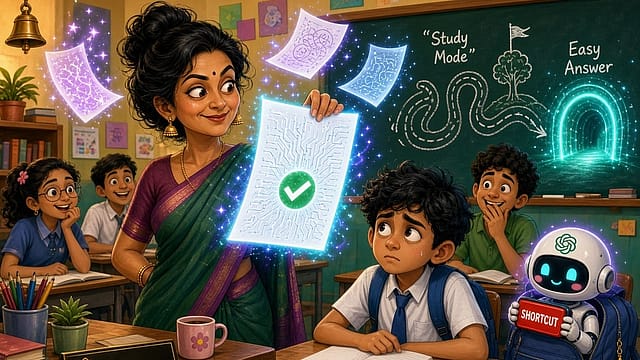
The teacher reads the assignment. The grammar has improved. The sentences have acquired an unfamiliar confidence. The argument is polished. The child sitting before her, however, appears not to have undergone the same overnight transformation.
“We know,” she says.
OpenAI’s new Teachers’ Day film turns those two words into a classroom verdict. Different teachers recognise different betrayals of authorship: a writing style that does not sound like the student, work the student cannot explain, intelligence arriving on paper without leaving evidence in the person who supposedly produced it.
The advertisement is funny because every teacher has always known more than the student imagines. It is strategically fascinating because the culprit in the film is also the advertiser.
ChatGPT has been asked to mark its own homework. Its answer is Study Mode.
The Product Corrects Its Own Product
Most brands advertise the easiest and most gratifying use of what they sell. A food-delivery app celebrates not cooking. A washing machine celebrates not washing. A search engine celebrates not having to remember.

Losing Memory
16 Oct 2026 - Vol 05 | Issue 42
The making of a medical and social emergency
OpenAI has chosen the opposite task. It is advertising against the easiest use of ChatGPT. The tempting prompt is brutally simple: write my essay, solve this equation, finish my homework. The useful educational response is slower and less immediately satisfying: what have you understood, where are you stuck, what should the next step be?
That is the contradiction inside the campaign. The product became famous for collapsing the distance between question and answer. It now needs to restore some of that distance in the name of learning.
OpenAI says ChatGPT for Teens can recognise when a young user appears to be shortcutting an assignment and redirect the conversation towards Study Mode. There, guiding questions, scaffolding, quizzes, metacognitive prompts and knowledge checks are meant to help the student work through a problem instead of receiving the solution. Study Hours can make that mode the default during selected periods; linked family accounts can also use Quiet Hours and break reminders.
Together, these features divide one enormously popular behaviour into two moral categories: using AI to understand and using AI to escape understanding.
The interface looks similar. The educational consequences may be profoundly different.
“This is an unusual piece of brand strategy because OpenAI is advertising against the fastest and most seductive use of its own product,” says Ashita Aggarwal, professor of marketing at SP Jain Institute of Management & Research. It is asking students to trade instant completion for slower comprehension because the long-term legitimacy of ChatGPT in education depends on teachers believing it can support effort rather than replace it.
The campaign’s real audience is therefore not the teenager who already knows how to open ChatGPT. It is the adult who can ban it.
Friction Becomes the Feature
Technology usually treats friction as an enemy. Fewer clicks, shorter waits and instant results are considered progress. Education is awkward. Friction is often the point.
The failed attempt tells the teacher what the student does not understand. Retrieving an idea strengthens memory. Explaining a solution exposes the gap between recognition and comprehension. The struggle that makes homework irritating is frequently the mechanism that makes it useful.
ChatGPT can remove that struggle with spectacular efficiency. Study Mode tries to reintroduce the productive parts without recreating the loneliness of being stuck.
Research gives OpenAI a strong defence. A field experiment involving nearly 1,000 high-school mathematics students compared a standard GPT-4 interface with a safeguarded tutor. While AI was available, the standard version improved practice performance by 48 per cent and the guarded tutor by 127 per cent. Then researchers removed the tools. Students who had used the unrestricted version scored 17 per cent below those who had used no AI. The guarded tutor largely eliminated that negative effect.
The unsettling lesson is that assistance can make today’s work look better while leaving tomorrow’s student weaker. The result also explains the campaign’s emphasis on being able to explain submitted work. A correct answer is evidence of output. It is not proof of learning.
Study Mode has been built around that distinction. OpenAI says it uses Socratic questions, hints, self-reflection and open-ended checks. Yet the company also acknowledges that the mode is powered by custom system instructions and can behave inconsistently or make mistakes. It remains easy to toggle on and off.
There lies the next contradiction. A student who genuinely wants to learn may find an endlessly patient tutor. A student who wants the answer can leave the classroom with one click.
Can a Toggle Manufacture Intent?
Study Hours can make disciplined behaviour the default. Responsible homework reminders can interrupt an obvious attempt at outsourcing. Parental controls can shape when and how a linked teen account is used.
None can supply academic intent. A mode can influence conduct, but the child, assessment and incentive system determine what conduct is rewarded. If marks depend entirely on a polished take-home answer, the pressure to manufacture polish will remain. If a teacher asks the student to defend the argument orally, show working, revise in class or connect an answer to personal experience, outsourcing becomes harder and learning becomes visible.
That shifts some responsibility back where it belongs. Schools cannot hand an assessment unchanged to an answer machine and demand that the machine protect the assessment from itself. Teachers need clearer policies, new forms of evaluation and the time to redesign work. Parents need more than a settings panel. Students need to know when assistance becomes substitution.
OpenAI, meanwhile, faces an incentive problem no parental toggle can conceal. ChatGPT grows when people use it. A tutor sometimes has to refuse the quickest route, ask another question and risk irritating the user. The better the educational product becomes, the more often it must delay the gratification on which consumer technology has been built.
“A mode can change the path through the product; it cannot manufacture the desire to learn,” says Aggarwal. The commercial and educational challenge is to make the slower path feel rewarding enough that students stay with it even when a complete answer remains available elsewhere.
The strongest feature in Study Mode may therefore be the thing product managers normally fear: restraint.
From Classroom Intruder to Institutional Guest
The film arrives inside a much larger courtship of Indian education.
In August 2025, OpenAI announced a Learning Accelerator with India’s Ministry of Education, the All India Council for Technical Education and ARISE member schools. It planned to distribute approximately half a million ChatGPT licences and training opportunities to educators and students over six months. It also committed $500,000 to a research collaboration with IIT Madras on learning outcomes and teaching methods.
That scale changes the meaning of the Teachers’ Day commercial. The film may be seasonal, but its strategic job is permanent. It is reputation infrastructure for a company seeking entry into classrooms, institutions and family routines. The student already sees utility. OpenAI now needs the teacher to see legitimacy.
The competitive race widens the lens. Google is training Indian educators to use Gemini, while Khan Academy and other technology companies are pushing deeper into AI tutoring. Supplying the best answer will not settle the next great technology contest. The winner must persuade schools that its machine improves the student after the screen is closed.
That is a much harder benchmark than engagement. The campaign wisely makes teachers the heroes rather than obstacles. They are observant, humane and impossible to fool. ChatGPT does not arrive to replace them. It appears to acknowledge the difference between generating language and knowing a child.
The teacher recognises the student’s voice, habits, capabilities and evasions. The model knows the prompt. That gap is the campaign’s most intelligent admission.
The Fair Defence
OpenAI deserves credit for dramatising the misuse most likely to damage its educational ambitions. It could have produced another film in which a grateful student asks a clever question and discovers the universe. Instead, it shows ChatGPT contaminating authorship and teachers detecting the result.
The corrective is also more substantial than a slogan. A patient, personalised tutor available after school could be valuable in homes where a parent cannot help with algebra, science or English. It can explain the same idea repeatedly without embarrassment, change the level of difficulty and turn notes into practice questions. That accessibility should not be dismissed because cheating is easier to dramatise.
Nor should every AI-assisted sentence be treated as fraud. A student can use ChatGPT to interrogate an argument, request feedback, practise a concept or overcome a language barrier while retaining intellectual ownership. The decisive issue is not whether AI touched the assignment. It is whether the student can still account for the thinking.
OpenAI is trying to move the conversation from prohibition to literacy. That is a useful move. It is also convenient. The company that supplied the shortcut now proposes to supply the guardrail, the tutor, the teen protections, the parental controls and part of the teacher training. Every problem created by widespread ChatGPT use becomes another reason to embed ChatGPT more deeply.
The remedy and the expansion strategy occupy the same desk.
OpenAI’s Real Report Card
Views will tell OpenAI whether people watched the film. Feature adoption will show whether families discovered Study Mode. Neither will establish learning.
The real report card begins after assistance ends.
Can the student solve a fresh problem without ChatGPT? Can she explain why an argument works, identify a mistake and defend a conclusion? Do teachers see fewer assignments that collapse under a follow-up question? How often do teens disable Study Mode when it refuses the shortcut? Does repeated use improve retention, independent performance and confidence grounded in ability rather than borrowed fluency?
Those measurements are harder than counting prompts. They are also the only ones that matter. OpenAI’s film ends with teachers knowing more than students think. The company knows something too: becoming indispensable to homework is not the same as becoming legitimate in education.
The student wants ChatGPT to complete the assignment. OpenAI needs the teacher to accept ChatGPT in the classroom. The harder assignment belongs to the brand.