Aashirvaad’s Fit Maveli: When Advertising Gave Onam a Metabolic Makeover
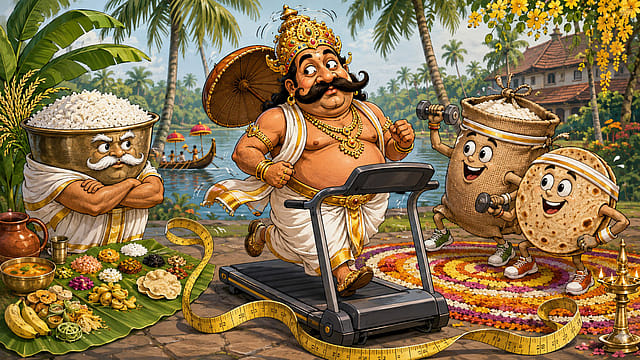
Maveli returns to Kerala once every year. This time, somebody has checked his BMI.
Aashirvaad Atta’s new Onam campaign begins with children preparing to welcome the legendary king. They expect the familiar Maveli: rotund, cheerful and carrying the well-fed magnificence of a ruler returning home for Kerala’s largest feast.
The king who arrives is considerably lighter. He exercises. He talks about balanced meals. He encourages the children to remain active. He also reassures them that fitness will not cancel the Onam sadhya.
The crown remains. The belly has lost market share.
Aashirvaad calls him “Fit Maveli”. The campaign wants to start a playful conversation around everyday health without wagging a nutritional finger at festive indulgence.
The Modi Years
02 Oct 2026 - Vol 05 | Issue 40
A Nation Rebuilt
But the king has returned with another assignment. He must help India’s largest packaged-atta brand enter deeper into a market where rice has ruled the plate for centuries. Advertising has given mythology a metabolic makeover.
When Maveli Became a Market-Entry Consultant
Aashirvaad is attempting three transformations inside one film.
It is making Maveli fitter. It is making atta appear healthier. And it is making a food associated more strongly with northern and western Indian kitchens feel culturally at home in Kerala.
The third transformation carries the real commercial weight. Rice anchors Kerala’s food culture. It sits at the heart of the sadhya, appears across breakfast preparations and shapes the state’s culinary identity. Aashirvaad cannot enter that relationship by declaring rice the villain and chapati the hero.
That would be less market expansion and more dietary trespassing. The brand, therefore, avoids confrontation. It does not ask Malayalis to surrender rice. It suggests variety. It keeps the sadhya sacred while proposing that wheat could find a larger place in the ordinary meals surrounding the feast.
Maveli performs the negotiation. If Kerala’s beloved king can modernise his routine without abandoning Onam, perhaps Kerala’s kitchen can accommodate chapati without betraying tradition.
Marketing and branding experts reckon that the campaign uses a familiar cultural character to reduce resistance to a changing consumption proposition. “Aashirvaad does not directly challenge rice. It allows Maveli to legitimise variety, balance and behavioural change," says Ashita Aggarwal, professor of marketing at SP Jain Institute of Management & Research. The cultural icon performs the market-entry work that a conventional product claim could not.
Aashirvaad has not hired a celebrity ambassador. It has hired a civilisation-level influencer.
Abundance Meets Portion Control
Onam celebrates abundance. The pookalam blooms. The boats race. Families return home. The sadhya arrives on a banana leaf carrying enough dishes to make minimalism seek psychiatric assistance. Into this celebration walks a packaged-food brand with a fitness message.
The contradiction is delicious. Advertising has invited abundance to practise portion control. To Aashirvaad’s credit, the film does not ask viewers to flee from the feast. Fit Maveli tells the children that exercise, balanced daily meals and festive enjoyment can coexist.
That distinction keeps the campaign from sounding like a gym trainer interrupting lunch. It also gives Aashirvaad a convenient strategic bridge. The company can associate atta with contemporary health consciousness without insulting Kerala’s traditional food. The product enters through coexistence rather than conquest.
The brand’s size makes this more than a decorative festival post. Aashirvaad crossed $1 billion in annual consumer spend and became ITC’s largest FMCG brand, according to a company announcement earlier this year. Kerala represents a serious growth market for the country’s leading packaged-atta player, not an annual excuse to place a pookalam beside its logo. The campaign’s cultural borrowing, therefore, serves a measurable business ambition. The king is exercising. The brand is expanding.
Who Put Maveli on the Treadmill?
Aashirvaad did not invent the fit king.
In 2025, a group of doctors and health campaigners in Kerala promoted “Fit Maveli, Fit Kerala”. They argued that folklore described Mahabali as a powerful, battle-hardened ruler rather than the cuddly, obese figure commonly seen in modern Onam imagery. Their campaign attempted to reclaim Maveli as a model of strength at a time when Kerala was confronting high levels of diabetes, obesity and lifestyle-related disease. Cyclists carried the message across the state.
Aashirvaad has now converted that public-health conversation into brand communication. This is clever cultural listening. The company did not parachute an entirely alien concept into Onam. It found an existing discussion, attached its product to it and gave the fit king a larger advertising stage.
But the shift from public health to packaged food creates a new question. A doctor can ask people to exercise without needing to sell atta. Aashirvaad cannot.
The message may discuss balanced nutrition, but the packet waiting outside the film contains wheat flour. Maveli’s new physique, therefore, operates as both health advice and product halo. He has become fitter. The atta benefits from the glow.
The Global Mascot Gym
Advertising has always exercised creative control over familiar characters.
The Michelin Man began life as a bulky stack of white tyres and was once depicted smoking a cigar. As the brand evolved, Bibendum became leaner, friendlier and more energetic. Even a man constructed entirely from tyres had to acquire a contemporary body.
Coca-Cola did not invent Santa Claus, a point the company itself acknowledges. But its advertising from 1931 onwards, illustrated by Haddon Sundblom, helped standardise the warm, red-suited, rosy-cheeked Santa recognised globally. Advertising did not create the legend. It helped decide what the legend looked like.
KFC repeatedly localises Colonel Sanders while protecting his unmistakable white suit, glasses and goatee. He acquires regional clothing, language and cultural settings as the brand travels. During Onam, even the Colonel can reportedly find himself in a mundu.
Other mascot changes have carried far greater social weight. Quaker retired Aunt Jemima and replaced the name with Pearl Milling Company after acknowledging that the character originated in a racial stereotype. Mars renamed Uncle Ben’s as Ben’s Original and removed the familiar face from its packaging.
Those were attempts to remove identities that companies could no longer ethically defend. Aashirvaad’s intervention is lighter and more playful. It is not retiring Maveli. It is updating his body to carry a wellness proposition.
Yet the underlying principle is similar. Characters do not remain frozen simply because consumers recognise them. Brands continually alter their appearance and meaning to suit the anxieties, ambitions and markets of the present. Even mythology, apparently, must close its fitness rings.
Does Slimmer Automatically Mean Fitter?
This is where the campaign begins to wobble.
Its language speaks of exercise, hydration, balanced meals and mindful portions. Its principal visual evidence is a thinner Maveli.
The two ideas are not interchangeable. A person can be thin and unhealthy. Another can be larger, active and metabolically healthy. Fitness includes strength, endurance, mobility, nutrition, sleep and several factors that cannot be established by reducing the circumference of a beloved character’s stomach. “When a traditionally plump figure is redesigned as fit, the brand must ensure that wellness does not become body judgement wearing festive clothes,” says Aggarwal. A transformation can create instant visual communication, but it can also strengthen the simplistic association that thinness equals health.
The same caution applies to the food proposition. Chapati does not automatically make a meal healthy. Rice does not automatically make it unhealthy. The grain, quantity, preparation, accompaniments and individual medical needs all shape the nutritional outcome.
A plate cannot be diagnosed from its geography. The campaign wisely avoids explicitly staging wheat against rice. Yet its commercial subtext remains unmistakable: Aashirvaad wants Kerala to regard atta as a useful component of a more varied everyday diet. That is a legitimate market ambition. It is not a universal nutritional verdict.
Culture Is Not Free Media Inventory
Brands approach regional festivals because cultural familiarity lowers the cost of explanation. A pookalam instantly signals Onam. A snake boat supplies movement. A sadhya supplies appetite. Maveli supplies affection, memory and belonging.
The problem begins when the brand behaves as though those symbols are free props. Maveli belongs to Kerala’s collective imagination. Aashirvaad is temporarily borrowing him to sell a behavioural and commercial idea. The execution succeeds only if Malayalis feel the brand understands the character rather than using him as a costume.
This is the difference between localisation and cultural decoration. Localisation begins with the market’s habits and contradictions. Decoration adds a mundu to a national campaign and hopes nobody asks another question.
Aashirvaad has gone further than decoration. Its atta proposition, Kerala’s changing meal patterns, the fitness conversation and Maveli’s popular appearance have been woven into one idea.
The borrowing is purposeful. Whether it is persuasive depends upon what viewers see first: an amusing reinvention of a loved king or a flour company inspecting his waistline.
The King and the Kitchen
Fit Maveli works because the transformation is instantly legible.
A conventional advertisement explaining dietary fibre, everyday exercise and meal diversity might disappear before the viewer finishes scrolling. The sight of a slimmer Maveli creates surprise before the first nutritional sentence arrives.
The campaign also understands an essential truth about entering a culturally entrenched market. Products rarely defeat food habits through superiority claims alone. They need permission from routines, occasions and identities. Aashirvaad is not trying to evict rice from Kerala. It wants atta to receive a key to the kitchen.
Maveli has been asked to hand it over. The campaign may attract questions about body image, simplistic health signals and the commercial appropriation of a cultural icon. Those questions strengthen the story rather than cancel the idea. Advertising becomes interesting when its product strategy, cultural borrowing and social message do not fit together too comfortably.
Maveli returned to inspect Kerala’s prosperity. Aashirvaad inspected his waistline. And somewhere between the sadhya and the treadmill, an atta brand found its route into the conversation.