Amitav Ghosh: "The world is not mechanical"
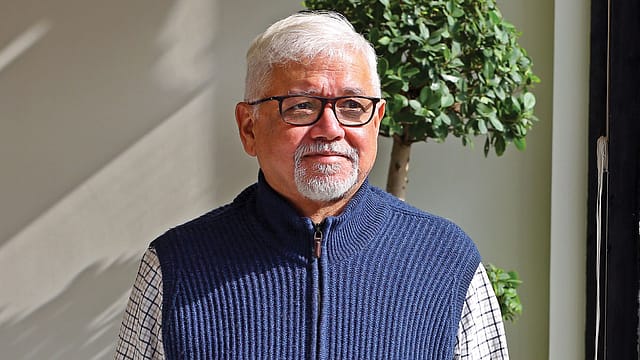
ON A SEEMINGLY ordinary day in 1960s Calcutta, Varsha Gupta refuses to eat unless there is fish on her plate. The demand is a troubling proposition for the Guptas, a Marwari Hindu family and strict vegetarians who would never allow fish into their palatial home. Varsha’s insistence poses more than just a logistical or even ideological conundrum. She is, after all, just three years old and has never seen or tasted fish in her life. Yet, she has vivid memories of her meals—sitting in a mud house by a river, cooking and eating fish with a different family, in a previous life. It is apparently “a case of the reincarnation type”.
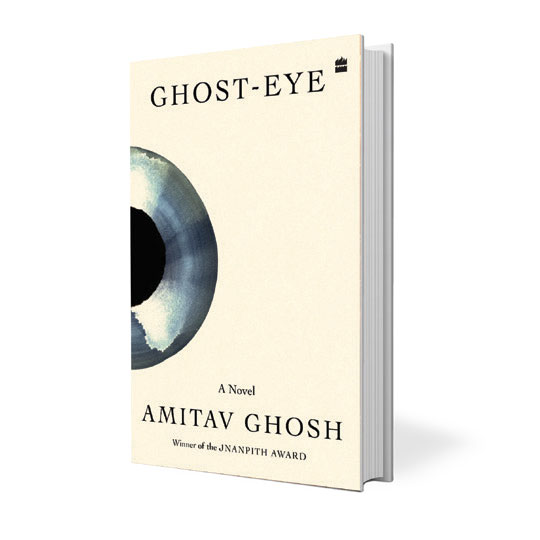
A premise rooted in reincarnation may evoke the fantastical or the supernatural, but Amitav Ghosh’s Ghost-Eye (4th Estate; 336 pages; Rs 799), in which Varsha is one of the key figures, is neither sort of novel. “This is not at all, a fantastical story,” the author tells Open. “It’s very much grounded, but I think that’s the real challenge, isn’t it? To reintroduce these mysteries into the normalcy of the life that we lead.”
Reading the opening chapters, this writer is suddenly reminded of similar stories from her childhood, from conversations between her parents and other grownups. Stories shared with the implicit suggestion that they were both commonplace and plausible. “We heard these stories all the time. So why does this not feature in our understanding of the world?” Ghosh says. The intention is not to regard it as truth, but consider its potential. “The moment you accept this possibility, then you also accept the possibility that the world is not mechanical.”
The Abandoned Kejriwal
01 May 2026 - Vol 04 | Issue 69
Brain drain from AAP leaves Arvind Kejriwal politically isolated
We are meeting at the Taj Mansingh in New Delhi in early January, hours before Ghosh launches the novel in Delhi, before heading to a country-wide tour. He offers to make tea and speaks fondly of his dinner at Indian Accent, where the Ghost-Eye themed menu included magur machher jhol (Bengal catfish curry). The easy demeanour belies Ghosh’s literary superstar status and the wealth of knowledge he brings to his fiction and non-fiction, combining history, anthropology, climate discourse, current affairs and more ideas in layered, genre-bending narratives. Ghost-Eye testifies to this dexterity.
Spanning decades, Ghost-Eye begins in the Calcutta of the ’60s and ends somewhere between Brooklyn and Bengal amid the Covid-19 pandemic. As Varsha recalls her past life more and more distinctly, psychiatrist Dr Shoma Bose who has been studying cases of reincarnation with an American expert, steps in. She devises a guessing game for the child, feeding her fish curries to test if she can identify them correctly. Ghosh describes these culinary rituals across the book in immersive detail, listing out varieties of fish—karfu, darkina, koi, neftani among several others—scenes from Kolkata markets and cooking methods that bring the recipes alive, especially to readers familiar with the integral role of fish in Bengali kitchens.
Food becomes a link between the past and the present in Ghost-Eye, and Ghosh’s specific, detailed descriptions have a bigger role to play. He calls it the primary medium for our relationship with the earth but also with our culture and with each other. “We don’t really think about the mystery that is food. When we eat, we ingest some of that mystery,” the author says. “I do think it’s very important to recognise this and to try and understand it as a phenomenon.” Decades after Shoma’s guessing games, her nephew Dinu preps another meal of fish for Varsha—this time in his Brooklyn apartment, navigating FDA laws, elusive ingredients and forgotten recipes to discover his Proustian Madeleine moment. Rekindling Varsha’s memories and a guarded power, food becomes akin to a magical bridge between the past and present, between the real and the uncanny. “I am trying
to teach myself how to cook the food I ate as a child,” Dinu tells a neighbour, who arrives at his apartment seduced by the aroma. When she asks why, he replies, “Because I’ve been told that in order to save the world, we have to remind ourselves of the old ways.”
Saving the world, or at least a part of it, becomes the long goal in Ghost-Eye, as the novel travels through time and space. Half a century after Shoma takes Varsha on an illuminating journey, and finds her own perspective on the world transformed, Dinu and a couple of environmental activists, launch their own search for Varsha believing her to be key to resolving an ecological crisis brewing in the Sunderbans. The mystical continues to linger, especially in Tipu whose “ghost-eye”, or heterochromia (having differently coloured eyes), gives the novel its name. Some communities believe that heterochromia endows people with the ability to look into the spiritual world. At various times in the novel, multiple characters exhibit what can be best described as superpowers—travelling across space, conversing with spirits, predicting the future with far greater accuracy than the next-door astrologer and reincarnating. Concepts like reincarnation can be disturbing even to imaginative minds, and it has a ‘woo woo’ reputation in science despite existing research on children of the reincarnation type (such case studies are fictionalised in the novel). Ghosh, whose 1995 novel The Calcutta Chromosome won the Arthur C. Clarke Award for science fiction, is far from anti-scientific. “But science has its limitations,” he says. “I would definitely want to challenge the idea that science explains the whole world.”
SITUATING THE plot in contemporary concerns also adds to Ghost-Eye’s realistic setting. If the early parts of the novel allude to a vintage Bengal, a time jump lands readers in the middle of Covid, suffused with the fear of infections and lockdowns. Ghosh wanted to anchor the supernatural buoyancy in ground realities. “I wanted it to be very much about the real world, about the here and now, the world that we live in and the world that we inherit. And, certainly for all of us, I think that the pandemic was an era-defining experience. So, I did want to write about that and my own experience.”
Apart from Kolkata and Brooklyn, the Sunderbans is another significant site in the novel. The mangroves are part of Varsha’s origin story and become the centre of an “irruption” in the novel’s climax against a corporate trying to build a power plant in the region. Recent years have drawn global attention to the ecological crisis unfolding in the Sunderbans, where climate change has caused cyclones, riverbed erosion, decreasing freshwater and loss of biodiversity as much as human livelihoods. Ghosh’s connection with the area goes back to his childhood, when he would visit the Sunderbans with his family. “It is an absolutely incredible landscape but strangely doesn’t feature much in literature,” he says. “Well, that has really changed, and I’d like to think that my books had something to do with it.” The Sunderbans must bring to mind many of Ghosh’s writings over the years, both non-fiction and fiction such as the beloved 2004 novel, The Hungry Tide and Gun Island (2019). Ghost-Eye is a successor, if not a sequel to both novels and not only because of the mangroves. Dinu is also Deen Dutta from Gun Island where he first meets Tipu, who in turn is the son of Fokir, a fisherman who played a key role in The Hungry Tide accompanying the protagonist Piya on her journey through the Sunderbans. Piya is one of the main characters in Gun Island and appears intermittently throughout Ghost-Eye. One might argue that Ghosh is building his own literary universe. The suggestion makes him chuckle.
Ghost-Eye ends with hope, with life-changing revelations for Dinu and a positive outcome far away in the Sunderbans. It is more optimistic than how Ghosh feels about the regressive state of climate change discourse at the moment. Yet, there is always hope—for action if not outcome. Ghosh observes that the novel has arrived amid protests and activism to conserve the Aravallis; the fictional protest in the Sunderbans seems to anticipate this real-life mobilisation of people for the cause. “It has touched a core and people have invoked the sacred nature of the Aravallis,” he says. “That kind of popular environmentalism has to rely on more than just science. It has to be about your relationship with the earth.”
Ghosh’s ability to see and narrate climate change as a cultural and imaginative crisis has made him one of the most prescient writers of our times. It is fitting that one of his forthcoming projects is to contribute a manuscript to the Future Library project. Joining the manuscripts of Han Kang, Margaret Atwood, David Mitchell and other eminent writers, the manuscript will remain locked away in the Deichman Bjørvika building at the public library in Oslo and will only be opened in 2114, and printed on paper made from spruce trees specifically planted for the project in Nordmarka. Stories can time-travel, but this is writing purposely for the future—Ghosh admits it is a challenge. What will the world look like for readers, a century for now? How will climate change impact the planet? Or, will nuclear war get us faster? Will the forests and mangroves, rivers and mountains endure? (The pessimistic will wonder the same about people.) Perhaps Ghosh will continue in the vein of Ghost-Eye, writing stories with a curiosity for the unknown and a willingness to embrace the strange and mysterious.