The Photograph
THIS IS A TALE FROM THE DAYS when the entire lane—from house numbers 76 to 212—in one of the better colonies in South Delhi was being taken over by the builders. One by one the householders were approached, tempted, even threatened by them to enter into deals for redevelopment of the old houses. Within eighteen months of signing the deal, and sometimes even earlier, the low, spacious, single-family home would be torn down and replaced with a new multi-storeyed building. This building would have a basement gorged out of the rock on which much of that part of the city was founded, stilt parking for eight cars, four independent apartments and a terrace with staff quarters. Depending on the deal, the original owners would get perhaps a flat or two, or even none if they preferred to just take the cash and move out to Gurgaon or Greater Noida, and new owners would move into the apartments. It was not just the householders who were changing in that lane; the warmth and friendships that had once bound together the families who had built their homes around the same time, watched the children of the lane grow even as they watched the gulmohar and neem saplings grow into magnificent trees, had gradually been replaced by aloof indifference.
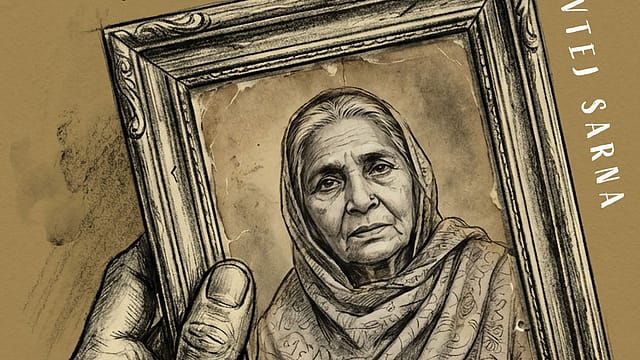
It was in those days that a framed photograph lay on a garbage heap at the far end of the lane, just before the Rock Park, next to the two yellow electricity transformer units. Technically speaking, that wasn’t a garbage heap at all. There were metal signboards tied on the wire netting that enclosed the transformer units that specifically denied the existence of a garbage heap: one put up the Resident Welfare Association prohibited the dumping of any malba or waste and another put up by the Municipal authorities directed the residents to keep the colony clean. Another with the skull and bones sign announced the danger of 11000 volts. Tucked under it was an advertisement for a yoga trainer who guaranteed ultimate relaxation of mind and body. So while there was no kitchen waste, or any plastic bags or empty pizza boxes in the heap, there were other discarded items—soiled rags, a blue and yellow sack that had once held ‘Wonder Cement’, fragments of broken terra cotta flower pots, used paper teacups thrown by security guards and construction labour, a couple of gutka pouches and six empty cigarette packets. If it had been a designated garbage point the garbage collector who came around every morning with his hand-pulled cart would have, sooner or later, dumped everything including the photograph onto the putrefying pile in his cart and carried it away into oblivion. But no garbage collector looked in that direction since it was not, technically speaking, a garbage collection point and the photograph lay there many weeks, through the polluted days of Delhi’s November and then through the smoky chill of December as the year dragged to its inevitable end.

Zeroing In on ECI
09 Oct 2026 - Vol 05 | Issue 41
Constitutional legitimacy versus political opportunism
Many residents passed that way as they went for their walks in the park. Young men and women listening through their ear-pods to music or to podcasts about the stock market, or the Middle East, or the latest in artificial intelligence. Elderly members of the laughing yoga club who would sit on the benches and sing bhajans after their laughing exercises and eat triangular mathis and wash them down with tea dispensed from a large steel thermos flask. And the dog-walkers with their Labradors and Shih-tzus on the leash. Once in a while someone would glance towards the photograph or make a remark about it to a partner. But soon, it seemed, the regulars had got used to it, as if it was part of the scene, just another object along with the terra cotta fragments, the decaying paper cups and the signboards. Nobody knew, or thought it necessary to find out, whose photograph it was or from where it had come.
If any of the passers-by had stopped to take a closer look, they would have seen that the old frame of the photograph had decayed unevenly and parts of it had fallen off. But splashes of whitewash and patches of darkening damp seemed to have a formed a new frame of their own around the face of a woman, a woman of around seventy with a black shawl that partly covered her head and then fell in a gentle double fold over her shoulders. It was a face that had hardened and wrinkled much before its time; it did not speak of a life lived in much comfort. But it was the eyes that told a tale of their own. A lost world still lingered in those eyes, a world in which a tapestry of pain and regret had been layered over despair and then stitched together by a deep fortitude.
Sometimes, at the twilight hour, that magical hour between day and night when the acrid smoke was dispelled by a gust of wind and the scent of the night jasmine bravely explored the lane, those eyes seemed to turn. Always towards one house, the second in that lane of the builders. The eyes seemed to be searching, not for the brand-new building but for an older house that had once, not too long ago, stood in its place. That house, built by the woman’s husband half a century earlier, had been a single-storey house with a patch of lawn in front and a driveway that led to a garage. It had wide teak doors that shone just with a wipe of the dusting cloth, backed up by to come in while keeping the insects out. A house with three bedrooms and a drawing-dining hall, a kitchen with the concrete shelves made to suit her height and overhead storage cupboards that kept everything spare and clean, just as she liked it. A small store to keep the clutter away from the bedrooms and a back veranda to hang the washing; the one luxury had been a bathtub in one bathroom with its mixing taps of hot and cold water.
A short flight of steps led up to the terrace where on summer nights, the family would sleep under the stars on clean white sheets spread out on string cots. Her husband would narrate stories of his Rawalpindi childhood or battle tales from Sikh history to their three boys who took turns pouring cool water from the earthen surai with the lion’s head spout. At dawn, just as the sun would be peeping out from behind the crumbling ramparts of Tughlaqabad fort that lay across a stretch of rock and thorn—for South Delhi was still far from built—they would roll up their pillows and sheets and rush downstairs for the last spell of sweet sleep under the ceiling fans. But she would not sleep; her day’s work would begin. Opening the front doors, she would let out the stifled air of the night and let in the early morning sounds: the thud of newspapers rolled up tight with black rubber bands and thrown expertly on to verandas and balconies by newspaper-wallahs from bicycles with wicker baskets; the clang of glass milk bottles as the metal crates were unloaded from the milk truck at the corner booth; the conch shell from the temple in the next lane and far away, from the small mosque half-way to Chiragh Delhi, the call to prayer. She would lay out the school uniforms, pack the tiffin boxes and plait the long hair of her sons and wind them up in tight top knots, tight enough to last the whole school day with its daily quota of scruffy fights, lunch-time games and midday sweat.
Despite the demanding routine of managing her family on the modest salary of her husband—a news editor in the Punjabi unit of All India Radio—she would always remember those days as the best of her life. She had been the anchor of her family, the undisputed mistress of the house. Everything had run the way that she had wanted it to, and she had wanted it only for everyone’s good, their health, their growth. She spent carefully, allowing no expense that could be avoided, knitting sweaters for the boys herself, washing and ironing their clothes and making the desserts that her husband just could not do without, small rasgullahs in summer, gajar halwa in the winters. Chicken was cooked only once a week, only one cleaning woman was employed for the utensils, the sweeping and the mopping; that way a government salary could be made to stretch, even allowing for a little deposit every month at the post office.
But life is relentless. It moves at its own pace; it decides its own rhythms. Its big lesson to vain humans—even to well-meaning, humble humans who only want to cling on to small joys—is that nothing stays. Things change, phases end, people fall sick and die. And so much happens when you least expect it.
And nobody ever expects the death of a loved one, even when one knows that such things are inevitable, only a matter of a time that is already designated, destined. The wise men all say so, the scriptures try to prepare us for these truths and yet we are always found wanting.
Five years after his retirement, her husband’s heart started to falter and despite two years of treatment and care—queues in hospitals, medicines from the government dispensary, tests every six months, a measured diet, low salt, less water and an hour’s rest every afternoon—it finally gave up. It happened on a day when all her three sons were out—one at a coaching class for the civil services examination, another at the broker’s office where he was learning to decipher the dips and spurts in share prices and the third one at college. She was left alone with her husband’s body, his eyes shut, his mouth slightly open, his hands spread in final surrender, palms upwards.

Many things changed after that. She became a widow with a family pension and a quarterly payment of interest from the postal deposit. Her eldest son gradually moved into the role of the head of the family, taking care of the finances, leading the decisions, guiding his brothers into their new careers. A new television, then a sofa-bed were added to the drawing room. She began to retreat from the daily running of the house and then more and more to her room so as not to be in the way of her sons and their visitors. By the time the eldest son brought a wife into the house, her eyesight had begun to fade. One botched up cataract operation kept her away even from the television and her world contracted further. Finally, she began to find comfort in prayer. Perhaps it was fortunate that a massive heart attack took her away, four years after her husband. Fortunate because that saved her from a time of further retreat, from a time when three daughters-in-law would be vying for space and influence in the house, from a time of increasing incapacity, a time of inevitable weakening of limbs and spirit.
But her true good fortune was that she died in her own house, the one that her husband and she had built modestly and honestly, with the help of a government loan. Her death saved her from many heartbreaks. From a time when the builders began to visit the house, targeting first one brother and then the others, asking them in soft persuasive terms whether they were ready to make a deal to move out for a year with rent paid and come back to a new building with stilt parking, a basement, three spanking new apartments—one for each of them, and a fourth to be sold by the builder to the highest bidder. She was saved from seeing the differences that appeared among her sons—and their wives—when the discussions with the builders became serious. Who would get which floor, how would the basement and the terrace be shared, the division of the staff quarters, the allotment of parking slots… After a couple of occasions when these differences became very evident, the wives stopped participating directly, preferring to make their claims through their husbands; the brothers, in turn, tried to keep the discussions polite, their voices down and their respect as brothers intact, but gradually the conversations became stiff and formal, the old family jokes withered away, the common meals ended. And one day the youngest brother raised his voice and, in his anger, broke the flower vase that had been the retirement gift to their father from his unit in All India Radio. After that the contract with the builder and the memorandum of understanding governing the division of the redeveloped property was sorted out in the office of a property lawyer in Nizamuddin in sullen silence, under the looming shadow of bookshelves lined with leather-bound legal volumes.
A certain heartlessness accompanies the tearing down of old houses. Big yellow machines with claws and incisors pull out the innards of cherished homes. Everything moves at a disrespectful pace because the demolition teams are paid by the day. It didn’t take long to turn the house into scrap. The old teak doors and windows which still seemed to shine in the sunlight were thrown unceremoniously into a truck along with the electrical fittings and fans that had been chosen carefully by the news editor after several visits to Bhagirath Place in Chandni Chowk and the taps and showers with the Victorian design that had reminded him of his only visit to England. In another truck went the old bricks and concrete chunks along with the remains of the old terrazzo flooring of the kind that no craftsman can make any longer. In less than a week, it was all done and a gap had appeared in the lane, a gap as neat and clinical as one left by an extracted tooth. The yellow machines were ready to dig out a basement.
And all too soon a year had passed. Vans with baggage began to arrive as the brothers returned from rented houses to the new apartments. That was also the time for culling, weeding out, for making sure that only nice neat new things went into the shining rooms; there was no need or place for old things that had been lying around simply for some outdated sentiment, or just out of pure inertia. Somewhere in that heady process of setting up new homes—and possibly it was not intentional, because nobody really can be so callous —the mother’s photograph, and much else that we will never know about, got left out of the house. For a night it lay in a pile of refuse near the gate and the next day, the cleaning woman who worked the lane deposited it on the pile near the electricity transformer units, on the pile that was not, technically speaking, a garbage heap.
AGMEET SINGH DID not notice the photograph the first time he went to check the fault in the transformers. It was getting dark and he was new to the line, having been transferred there only a few days earlier. Wearing his rubber gloves, he opened the lock of the wire net doors in the light of the torch that he held between his chin and shoulder, leaving his hands free. The electricity of the entire lane, including the new house with its four floors, had to be switched off while he worked on the high voltage equipment. Finally, he identified the fault and patched up the connection temporarily. It would hold for the night and the heaters, the cooking ranges, the televisions could all run in the new apartments. He would need to come back during the day—when the electricity could be switched off longer without too many complaints—to do a proper job. He called in to the sub-station and the lights came on as he locked the door behind him. Then, giving a playful pat to the skull and bones sign on the door, he started walking in the direction of the one room unit that he had rented on the second floor of a Gobindpuri house.
The bright light from the naked bulb in his room highlighted the bareness of the pista green walls, bereft of any photograph of family or friends, or even a calendar. Jagmeet took off his turban—its once bright red colour had dulled with constant washing—and put it on the table. He combed his hair and swiftly tied it in a top knot. Running his fingers through his open beard, he glanced briefly into the mirror on the mantelpiece. At nearly forty—he was never sure of his exact age—his beard was already streaked generously with grey. A clear line divided his forehead into two: the upper fairer part protected all day from the harsh sun by his turban and the deeply tanned he was hungry. Quickly he turned on the gas stove and started heating in a pan the vegetable and three parathas he had made and left for himself that morning.
Inevitably, as he sat down to eat alone, he thought of his mother. How she would always insist that he eat fresh food, how she would wait up for him, no matter how late he returned to give him hot chappatis, how she never allowed him to eat leftovers. She had died two years ago, not yet sixty-five. It was not age but the leaden burden of grief and despair that had overwhelmed her before her time, a burden that had become her lot since that day in November 1984 when the Prime Minister of the country had been cut down by a hail of bullets by her own Sikh guards.
Things had been building up to that dark moment. The politics of Punjab, the guns and the terror, the rolling of Army tanks into the Harmandir in Amritsar. But she, Kartar Kaur, the thirty-year-old wife of Balwant Singh, an expert mechanic of scooters and motorcycles, had understood none of that, or even known the details. That was not her world. Her world had been the two-roomed home across the grey river, the home whose plastered walls were yet unpainted. Her days were spent keeping that home clean, filling and storing water in a large plastic drum which had a tap fitted to it and cooking meals on a kerosene oil stove for her husband and her three-year-old Jagmeet in the small kitchen. She was happiest when dressing him up every morning, applying oil to his long hair and combing it lovingly before plaiting it with a red ribbon into a loop that swung behind his head.
Her little world had gone up in flames when the unholy mob of men swinging iron rods and carrying cannisters of petrol entered their lane, screaming for revenge on all Sikhs for the killing of the Prime Minister. Jagmeet had only one memory of that night which he had tried to erase from his mind, or stow away somewhere from where it could never return. But return it did, every now and then, destroying his nights and darkening his days. The memory of shrieks that shredded the night, of the howling of men being burnt alive. Of a house he could see from the window that suddenly burst into flames as a live match caught the petrol that had been poured on it. After that he only recalled being stuffed under quilts in a big metal trunk by his mother and the lid being banged shut. When she finally pulled him out there had been silence all around, the kind of silence he had never ever heard again and then the dark memory of being carried in the cold night, wrapped up in her black shawl close to her chest, through bush and bramble along a drain steaming with sewage. He had no memory of what had happened while he was hiding under the quilts, of how they were picked up by an Army truck and taken to a large hall where they got some water and food, and how finally they landed up in the Widows Colony.
Of that colony he had clear memories. Of growing up with other children without fathers. Of his mother, always wrapping her black shawl tight around her chest, constantly knitting sweaters from the wool that a woman would give her every few weeks and then one day the same woman would come and take the sweaters away, paying Kartar Kaur for her work. Of going to a school not far from the colony with some other boys; only later did he learn that a voluntary organisation had paid his fees for many years. As they grew up, the boys began to trade the stories they heard from their mothers, about how they had reached the Widows Colony, about what had happened to their fathers or grandfathers. But whenever Jagmeet asked his mother for their story, she would only hug him close and tell him that he should just concentrate on his studies. Finally, when he was around fifteen, she relented.
Balwant Singh had stayed too long in his mechanic’s shed at the end of the lane. When he had tried to run from the mob towards his home, he had been quickly overtaken and surrounded. One blow from an iron rod had shattered his skull through his turban and as he lay bleeding another man had poured petrol over him and set him ablaze. A victorious howl had gone up from the mob. One more traitor is burning, someone had shouted. Kartar Kaur had watched it all, frozen in her doorway. The day that she told him the story, Jagmeet did not eat his dinner and his body burnt with fever all night.
But Kartar Kaur did not let him lurch down the path that many young boys in the colony had taken, the path of anger, resentment, despair and drugs.
“Your best revenge is to do well,” she told him again and again. “Criminals do what they are born to do. You cannot waste this beautiful God-given life on anger and revenge. The merciful God has saved you, protected you with his own hand. There must be a purpose to that.”
And on the second day of November that year, the day that his father had been murdered, she took him to Sisganj gurudwara, to donate eleven rupees for parsad and to pray for peace for his father’s soul. That day she made him pledge that he would look to the future, not the past.
But she never told him what took place between his being stowed under the quilts in the big trunk and the scramble through the night, wrapped up close to her chest under her black shawl, along the sewage drain. His questions on that would only be answered with a deep silence and he would see her lips begin to move involuntarily in prayer.
But the widows talked to each other. They all knew each other’s stories, they sympathised with each other, held each other close when the memory of the horrors became too much for any of them. Some of the stories were revealed to the children, sometimes in anger, sometimes in sorrow, or the children picked up the whispers of their mothers. Bit by bit, Jagmeet had pieced together what had happened as the blood-thirsty killers spotted a shocked Kartar Kaur standing in her doorway, helplessly watching her husband die. Three men had rushed into the house after her, their faces twisted in ugly leers, their blood racing. They had fallen on her and she had shut her eyes to the nightmare, thinking only of the little child hidden under the quilts. They had staggered away after that, leaving her sobbing on the floor, forgetting to search or loot the house. Jagmeet never asked her to tell him anything more; he knew she would not have survived the telling. He also understood why for years the black shawl was always, winter or summer, wrapped around her chest, like it was her only protection.
She also did not tell him when she began to feel weak and ill. Jagmeet had just got his first job as an electrician and she had not wanted to distract him. He was armed with a vocational diploma thanks to the generous help of a dignified Sikh gentleman with a flowing beard and a starched white turban who had helped many families in the Widows Colony. The diploma had been good enough for him to get picked up as a linesman by the sub-contractor of the main electricity distribution company. But Kartar Kaur could not keep her heavy breathing and her constant fatigue a secret much longer. The few visits to the government hospital did not help and one winter morning she simply did not wake up. As he watched her ashes float away in the Yamuna behind the Majnu ka Tila gurudwara, Jagmeet knew he had grown up. That month he moved out of the Widows Colony.
AGMEET SPENT THE SECOND HALF of the next day fixing the fault in the transformer unit. When, late in the afternoon, he finally put the lock back on the door with a sense of a job well done, his eye fell on the photograph on the garbage heap. Silently he gazed at it, the aquiline features, the double fold of a black shawl, the wise sad eyes looking into the distance. He bent down and picked it up carefully and wiped away the dust and the grime with a work cloth from his bag, tracing his finger on the folds of the black shawl. He turned it around to see if there was any indication that might show to whom it belonged or whose photograph it was. There was no name, no year, not even a photographer’s stamp. After a moment’s thought he took the photograph and began to walk towards Alaknanda market which fell on his way home.
At one end of that market, Krishna ran his business of framing pictures from inside a dry-cleaner’s shop. For a small rent, the drycleaner had given him space in the rear to keep his materials and allowed him to set up a work table in the front veranda. Krishna shared the veranda with a tailor wearing thick spectacles who was perpetually bent over a sewing machine operated with a foot pedal.
Krishna took the woman’s photograph from Jagmeet and inspected it closely.
“The photo is safe, more or less, but the mount and frame are gone. These stains of whitewash may not go fully. Somebody has treated it badly,” Krishna’s gaze flickered on Jagmeet’s face, searching for any trace of a response.
But Jagmeet was staring intensely at the photograph.
“Ok, let’s make a new frame. And a new mount.”
“The cheapest—this one for example—will be around four hundred and fifty.”
“Can you do it now?”
“It’ll take about one hour. Or take it tomorrow?”
“No, no, I’ll wait.”
The newly framed, freshly mounted photograph was ready in less than an hour. Krishna had gently cleaned out much of the whitewash with some spray. He put away the money that Jagmeet handed over and watched his customer hold the photograph at a distance and gaze at it. Jagmeet’s face glowed in the last light of the day.
“You are treating this photo with a lot of love... May I ask who is this person?” Krishna asked.
Without hesitation, Jagmeet responded: “My mother.” And then he walked away quickly towards Gobindpuri, identifying in his mind the exact spot where the photograph would hang on the pista green wall in his room.