Starship Flight 14 Set for First Orbital Mission, Carrying 26 Starlink V3 Satellites
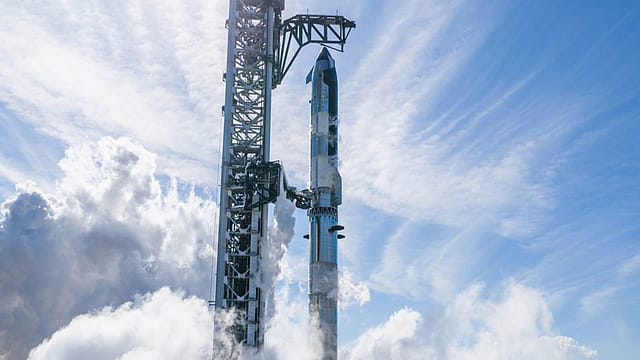
SpaceX is preparing to send Starship into Earth orbit for the first time on September 28, with Flight 14 scheduled to deploy 26 next-generation Starlink V3 satellites before attempting a controlled return to Earth.
The 75-minute launch window opens at 7:15 am Central Time, or 5:45 pm IST, at Starbase in Texas. According to SpaceX, the mission will test several capabilities needed for the rocket’s future operations, from orbital insertion to satellite deployment and reentry.
Starship is expected to fly approximately 275 kilometres above Earth, completing around six orbits during a nearly 10-hour mission. Splashdown is targeted in the Pacific Ocean, west of Chile.
What Flight 14 Will Test
The Starship system comprises the Super Heavy booster and the Ship upper-stage spacecraft. Each has a separate set of objectives.
Super Heavy will attempt launch, ascent, stage separation, a boostback burn and a landing burn at an offshore location. SpaceX says hardware and software have been modified to address issues encountered on the previous flight.

Zeroing In on ECI
09 Oct 2026 - Vol 05 | Issue 41
Constitutional legitimacy versus political opportunism
The upper stage will attempt its first orbital insertion, release the satellites and perform a deorbit burn using a single Raptor engine in space. It will then attempt a controlled reentry, descent and ocean splashdown.
The planned ocean landings mean this mission will test stages of the return process rather than complete a return to the launch site.
What Makes Starlink V3 Different?
SpaceX says the new satellites offer substantial increases in communications capacity, data density and power generation.
Each Starlink V3 satellite is designed to support 1 terabit per second of downlink capacity and 160 gigabits per second of uplink capacity. The company describes those figures as improvements of ten times and 22 times, respectively, over Starlink V2.
These are satellite capacity figures, rather than promised internet speeds for individual customers.
After deployment, the satellites will unfold their antennas and solar arrays, establish radio and laser connections, and use onboard thrusters to raise their orbits.
SpaceX says customer service could begin within weeks, following checks in orbit.
Three Satellites Will Inspect the Heatshield
Three of the satellites carry cameras intended to scan Starship’s heatshield and transmit images to mission operators.
The exercise will test ways to assess whether the spacecraft is ready for reentry, supporting future missions that aim to return to the launch site.
Standing approximately 407 feet tall, Starship is described by SpaceX as the biggest and most powerful rocket ever built.
Both stages are designed for full and rapid reuse, a capability the company calls the “holy grail of rocketry”. Flight 14 will test elements needed to pursue that ambition; a successful launch alone would not demonstrate the complete reusable system.
For this mission, the key milestones extend well beyond liftoff: reaching orbit, deploying the satellites and bringing the spacecraft through reentry to its planned splashdown.
With inputs from ANI