‘All Politicians Are Actors’
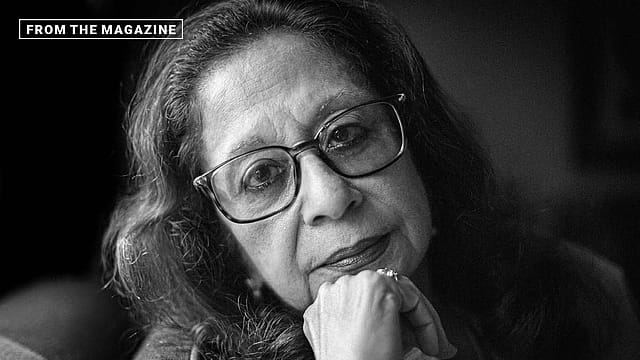
When Tavleen Singh was writing Durbar, her 2012 book that was as much the memoir of a journalist covering some of the country’s most pivotal moments in history as an exploration of the nature of power itself, she had initially intended for it to be a work of fiction. “I was trying to, sort of, not talk about people that I knew very well,” Singh says. “But then a wise, old friend of mine said to me, ‘The characters are too obviously who you’re talking about. So just write it as non-fiction’.”
A similar problem arose when she began work on a new book around the time of the 2024 General Election. She wanted to write it as a political book that had something of a playful hybrid form consisting of both fiction and non-fiction elements. “That really messed things up,” she says. “It just didn’t work.”
So, Singh—who earned her stripes first as a journalist and later as a columnist and author of non-fiction books—began reconstructing it as a work of fiction. Out now, The Actor is her first novel, set in a not-so-distant future. Its characters may be made up but their mannerisms, and the political ideas and social churns being described are so immediate and familiar that they could have been pulled out of today’s newspapers.
There was also another reason for writing The Actor as a novel. It was politically more expedient. “There is a lot of pressure on political journalists these days,” she admits. “It’s a lot easier to write fiction than non-fiction.”
The book tells the story of a country on the brink of political change. A populist leader known as Guruji has been Prime Minister for four terms through a combination of political smarts and ratcheting up communal politics; clueless opposition parties are mostly family-run affairs; and a new political upstart with fresh ideas wants to unseat Guruji.

Singh tells this story through the eyes of Amit Singh, a fading Bollywood superstar. He’s had three flops in a row, younger actors are on the horizon, and the industry’s movers and shakers are moving on. That’s when Naresh Khanna, an old friend who is about to launch a new political party to challenge Guruji, offers Amit to come on board as his No 2.
Singh finds the linkages between the Indian film industry and political power fascinating. “If you look at it, all politicians are actors. And if they’re not good actors, they don’t win elections,” she says. “You must be able to perform many times a day on a public stage.” And then there were the actor-politicians whom she knew: From Amitabh Bachchan and Vinod Khanna to Rajesh Khanna and Shatrughan Sinha. Unlike the South where actors often have long and successful political careers, Singh says that the people in the North tend to be more suspicious of them. Several years ago, the late Dilip Kumar told her an amusing anecdote about the time he campaigned for a leader. Towards the end of his speech when Kumar asked the audience, ‘Desh ka neta kaisa ho?’ (Who should the country’s leader be like?), the audience shouted back, ‘Saira Banu jaisa ho’ [the actress and wife of Dilip Kumar]. Singh recalls this with a chuckle and says, “You will meet some of the most political people in villages of UP and Bihar. These guys make a distinction between politicians and actors [playing at being politicians].”
For Amit, she chose to put many of the things she had observed while interacting with actor-politicians. Some of the things Amit says and his reactions to villages, for instance, came from Amitabh Bachchan during his election campaign in the 1984 General Election. “Amitabh was contesting from Allahabad (now Prayagraj), and when he went into the villages around Allahabad, he told me he couldn’t believe how poor they were. That always stuck in my mind.”
Having an actor-turned-politician as a protagonist also allows the writer to take the book into locations as varied as Bollywood parties and dinners thrown by Maharanis and socialites to journeys as a political campaigner into less privileged quarters. Few writers are as uniquely equipped to bring these disparate worlds to life as Singh, whose journalism has long brimmed with access to elite political drawing rooms as well as explorations into the strife and turmoil unfolding within the country.
Singh began working as a journalist in India with The Statesman in 1975, just one month before the Emergency was declared. There were only a handful of female reporters in the capital then, and fewer who reported on ‘hard news’. One of her first big assignments was in Punjab where she travelled to cover the rise of Jarnail Singh Bhindranwale. Singh interviewed him multiple times inside the Golden Temple and was fearless enough to ask questions that incensed him. “It was very fraught from the beginning because he knew I was a Sikh,” she says. Her last encounter with him was two weeks before Operation Blue Star when Singh travelled to Amritsar with photographer Sondeep Shankar. Bhindranwale was in a meeting with armed militants on the roof of the kitchen where the langar was prepared. “He summoned me to the front. And then in front of everyone, he said, ‘This is the woman who says she is ashamed to be a Sikh’,” she says.
Singh had written an article not too long before headlined ‘Why I am ashamed to be a Sikh’, where she had explained why the sight of guns and violence inside the Golden Temple had disturbed her. “I said, I had meant that to see so many guns in the Golden Temple had made me very ashamed. And he said, Guru Gobind Singh has given us the right to carry arms when we’re fighting repression. He then flounced off and his coterie followed,” she recalls. It was particularly nerve-racking because people were often attacked after Bhindranwale made it a point to single them out like this, and a journalist had only recently been stabbed while walking down the stairs.
Once Operation Blue Star was complete, the government imposed a curfew and martial law-like conditions across Punjab to keep the press away. Singh was, however, among the first journalists to sneak into Amritsar just days later. Using a letter from her father, the retired Brigadier Amarjit Singh to General Kuldip Singh Brar, who had led the commandos in Operation Blue Star and was once his student, Singh and her colleague waved the letter to pass through military barricades, before finally being brought in front of the General. He eventually allowed them to enter the Golden Temple, because he was upset with the government for failing to give them intelligence “It was not a very wonderful thing to be able to see. But we did get in,” she says.
In the book, just like how Bachchan told Singh about travelling to villages and encountering poverty, Amit embarks on something akin to a discovery of the country. Beneath this narrative, however, is a strong undercurrent of a political churn, something that today probably finds its real-life echoes in the youth protests that have besieged Delhi. “I was so stunned when the Cockroaches (Cockroach Janta Party, CJP) arrived,” she says. “But I did feel, on the ground, wherever I went, a sense of disappointment with mainstream politicians.”
Singh was enamoured with the CJP when they first appeared, taken in by their youthful energy and the issues they took up. Of late, she has felt a bit let down. “I feel they have become a bit directionless,” she says. “Also, all these people riding on the back of the Cockroaches are going to benefit from the association, but not the Cockroaches. The Congress party trying to jump in on their parade is also not helping.”
The book also has a character named Maya, a journalist and Amit’s love interest, whose opinions bear some similarity to Singh’s. Did she model the character on herself? “I wish I’d had an affair with a Bollywood superstar,” she says with a laugh. “She might have my opinions, but she has much better luck.”