Power Pill: The making of Lupin and homegrown pharma

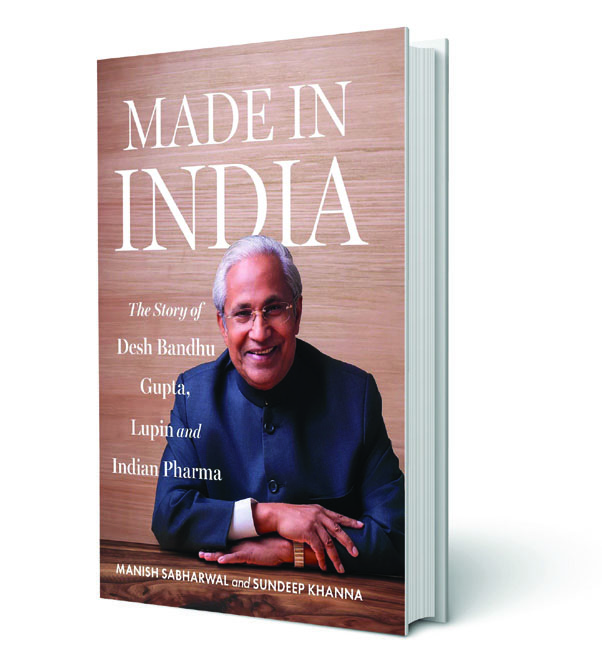
WHEN YOU WRITE about Lupin and its founder Desh Bandhu Gupta (DBG), less is more. His story does not need lavish praise. It is, after all, inextricably intertwined with the enterprise of a generation of Indian visionaries—their ambitions, their mistakes, and their determination to build an industry that has made India the world’s pharmacy. Made in India: The Story of Desh Bandhu Gupta, Lupin and Indian Pharma captures that larger story with a fair measure of success.
On page 153, there is a photograph of DBG aged 14, taken in a studio in Rajasthan’s Rajgarh village where he was born. It is the picture of a rural boy who, as the book reveals at the start, had to be carried by his father four years earlier to reach a hospital 20km away to treat a broken ankle. He never received good treatment and lived with a limp all his life. This boy was destined decades later to fly on the Concorde from London to New York to parley on equal terms with the chairman of an American drugmaker. By then, DBG, who went on to earn a master’s degree in physical chemistry and teach chemistry at BITS Pilani, would have taken a plunge into the pharmaceutical business.

Zeroing In on ECI
09 Oct 2026 - Vol 05 | Issue 41
Constitutional legitimacy versus political opportunism
Made in India: The Story of Desh Bandhu Gupta, Lupin and Indian Pharma by Manish Sabharwal, TeamLease Services co-founder, and journalist Sundeep Khanna deserves attention because it tells readers a typical story of entrepreneurs of the time, in the initial years after Independence, whose rise often came from humble backgrounds.
In Indian pharma, DBG occupies a hallowed space alongside the likes of Yusuf Hamied (Cipla) and K Anji Reddy (Dr Reddy’s Laboratories) in driving gains for homegrown companies as they grew into global corporations. DBG is regarded by industry peers and historians as one of the foundational architects of India’s modern pharmaceutical industry, and he built it from scratch in 1968 with an initial `5,000 loan, without patronage or privilege. He showed as much finesse in navigating the restrictive regulatory environment of the 1960s and 1970s as he did with global legislative shifts—the Indian Patents Act of 1970 and America’s Hatch-Waxman Act of 1984.
His was not merely a reckless drive to make profits. This was why instead of chasing high-margin lifestyle therapeutics, DBG focused Lupin’s initial research and development on endemic, low-margin—perhaps heavily neglected —diseases like tuberculosis. At the same time, he performed the tightrope balancing act of transforming Lupin into a major pillar of the Indian pharmaceutical industry, taking it from a domestic supplier to a global generic powerhouse. Nobody can contest that Lupin revolutionised the supply chain for anti-TB drugs. It also made the most of the generic revolution that came later as India joined the World Trade Organization and signed the TRIPS agreement. The book also focuses on the multiple, and often formidable challenges he had to tackle. The section titled “Existential Crisis: 1993- 2003” is a must-read for business executives and anyone interested in how companies make mistakes, learn from them and move forward. DBG was a man of action despite the odds that confronted him and the company. “He suffered mental health struggles compounded by a complicated heart bypass surgery in 2001 that left him in the ICU for weeks. Yet his earlier decisions had laid the groundwork for Lupin’s transition from crisis to growth,” the authors write, elaborating later on the role of “Big Bull” Rakesh Jhunjhunwala in this recovery.
The authors quote Jhunjhunwala, shortly before his death in 2022, recalling his meeting with DBG, who died in 2017 aged 79, as a “meeting of the minds”. This work puts the spotlight on how Lupin grew, faltered, staged a comeback and how his family carries forward DBG’s legacy— without slipping into hagiography.