Imported copies of Joe Sacco’s Muzaffarnagar riot book are selling in India for as much as Rs 2,800
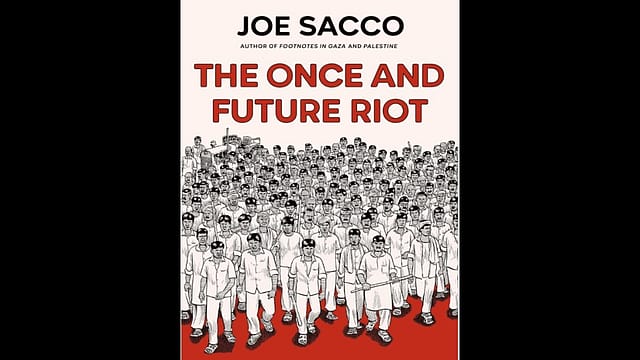
Even as Joe Sacco, the Maltese-American cartoonist and journalist, says he is in talks with multiple publishers to make his latest book affordable for Indian readers after Penguin India decided not to distribute it, it is already available in India--yes, in select bookshops and on Amazon India, where the 135-page illustrated account of the 2013 Muzaffarnagar riots is selling for as much as $20 or more--at "The Bookshop Inc" in Delhi's Lodhi Colony, it is being sold for as high as Rs 2800.
A publisher told Open that their team is in advanced talks with the author of The Once and Future Riot, a pioneer of investigative journalism in the comics format. At least some of us have been familiar with his work since Days of Destruction, Days of Revolt, his collaboration with the legendary journalist and commentator Chris Hedges, who wrote the text while Sacco provided the illustrations, highlighting poverty in the US.

The Health and Wellness Issue
25 Sep 2026 - Vol 05 | Issue 39
Hedges once said of Sacco that he “invented nonfiction graphic journalism, marrying rigorous and detailed reporting with illustrations that leap off the page and give his stories a texture, depth and power that is hard for most writers to match”. Sacco, 65, has done much more: Safe Area Goražde, a graphic account of the Bosnian War that he wrote and illustrated; Palestine, also written and drawn by Sacco after travelling through the West Bank and the Gaza Strip in late 1991 and early 1992. He has several other works to his credit, including Footnotes in Gaza, a journalistic graphic narrative about crimes committed against Palestinians during the Suez Crisis. It was published in 2009.
The Once and Future Riot begins with Sacco and his local collaborator, Piyush Kumar, visiting Muzaffarnagar in the aftermath of the 2013 riots, meeting perpetrators, victims, survivors and officials familiar with the communal clash that killed at least 60 people and displaced more than 40,000. Although the graphic non-fiction opens with a reckless drive through western Uttar Pradesh, it quickly returns to “the incident” in Kawal village in Muzaffarnagar district on August 27, 2013, when a Muslim youth, Shahnawaz Qureshi, was killed by Sachin Singh and Gaurav Singh, two young Jat men, allegedly over claims that Qureshi had eve-teased their cousin. The two men were immediately lynched by a Muslim mob as they tried to escape. Sacco narrates multiple versions of the attack and the retaliation with the help of Piyush and their seasoned driver. Very often, after meeting groups of people, where it is usually their natural leader who speaks, presenting a version of the violence that unfolded in the weeks and months that followed, Sacco remains equally sceptical of what is projected as the truth and of the enigmatic silence of those seated around such leaders, seemingly willing to accept even the most outlandish claims without question.
After briefly delving into the history of Partition, the exodus and the communal polarisation surrounding the demolition of the Babri Masjid in 1992, Sacco returns to his meetings with Jat leaders, one of them Virendra Singh, who tells him that Muslims and Jats had lived side by side harmoniously for generations. Calling himself a Hindu, but not a conservative one, Singh argues that many Jats had converted to Sikhism and Islam during the Mughal period and that those Muslims had continued to follow several Hindu traditions for decades, particularly until the early 1990s, when they began asserting a more distinct religious identity in the wake of the political churning triggered by 1992.
Sacco then reconstructs the politics of the region, explaining how Muslims had once favoured the Jats, especially when the late Prime Minister Chaudhary Charan Singh was at the helm. Over time, with the late Mulayam Singh Yadav, who later founded the Samajwadi Party, courting Muslim voters, the political equations began to change. Sacco visits Dr Zile Singh, a political science professor at Sanjay Gandhi PG College, Meerut, who says “a kind of hatred” began to emerge between Jats and Muslims from that period onwards. He also dwells on the idea of the Muslim vote bank while examining the class relationship between Jats and Muslims in Muzaffarnagar, Shamli and the wider western Uttar Pradesh region, where many Muslims who remained in villages after the younger generation migrated to cities were largely landless peasants.
The graphic non-fiction account also offers a blow-by-blow chronicle of communities gathering on either side of a widening divide; the simmering tensions beneath everyday life; the impunity enjoyed by privileged men who sexually assault women and escape accountability; the role of the police; the unforgettable characters from rival communities; the voices of the displaced; powerful politicians and religious zealots; brutal attacks, ambushes, revenge killings, denials and the politics of victimhood. All of this unfolds through a guided tour of the worst-affected sites of the violence that arguably reshaped Indian politics. Sacco also revisits the riots that followed, tracing how certain political forces consolidated their power by weaving religion ever more aggressively into the fabric of electoral politics.
Interestingly, for someone with a remarkable knack for understanding unfamiliar places, Sacco acknowledges that a journalist can seldom succeed in an alien environment without relying on those with specialised local knowledge. “My own experience is that I couldn’t have walked two steps in Uttar Pradesh without my guide and translator, Piyush, who is a seasoned journalist in his own right and one of exacting standards. He gave me a crash course in the arcana of the state’s politics and helped me connect the dots that I probably would not have seen.”
Published by Metropolitan Books of New York, Sacco dedicates the book--which provides a nuanced account of the 2013 communal violence, its dynamics and mechanics--to “the hardworking rural journalists of India”.
Joe Sacco dedicates the book titled The Once and Future Riot to “the hardworking rural journalists of India"