Book Review: China’s Wars: The Politics and Diplomacy Behind Its Military Coercion
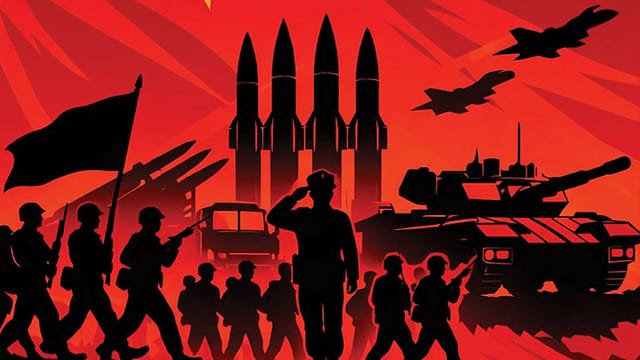
A POPULAR NATIONALIST narrative in China centres around the “100 years of humiliation” during which, as the telling of the story goes, foreign powers imposed unfair terms on the Qing dynasty and its quest thereafter to regain its rightful place in the world order. While no doubt China was treated harshly, what can befuddle the observer is Beijing’s way of correcting the wrongs which seems rather similar to the heavy-handed methods China’s tormentors supposedly used.
In Beijing’s imagination it is only correct and proper that its primacy in its neighbourhood—and even beyond— be recognised and respected. As then Chinese foreign minister Yang Jeichi told an ASEAN forum meeting in July, 2010, “China is a big country and other countries are small countries and that’s just a fact.” The point being China’s concerns must be accorded priority even if this means a diminution of sovereignty and this is just how it is meant to be. Any suggestion that a “vassal” nation may not see things similarly could invite chastisement.

Losing Memory
16 Oct 2026 - Vol 05 | Issue 42
The making of a medical and social emergency
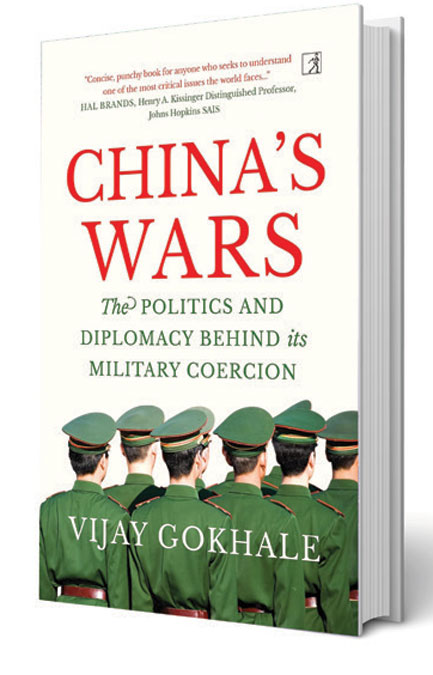
Over the years former foreign secretary Vijay Gokhale has emerged as an authoritative voice on China’s conduct of foreign relations and the lessons for India. China’s Wars: The Politics and Diplomacy Behind Its Military Coercion, his latest book examines the common threads running through China’s conflicts with the US, India, Russia and Vietnam and concludes that its goals are never defined in military terms alone. This may seem, on the face of it, applicable to other powers too, but becomes worthy of careful analysis if India is to build deterrence against China’s assertive policies along the borders and complex “grey zone” tactics it widely deploys.
It is in this context that China’s military coercion is presented as a “righteous” act and the offending party’s provocation can be a legitimate act to defend its boundaries. For example, the Philippines invited China’s ire by refusing to acquiesce to unilateral claims over islands in the South China Sea. China chose to ignore the fact that it was Beijing’s actions at the Mischief Reef in 1994 that had, in the first place, triggered a “counter response” by Philippines. India’s decisions to build strategic roads along the line of actual control may be a “threat” to China’s interests while its own border infrastructure is perfectly legitimate.
Gokhale dwells at length on China’s “grey zone” strategies and explains the use of violence and force in the ruling communist party’s rise to power and its view that deterrence and pre-emption are interchangeable. “Political warfare and battlefield are deeply entwined in Chinese strategic culture. The PRC’s propensity to strike the first blow in order to seize the initiative from the adversary or to risk a conflict with a stronger adversary is driven more by political considerations than purely military ones since it weighs the waging of war not solely or even principally in terms of operational outcomes as much as in terms of larger geo-political goals.”
Mao Zedong’s decision to launch a massive attack on India in October 1962, was intended to deliver a debilitating “political-psychological” shock that would knock all thought of playing an interventionist role in Tibet for good from the minds of Indian leaders. In this he succeeded though the Nehru government had voluntarily given up the “Tibet card.” Mao also thought defeat will force India to the negotiating table. This did not happen and India-China ties went into deep freeze for two decades and more recently saw India reset the terms of engagement along the border.