Book Review: A Home in the Hills

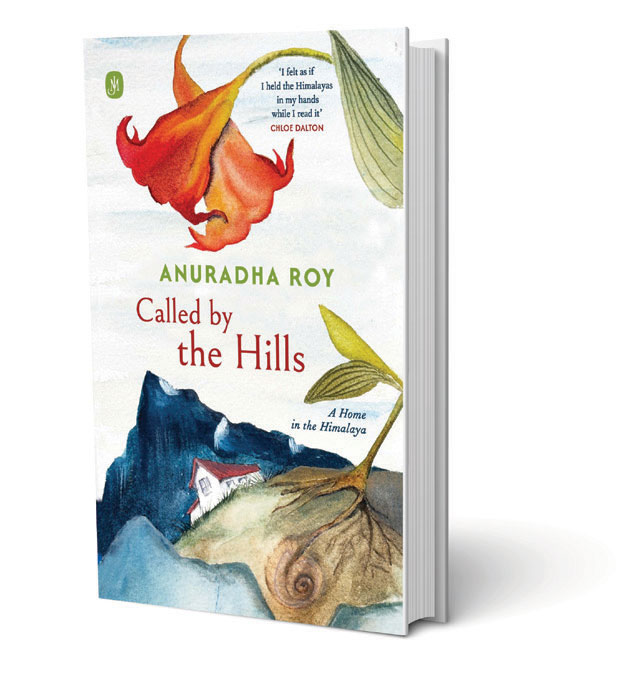
TOWARDS THE END of Called by the Hills, author Anuradha Roy mentions that she feels a kinship for the whistling thrush. It is an affinity that flows through her first nonfiction book, which chronicles her making a home and a career in Ranikhet. Like the whistling thrush, Roy has a melody that is all her own. It is a song borne from living in the mountains, fine-tuned by the glories and struggles of rarefied air and remote life. Like the thrush, Roy too prefers the solitary to the communal, she is always an observer and on guard. Like the bird she is “ever watchful” and “quick to fly off at the first sense of intrusion.”
Ranikhet is not new clay to Roy’s wheel. The Himalayan hill station features memorably in her novel The Folded Earth (2011). But this is the first time that Roy—a potter, painter, gardener, editor, illustrator— moves away from fiction and into nonfiction/memoir. In The Folded Earth, Ranikhet becomes a refuge for a woman battered by grief, the town both splendid and unpredictable. Roy writes in the novel, “Everything looks sharper-edged in the clear air, as if your bad eyesight has been inexplicably cured. Ferns fountain from rockfaces, flowers blossom on stone”. But it is also a place that reminds one of a human’s place and nature’s force, as “The monsoon in our hills is a time of thunder, lightning, water, and wind so endless that it has been known to push people into fits of rage.”
Zeroing In on ECI
09 Oct 2026 - Vol 05 | Issue 41
Constitutional legitimacy versus political opportunism
These twin elements of Ranikhet—a place of refuge and risk—emerge poignantly in Called by the Hills. When Roy and her husband R (Rukun Advani, a publisher and editor) first moved to Ranikhet and started their publishing house (Permanent Black) they could barely afford a second battery-lamp. Over 25 years they built a life, not by transposing urban amenities, and islanding themselves, but by coexisting—with scorpions and langurs, leopards and wild pigs, cowherds and watchmen, and other residents and not tourists. Theirs is not a life of luxuriating in a holiday home; instead they must cope with leaking roofs, bloodsucking leeches and prowling leopards that covet their beloved dogs.
Called by the Hills is distinguished by its beauty and the sense of transience. Roy’s watercolour paintings don’t merely accompany the text, they elevate it. It is rare to find a writer who is as accomplished an artist. Through her strokes we see a caramel-coloured dog snoozing on a sofa, and another one gambolling down the hills, we watch the swaggering Great Himalayan Barbet, the langurs swinging on a rhododendron tree, the locals who are as eccentric as they are wise, and bookending it all are the mountains. Peaks that loom and bless from a distance, peaks that Roy and her husband have no desire to climb.
Roy’s art might be postcard perfect, but in her writing, she constantly reminds us about the ferocity of nature and man’s assault, which has “wounded” the mountains. She writes, “From our garden we can see that the flanks of the peaks on our horizon that were dazzling white when we came to live here twenty-five years ago are bare and black now in summer. They are still white on the top, but the ice seems thinner, as if the mountains are ageing and balding.” This tonsure has occurred because of the felling of trees, the building of roads, the damming of rivers.
Called by the Hills is a book about the folds of earth. How tending to earth, creating mulch, sowing seeds, observing buds, schools one in patience. It is a book about respecting the earth and acknowledging that humans are only guests not owners on it. It is about the joy of feeling “clay bloom between fingers” and knowing that the leopards will lurk long after all traces of the house and humans on the hill have vanished.