Yayoi Kusama Dies at 97: The Woman Who Turned Terror Into Infinity
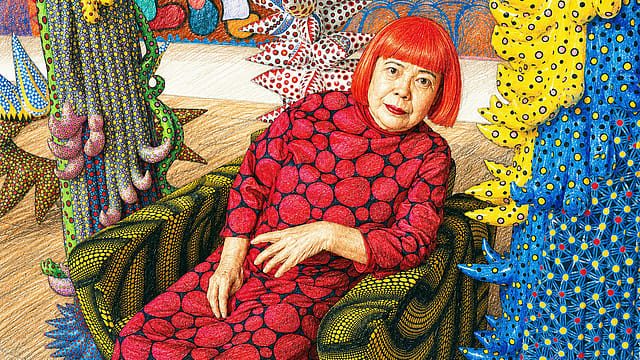
Yayoi Kusama spent much of her life seeing things other people could not. Dots flew through rooms. Flowers spoke. Patterns crawled across walls, ceilings, objects and her own body. The world would begin to multiply, swallow her and erase the boundaries of the self.
Most people would have tried to escape those visions. Kusama painted them. Then she sculpted them, wore them, performed inside them and eventually built mirrored rooms where millions of strangers could experience a beautiful approximation of what had once terrified a little girl in Matsumoto.
The Japanese avant-garde artist died at a Tokyo hospital on August 14, aged 97, the Yayoi Kusama Museum announced on August 27. No cause of death was disclosed. According to Reuters, she continued painting until her final days. Kusama leaves behind far more than polka dots and pumpkins. She leaves an extraordinary story of art as survival, repetition as rebellion and obscurity defeated by sheer, obsessive creation.

Zeroing In on ECI
09 Oct 2026 - Vol 05 | Issue 41
Constitutional legitimacy versus political opportunism
Who was Yayoi Kusama?
Born on March 22, 1929, Kusama grew up in a prosperous but deeply troubled family that operated a seed nursery in Matsumoto, central Japan. She began experiencing hallucinations as a child. Flowers appeared to speak to her. Patterns expanded until they seemed to cover everything around her. Drawing gave the frightening visions a boundary. If she could place them on paper, she could confront them. Her family did not nurture the escape. Kusama recalled that her mother tried to stop her from painting and pushed her towards marriage. She nevertheless studied Nihonga, a traditional Japanese painting style, at the Kyoto Municipal School of Arts and Crafts. Traditional instruction soon felt like another enclosure. Kusama wanted scale, experimentation and freedom. Japan’s conservative art establishment offered little room to an ambitious young woman who wanted all three. After corresponding with American painter Georgia O’Keeffe, Kusama left Japan for the United States in 1957, first reaching Seattle and then moving to New York in 1958. She arrived with limited English, little money and enormous intent.
How did fear become polka dots?
Kusama’s dots were never merely cheerful decoration. They grew from the hallucinations that had pursued her since childhood. Through repetition, she tried to overwhelm fear with form. A dot could be copied. A net could keep expanding. A frightening vision could be turned into a system over which the artist exercised control. Soon after arriving in New York, she began exhibiting her Infinity Nets: large canvases covered by thousands of small, repeated arcs. The Museum of Modern Art describes the series as an exploration of infinite repetition and space, but the paintings also carried the pressure of compulsion. Their surfaces appeared calm from a distance and almost feverish up close. Kusama called the larger process “self-obliteration”. By covering a canvas, chair, room, performer or herself in the same pattern, she tried to dissolve the individual into something limitless. The dot became her weapon against the ego.
It would later become her logo.
What did Kusama change in 1960s New York? Kusama entered the New York avant-garde when Abstract Expressionism was yielding ground to Pop Art, Minimalism, performance and installation. She refused to stay within any of those categories. She painted enormous canvases. She covered furniture with stuffed phallic forms. She staged nude happenings and painted bodies with dots. She organised performances against the Vietnam War. She made films, clothes, poetry and fiction. The Whitney Museum notes that her practice stretched across painting, drawing, sculpture, performance and immersive installation.
She also developed ideas that would become central to contemporary art. In 1965, Kusama unveiled Infinity Mirror Room: Phalli’s Field. Mirrors multiplied a landscape of red-spotted, stuffed forms until the installation seemed to extend beyond the room. The Smithsonian’s Hirshhorn Museum identifies it as the first time she used mirrors as a multi-reflective device, converting her earlier repetitions into an environment viewers could physically enter. The immersive art experience, now a museum staple and an Instagram genre, had found one of its great pioneers decades before the smartphone.
Yet Kusama watched male contemporaries achieve the recognition and commercial success that largely eluded her. Her experiments with repeated images, soft sculpture and immersive environments preceded or paralleled celebrated work by artists including Andy Warhol and Claes Oldenburg. Her place in that history would take much longer to secure. Race, gender, nationality and the art market’s preference for promotable male stars all worked against her. Kusama was visible, provocative and frequently discussed, but visibility did not become security.
Why did she sell mirrored balls at the Venice Biennale?
In 1966, Kusama appeared at the Venice Biennale without an official invitation and installed approximately 1,500 mirrored spheres on the ground.
She called the work Narcissus Garden. Dressed in a gold kimono, she attempted to sell the spheres to visitors for about $2 each under a sign offering their narcissism for sale. Biennale officials stopped the transaction, but Kusama had already made her point. The art world converted objects into prestige and prestige into money. She simply made the exchange embarrassingly visible.
Twenty-seven years later, the institution that had treated her as an interloper welcomed her back. In 1993, she became Japan’s official representative at the Venice Biennale. The Japan Foundation’s official Biennale archive described it as a triumphant return. The woman who once gatecrashed Venice had become the nation inside the pavilion.
Why did Kusama choose to live in a psychiatric hospital?
By the early 1970s, exhaustion, financial strain and deteriorating mental health had taken their toll. Kusama returned to Japan in 1973. There was no triumphant reception. To sections of the Japanese media and art establishment, she was better remembered for nudity and scandal than for the artistic ideas she had helped pioneer in New York.
In 1977, Kusama voluntarily entered a psychiatric hospital in Tokyo. She would remain a resident there for the rest of her life, travelling regularly to her nearby studio to work. That decision is often reduced to a dramatic biographical detail. In reality, it gave her life a structure. The hospital offered stability. The studio offered purpose. She moved between the two for nearly five decades.
Kusama spoke candidly about mental illness at a time when many public figures concealed it. But she resisted being reduced to a diagnosis. Art was neither a romantic side effect of suffering nor a miraculous cure. It was work, discipline and a method of staying alive. “What kept me from ending my life was drawing and making art,” she said in a 2014 interview recalled by Reuters. She did not conquer the hallucinations. She returned to the studio every morning and negotiated with them.
How did a nearly forgotten artist become a global superstar?
For years after her return to Japan, Kusama slipped from the centre of the international art conversation. The recovery began in the late 1980s through exhibitions that reconsidered her New York years and recognised how early she had anticipated installation art, feminist performance and Pop’s appetite for repetition. Her 1993 Venice Biennale presentation accelerated the revival. Major retrospectives followed. MoMA revisited her New York work in 1998. Tate Modern and the Whitney mounted sweeping exhibitions in 2012. The Yayoi Kusama Museum opened in Tokyo in 2017.
Then the crowds arrived. Her Infinity Mirror Rooms became cultural events. Visitors queued for tightly rationed seconds inside spaces where lights, pumpkins or suspended forms repeated into apparent eternity. Museums gained blockbuster attendance. Social media discovered an artist whose work had been immersive long before “immersive” became an entertainment industry.
The irony was exquisite. Kusama’s rooms had emerged from a desire to erase the self, yet millions entered them to photograph themselves. Commercial culture embraced her too. Her collaborations with Louis Vuitton placed dots across handbags, shopfronts and giant sculptures. Her yellow-and-black pumpkins became instantly recognisable public artworks. A woman once unable to earn a secure living from radical experimentation became a luxury-brand phenomenon and an auction heavyweight. Reuters reported that her 1959 painting Untitled (Nets) sold for $10.5 million in 2022.
Kusama’s popularity sometimes encouraged a shallow reading of her work. The dots looked playful. The pumpkins looked friendly. The mirror rooms supplied spectacular photographs. Underneath the colour, however, remained fear, compulsion, mortality and the terrifying thought that the individual could disappear into infinity.
Was her legacy free of controversy?
No serious tribute should sand away the difficult parts. Kusama faced renewed criticism in 2023 over racist descriptions of Black people in some of her earlier writings. She issued an apology expressing regret, while the San Francisco Museum of Modern Art publicly acknowledged both the harmful language and her response. SFMOMA said the comments ran against the values of inclusion and respect it sought to uphold.
The episode complicated the popular image of Kusama as a universal messenger of love. It did not erase her art, but it prevented admiration from becoming sainthood. Artists can enlarge the world and still carry its prejudices. A full legacy must hold both truths.
What did Yayoi Kusama ultimately give the world?
She gave contemporary art a new kind of infinity. Her work could be intimate as a hallucination and enormous as a universe. She collapsed painting, sculpture, fashion, performance and architecture into a single restless practice. She pushed viewers beyond looking at an artwork and invited them to step inside it. More profoundly, she demonstrated that repetition need not signal creative exhaustion. In her hands, doing something again became a form of endurance. One dot followed another. One net followed another. One day at the studio followed another. The dots did not make her demons disappear. They made the demons answer to her. Yayoi Kusama spent a lifetime trying to obliterate herself inside her art. Instead, she became unmistakable.
(With inputs from agencies)