Glitz and Clamour
Siddhartha Bansal compares history to poetry. Growing up in Old Delhi, the fashion designer discovered an early interest in historical stories and the architecture of ancient temples, forts and monuments. His latest collection, titled ‘World From Above’, translates this fascination into a style statement inspired by the mandapas and pillars, friezes and sculptures of Vesara temple architecture. Think jewel-toned blouses with intricately pleated sleeves; jackets with batua pockets; embellished jackets featuring architectural details; and a collision of prints, colours and textures on flouncy skirts.
Bansal was among over 30 designers who showcased their collections at the most recent edition of Lakmé Fashion Week (LFW) in partnership with FDCI (Fashion Design Council of India) this month in New Delhi. It has been half a decade since LFW and FDCI signed the joint partnership (2021) uniting the two fashion weeks; since then, the event has been hosted bi-annually between Mumbai and New Delhi. The latest edition arrived at a fragile time with the national capital bearing the weight of protests (as well as the frenzy of seasonal festivities). Hosted at Taj Palace, New Delhi—incidentally not far from where much of the protests were taking place—the event took an unsurprisingly apolitical stance, unfolding in a mix of shows that were great, good or bad; a few grand spectacles and plenty of room for improvement.
The week began not at the official venue but at the French Embassy on October 13 with the announcement of the R|Elan Circular Design Challenge (RCDC)—a mentorship platform for designers and innovators working in the area of circular fashion developed in partnership with Reliance Industries Limited’s, R|Elan™, the United Nations in India and Lakmé Fashion Week. While Designer Saurabh Maurya’s label MARGN emerged as the winner, and Yoshita 1967 by Anil Padia took home the runner-up prize, the real appeal of RCDC lay in its lineup of finalists. From biosequins and leather-off accessories to ensembles made from upcycled textiles (even towels), the runway pushed the boundaries of what fashion can be.
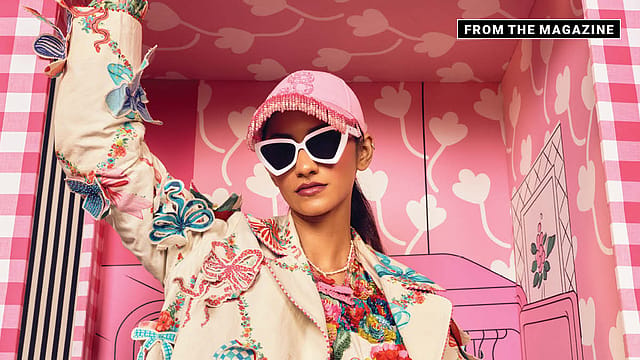
The following day, fashion week shifted to its official venue with an opening show by the fashion label péro. If the organisers wanted to follow one impressive opener with another, they couldn’t have made a better choice—péro is known for its immersive shows as much as its designs that combine Indian textiles with globally resonant style sensibilities. The label, founded by designer Aneeth Arora, has also clinched some most unusual collaborations, most famously a 2024 partnership with Hello Kitty. This season, péro showcased a collaborative line with Barbie for its Spring/Summer 2027 collection, drawing from an out-of-the-box metaphor and a profusion of pink that extended from the scenography to the clothing. The excesses of colour and merchandising make the show feel less like a péro experience and more of a Mattel-dominant brand
exercise (rather resembling the mood of the 2023 Margot Robbie-starrer Barbie). Yet, layered with the pink and the logomania, péro’s designs still made an impact with the brights handloom checks and stripes, experiments with mashru, Banarasi brocades and linens, and in particular a lovely new line titled péro Intimates.
ENSEMBLES BY SIDDHARTHA BANSAL

In a lineup that felt rather lean compared to previous seasons, only a handful of designers stood out—whether it was for style, spectacle or both. A large number of the shows are curated as multi-designer showcases comprising two to three labels who appeared consecutively. The GenNext show, an incubation programme for emerging label and always hosted as a multi-designer presentation, presented labels— Abhishek Chauhan Studio, Subbah and Day & Age. Chauhan rooted his collection in plant-based leather garments made using interlocking techniques by artisans who were previously domestic staff workers. Nimisha Diwakar of Subbah brought Batik to the runway while Day & Age by Shreya Parasrampuria and Sharan Adka upcycled vintage textiles with a serving of Kantha stitches.
Among other shows that stood out: Countrymade by Sushant Abrol presented a collection of easy menswear inspired by material memory. Imagining “what remains in a fabric after it has been worked, altered or worn”, it featured experiments in denim, reversible textiles, hand-coated surfaces, mineral treatments, embroidery and construction. Til by Ankur Verma juxtaposed the growth of moss with the human body in a collection titled ‘Still Becoming’ that showcased the designer’s texture-dominant practice and his use of repurposed materials and handworks. At HUEMN, designer Pranav Kirti presented a show visibly underpinned by politics—with models hurtling down the runway in athleisure as well as masks, hoods and more controversially, bruises. The clothing aside, which was signature HUEMN, the show’s success lay simply in that it provoked post-show conversations and debates.
Backed by sponsors R|Elan, HUEMN got a solo spot this season. It is worth noting that a majority of the solo shows were sponsored fixtures. There was of course péro as well as the multi-brand beauty store Tira. Samant Chauhan presented a collection with a desert-inspired colour palette in partnership with Jaisalmer Crafted Bar Collectibles. Namrata Joshipura’s party-ready lineup was backed by OPPO, Ashish N Soni partnered with Arvind, and Anushree Reddy was in association with Lakmé Salon.
For a showcase backed by NEXA, Manish Malhotra presented a luxe prêt collection with his signature glamour in curve-hugging saris, corsets with draped skirts and cocktail ensembles for women as well as menswear featuring ornate jackets with draped bottoms and roomy trousers that perhaps imagined themselves as silk pyjamas. The grand finale—always backed by Lakmé and usually spotlighting one of their collections—this season also went to a couturier’s ready-to-wear line, AM:IT by Amit Aggarwal who translated his signature techniques and material interventions into texture-rich prêt.
Big budgets make for banger shows. A sponsored slot is highly coveted, offering designers the scope and scale to think big. But brand stories are increasingly overshadowing collections—not only in shows or design concepts, but in press communication as well as on social media platforms. Designers also need to offer more information and details on their collections, and what makes them worth a conversation—and not just lean on visual appeal and influencers or celebrities.
In tandem, the multidesigner show format also deserves a rethink. It may be efficient in terms of time and costs but needs designers to be paired thoughtfully. A good group show this season, apart from the GenNext show, was ‘The Fifth Season: A Fashion Story from Ladakh’. Combining fashion with crafts, and bringing artisans on the runway with models, the show presented four designers and artisanal brands: Namza by Padma Yangchan, Zilzom by Stanzin Palmo, Changra Ladakh by Deskit Angmo and Charkha Ladakh by Rigzin Yangdol. The Ladakh show had a regional advantage but it was also stitched together by the show direction, set design and other details.
Such threads of coherence were missing in other group shows. But collections presented back-to-back, in a matter of seconds, with completely opposing sensibilities in music and aesthetics have a dissonant effect. With the format unlikely to disappear, anything less than meticulous curation is a disservice to the designers.
India is a booming fashion market both in terms of domestic expansion and international positioning—with designers showcasing at global red carpets, runways and retail locations. Yet, more than 25 years since its inception, the Indian fashion week remains a largely homegrown entity. There is a lack of consistency with designers shuffling each season, which rarely happens at fashion weeks abroad. There is also no seasonality although many of the participating labels are ready with collections six months ahead. It is more valuable for designers, especially those catering to the global market, to find their runway opportunity at the right time. If there are brands that don’t adhere to the same calendar— Indianwear and occasionwear, for instance—they can be categorised more distinctly. In the absence of these strategies, the season fails to offer a larger perspective that goes beyond individual shows. If the Indian fashion week must find its place among the world’s style capitals, it will have to stitch together style and substance.