Jogen Chowdhury (1939-2026): Hues of a Humanist
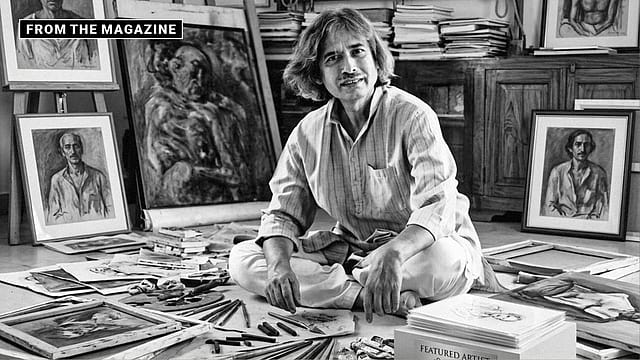
Jogen Chowdhury's vision was darkly beautiful— even sensual—yet it hovered on the edge of a nightmare. His world was riven by occasional violence. But he reserved his biting satire for the corrupt, the degenerate and the damned who were manifested as grotesque and pervy politicians and businessmen. The greenery, vegetal forms—mostly giant gourds echoing the sagging human torsos suggestive of earthen pots—and undulating creepers of his childhood spent in rural undivided Bengal surfaced in his works but mostly as organic forms divorced from romanticism. “The powerful drama of the human situation has always engaged me. And when I do take images from nature like creepers, etc, I exploit their tactile physicality to recall the human form,” Chowdhury had said in an interview.
His art unmistakably originated from Bengal for he drew heavily on traditional and even folk forms of expression such as patachitra, decoration like the alpona and Indian miniature paintings as well. Yet, it is obvious that he kept the windows of his mind open, allowing fresh ideas to waft in and refresh and transmute his aesthetic sensibility. His work has a boundless appeal. Which is why his work performs so well at international auctions and often fetches record prices. Chowdhury, who died on October 25 at the age of 87, belonged in the same league as his contemporaries Bikash Bhattacharjee, Ganesh Pyne and the 90-year-old Ganesh Haloi, whose genius was recognised beyond the confines of Bengal and the country, and who had given the younger generation of artists of Bengal a sense of direction.
Chowdhury could empathise with his subjects but he could also observe them critically from a distance. He was basically a humanist, he said once, and this explains why he chose figuration over all else. Human beings, their minds as perverted as their bloated, flaccid, twisted bodies that defied the rigid rules of academic drawing occupy his tenebrous world. His impeccable academic drawing skills he had inherited from years of training at the Government College of Art & Craft, Kolkata. Feminine beauty lured him and women with the ripe physicality of Yakshinis of yore were part of the oeuvre of iconic images he created. His drawings often had the gravitas of the works of Jean-Auguste-Dominique Ingres but their curvaceous bodies had a rhythm that was uniquely Jogen. They seemed to have emerged from a dream world that was so quotidian yet magical as well.
Defying all artistic and market trends that rule the art world of India and beyond, Chowdhury’s arts remained supremely figurative although he took the liberty of challenging the human anatomy in keeping with the ideas and emotions he wished to convey. “I feel figuration is extremely important because, first, the figure offers the possibility of distortions,” Chowdhury had said, adding: “It can be reduced to semi-abstract and abstract terms. And such reinvention of figuration can lead to an original, individual idiom”.
Chowdhury was born on February 15, 1939, in Daharpara of Faridpur, now in Bangladesh, to a Brahmin zamindar family. Several members of the family lived under one roof. Both parents were artistically inclined and his father, Pramathanath, occasionally made Durga and Saraswati images. His mother, Indu Debi, made beautiful designs on cloth. He had four brothers and two sisters. Chowdhury grew up amidst the abundance of trees and flowers that flourished in the village. Hindu festivals were celebrated all over the year and jatras were performed. He noted that Hindus and Muslims lived separately but otherwise shared harmonious relations. Even after Partition when the Chowdhuries left for Kolkata there was no personal animosity between the two communities.
As a child he went to a village school (pathshala) and devoured the fantastic illustrations in the heavy Ramayan and Mahabharat tomes that his family possessed. He later said that the village and his childhood “are alive in my mind as I work.”
During Partition, there “was no Hindu-Muslim tension”. Which perhaps explains his outrage at the Gujarat riots of 2002 that manifested in his work as a succession of brutalised supine bodies, faces contorted with rage and disembowelled pregnant women. In Kolkata he joined a Marwari school in Bhabanipur (Bhowanipore) and unlike most children did not mind studying. Later he joined another school in Dhakuria. His academic career was quite steady, but art had no place in it. He started sketching only after he decided to join art college in 1955. However, he was an avid reader and took a lifelong interest in literature and cinema, publishing his poetry till late in life. In Dhakuria, they lived in Sahidnagar colony with other educated refugees. Left politics dominated the area and his elder brother was a party member. However, life in the colony was hard and they had no electricity at home. When he practised art in the evening he was compelled to do so by the light of a hurricane lantern. This left a lasting impression of gloom on his art emphasised by the intricate cross hatching with pen and ink that became a hallmark of his work. He began painting on newsprint, and that was when black became the dominant note of his work. Like many of his classmates he found it difficult to buy art material.
Chowdhury graduated from the Government College of Art & Craft in 1960, and started participating in various art activities and exhibitions. He meticulously documented all the work he did and kept a diary as well. This helped when his first retrospective was held at Kala Bhavana, Santiniketan, in 2013. In his early youth he had done some powerful drawings of refugee women and children, who had turned the platforms of Sealdah railway station into their home. It had turned hellish with the stench of rotting food and excreta. His unerring draughtsmanship skills were quite obvious even then and figuration was infused into his work. Chowdhury had around the same time executed a series of fine portraits of himself as an angry young man with an angular face and intense, glowering eyes. He had designed an abundance of posters to celebrate various festivals but there was no market for paintings yet. Käthe Kollwitz and Degas impinged upon his artistic sensibility. By the time he graduated he had already started questioning certain aspects of communism before becoming disenchanted later.
In 1965, when Chowdhury was with the Handloom Board in Kolkata, he was awarded a French government scholarship for higher studies at L’Ecole Nationale Superiere de Beaux Arts in Paris for two-and-a-half years. His drawings acquired a distinctive European flavour but at the same time, saw the emergence of the flabby, chunky torso that became associated with his work.

After returning to India, for one whole year he was entirely engaged in contemplation and taking down notes on art. He was not 30 yet. Chowdhury joined the Weavers’ Service Centre in Chennai, and in 1972 he shifted to Delhi to take up the job of curator at Rashtrapati Bhavan. In Delhi his “perspective broadened” and his work reflected contemporary life. He painted Tiger in the Moonlit Night during this period. The tiger was a puppet for he felt that the reasons cited by Indira Gandhi for the imposition of Emergency were fake.
In 1987, Chowdhury joined Kala Bhavana at Visva Bharati, Santiniketan as a Reader. He had briefly taught at a school in Howrah, but this was the first time he was interacting with senior students and came in contact with that rare individual, KG Subramanyan popularly known as Manida. Santiniketan acted as a stimulant and lines began to play a more pronounced role in his compositions. His works turned into expansive, often monochromatic drawings marked by the fluidity of lines that enhanced the sensuousness of his works and quickened their pulse. Chowdhury did not believe in any hierarchy when it came to his work, and for him drawings with pen, ink and pastels were as vital as paintings. “Paintings and drawings involve the same degree of freedom and the same degree of alertness…I don’t think it is correct to assume that paintings must be more ‘finished’ and drawings don’t have to be so,” he would say.
Later he became Head of Painting and then principal of Kala Bhavana from 1997 to 1999. During his tenure, he broadened the aesthetic and intellectual outlook and capacity of Kala Bhavana and would invite artists like Vivan Sundaram and Atul Dodiya and art critics of the stature of Geeta Kapur. He retired in 1999. His official work was becoming burdensome and he needed to focus on his own practice. At a later stage, the title of professor emeritus was conferred upon him by the university.
Throughout his career as a teacher, he had championed the cause of students and budding artists, and in 2019, opened Charubasona, the Jogen Chowdhury Centre for Arts, in Kolkata, a much-needed dedicated centre for display and research.
Chowdhury was known to be an activist and joined protests that he felt would threaten Santiniketan’s environment. Later he became involved in the Singur and Nandigram movements, protesting against the Left Front government’s land acquisition policies. In 2014, former Chief Minister Mamata Banerjee sent him to the Rajya Sabha—a phase of his life many find questionable. Even then, he maintained a Parliament Diary in which he captured the many moods of parliamentarians in his sketches.
Soumitra Das is a journalist based in Kolkata. He is the author of, among other titles, A Jaywalker’s Guide to Calcutta and White & Black: Journey to the Centre of Imperial Calcutta