What’s on Your Plate?
Funny video which did the rounds on Indian social media a few years ago tells us what is wrong with the way an average Indian thinks about food. It shows a man telling his wife that since he is fasting, she should prepare only a few “light” items. The list that follows makes it less a fast than a small carnival of carbohydrates. One dish after another arrives, enjoying the protection of vrat ka khaana, but which, when added together, amounts to not only calorie surplus but also a dietary pattern increasingly associated with conditions such as diabetes, obesity and cardiovascular disease. The joke, of course, is that the man believes he is eating lightly. The camera knows better.
But remove the question of whether a food item is permitted during a fast and ask a different question: How much carbohydrate, fat, and energy is actually on the plate? The middle-aged man who displays his plate of dal-chawal to show how frugally he eats has no idea as to what a healthy portion of rice is. Perhaps he also believes that all his protein requirements have been met with that dal. But he is far from an ideal diet and is clueless about it.
Zeroing In on ECI
09 Oct 2026 - Vol 05 | Issue 41
Constitutional legitimacy versus political opportunism
“An Indian plate is typically 70 to 80 per cent carbohydrates,” says Shashi Iyengar, a metabolic health coach. “It used to be okay because most of us performed a lot of manual work. But with sedentary lifestyles and the entry of ultra-processed foods, we are now staring at a health nightmare.”
In the last few years, a new science of eating has evolved, which goes much beyond the old vocabulary of “healthy” and “unhealthy”. Instead, it asks more nuanced questions like composition of a meal and the timing of it. From an Indian perspective, this acquires much more significance because for us the rules of eating have remained almost insultingly simple. Our traditional meals are being eaten in a country undergoing a rapid dietary transition while diabetes, abdominal obesity and cardiovascular disease are appearing with increasing frequency. This has been a country where, till recently (and maybe even now in some cases), on being asked for advice on diet, a doctor would simply say: Ghar ka khaana. At one level, it makes sense because home-cooked food is always better than the terrible food one eats outside. But looking at how metabolically compromised Indians are becoming, this advice may not be enough.
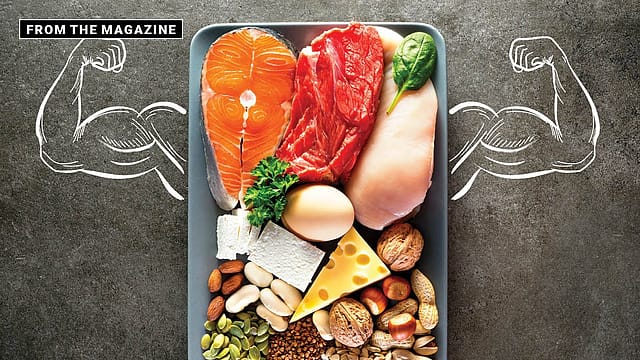
A large analysis of the ICMR-INDIAB survey, published in Nature Medicine in 2025, looked at dietary data from over 18,000 Indian adults. It found that carbohydrates supplied about 62 per cent of Indians’ daily energy while protein supplied only 12 per cent. Much of the carbohydrate came from refined cereals, including white rice, and from added sugar. The researchers found that higher carbohydrate intake was associated with greater odds of type 2 diabetes, pre-diabetes and obesity. Replacing some carbohydrate with protein was associated with lower odds of diabetes and pre-diabetes.
“Protein is so ingrained in Indians as cultural belief. Even people who eat meat, when they come to me, they will ask for a vegetarian plan,” says Iyengar. “A majority of Indians who say they are non-vegetarian are hardly that, because two pieces of meat a week is not really consuming meat,” says Shraddhey Katiyar, a doctor-turned-clinical nutritionist. Of course, one can be a vegetarian and still meet daily requirement; but for that one needs to be nutrition-literate, which most Indians are not. An average Indian still thinks that consuming a bowl of dal is enough for protein.
Katiyar, 39, learnt this lesson himself, the hard way. In 2013, his father, who was just 59, died due to complications arising out of diabetes. In medical college, Katiyar’s weight began to rise. His blood test report put him in pre-diabetes category. A senior doctor in his department immediately put him on medication, attributing his pre-diabetes to genetics. But Katiyar remembered his grandfather who, till he died at the age of 95, had not needed any medicine. Gradually, Katiyar understood what had gone wrong. When he was in primary school, his family had moved to the city. In a few years’ time, his father had become obese.
Katiyar immediately made amends. From samosas, he shifted to eggs. He started working out. In no time, all his parameters turned normal. “It’s a pity that there is hardly any education on nutrition in India. The food industry and pharmaceutical industry are benefiting from each other,” he says.
So, what is to be done? A few simple things. To begin with, an understanding that for much of human history, eating was less frequent than it is now. There were no concept of breakfast, and no alarm, except sunrise. One ate when one felt hungry. There was no refrigerator or supply chain to make food permanently available. With the advent of the supermarket, packaged food has abolished much of the effort once required to prepare a meal. Many of us are constantly snacking. One look at the street food that many Instagram influencers are pushing, one would immediately get a sense of why our health parameters are way beyond normal limits. Coupled with non-existent food quality standards, even big companies advertising “zero-sugar” and “zero-fat” snacks are simply lying to us. That is why we must now learn to read food labels and also be able to read a plate. Is the meal too large? Does it have a balanced mix of protein and fat? Are we really hungry or are we eating because we are bored and we can ‘Blinkit’ a packet of “healthy” chips?
Then there is timing. The evidence around intermittent fasting and time-restricted eating is still evolving, but it is wise to give the body a reasonably long overnight break from food.
The other important thing to remember is that after a certain age we start losing muscle mass. After about the third decade of life, the body begins to lose muscle progressively unless something is done to preserve it. The rate varies enormously between individuals, but the direction is unmistakable: age makes muscle harder to build and easier to lose. So, walking for 30-40 minutes, which most consider an adequate exercise, is just not enough. Strength training a few times a week builds muscle that absorbs more glucose, which is a starting point for maintaining metabolic health. Less the muscle mass, more disease. A useful way of thinking about this is as a water tank. If the tank is large, a sudden influx of water can be absorbed without the level rising too dramatically. If the tank is small, the same amount produces a much sharper rise. Muscle, in this analogy, increases the body’s capacity to deal with glucose. It is not only about the fat one sees outside but also the visceral fat that one needs to target.

“We have to now change everything. What is the promotional poster in a gym? It’s that of a body builder. We have to change that to an ageing woman working out,” says Katiyar. Apart from that, other small interventions could be done as well. Like taking a walk instead of going straight from the dining table to the sofa. Research increasingly suggests that even brief bouts of movement after eating can blunt the rise in blood glucose that follows a meal. Ten or fifteen minutes around the neighbourhood may not look like exercise, but muscles do not care what we call it.
This does not require a return to some imaginary India in which everyone ate perfectly. Traditional Indian diets contained their own excesses: sweets, fried food and enormous quantities of starch. Nor is modern nutrition asking Indians to abandon their food and replace it with salads, smoothies and imported notions of wellness. The dal, the sabzi, the curd, the roti, the rice, and the occasional sweet can all remain. What needs to change is the proportion, the frequency and, perhaps most of all, our understanding of what constitutes a meal. The new science of eating does not ask us to return to an imagined past; it asks us to become conscious about the present. It means eating less of the thing that dominates the plate and adding something that is missing. It means sitting down while eating, and eating slowly, finishing dinner early and walking afterwards.
Perhaps we must also, for once, leave the word ‘diet’ out of it, which suggests a temporary period of restriction, followed by the return to ordinary life. The more interesting possibility that science now offers is that ordinary life itself can be adjusted.
It means the Indian kitchen needs no reinvention; it is the plate that needs rearrangement.