The bread nobody dares throw away: Why Uzbekistan’s ‘non’ is going viral online
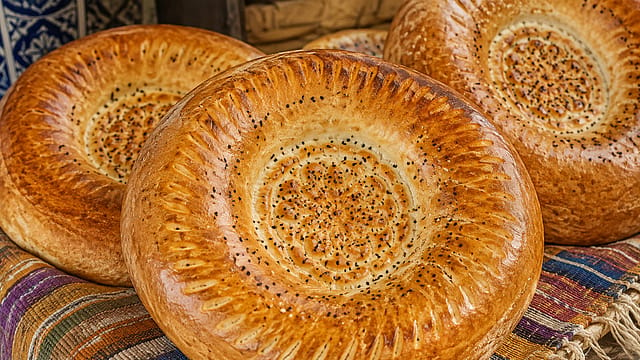
What if your daily bread came with its own artwork?
Imagine walking into a bakery and finding loaves that look less like food and more like something carved by hand.
Circular patterns.
Sunburst designs.
Intricate stamps pressed into the dough.
Rows of golden-brown bread stacked like edible sculptures.
That was the scene that stopped travel creator Ankita Kumar in her tracks during a trip to Uzbekistan. In a video that has been making the rounds online, she called Uzbekistan's traditional non "the most beautiful bread in the world"—and after seeing it, many viewers seemed inclined to agree.
But the real surprise wasn't how the bread looked.
It was how people treated it.
Why is Uzbekistan's non different from ordinary bread?
In most countries, bread is something you eat.
In Uzbekistan, it is something you respect.
Known as non (a linguistic cousin of the word "naan"), the traditional bread is baked in clay tandoor-style ovens called tandirs and can be found everywhere from bustling city markets to roadside bakeries. What makes it instantly recognisable are the elaborate patterns stamped into its centre before baking.

Zeroing In on ECI
09 Oct 2026 - Vol 05 | Issue 41
Constitutional legitimacy versus political opportunism
Those patterns are created using a special tool called a chekich—a bread stamp covered with tiny metal points that leave geometric and floral designs on the dough. The stamp is not merely decorative. It helps the centre remain flat while the outer ring rises and crisps up in the oven.
The result is a loaf that looks like a cross between bread and folk art.
Why are people fascinated by the bread stamps?
Because every stamp tells a story.
According to Ankita's video, different cities across Uzbekistan have their own distinctive bread styles, and locals can often tell where a loaf comes from simply by looking at the pattern pressed into it.
Travel writers and food historians have noted that regional varieties of non differ in size, thickness, texture and design. In cities such as Samarkand, Bukhara and Tashkent, bread carries unique visual signatures that have been passed down through generations.
Think of it as a passport stamp.
Except the passport is bread.
Why do Uzbeks never place bread upside down?
This is where the story becomes fascinating.
In her video, Ankita explains that locals consider it bad luck to place bread upside down. She also says that if bread falls on the ground, people often pick it up immediately and treat it respectfully rather than discarding it.
That isn't just a modern custom.
Multiple accounts of Uzbek food culture describe bread as a symbol of life, hospitality and blessing. Traditional etiquette discourages wasting bread, placing it face-down or treating it carelessly. In many households, bread is broken by hand rather than cut with a knife.
One travel writer in Uzbekistan recalled being stopped while brushing crumbs off a table because, as a local gently reminded him, "Bread is sacred."
How important is bread in Uzbek culture?
Important enough to appear at nearly every major life event.
Ethnographic records and cultural studies show that bread plays a role in weddings, family ceremonies and traditional celebrations. In some customs, bread is used to bless newlyweds. In others, it symbolises prosperity, protection and family unity.
A common saying in Uzbekistan is that no table is complete without bread.
And if you spend even a few days in the country, you'll understand why.
Non is everywhere.
Markets sell it.
Families share it.
Travellers photograph it.
And locals talk about it with genuine pride.
Why did the internet fall in love with this bread?
Partly because it looks incredible.
But mostly because it feels like the opposite of modern fast food.
In a world of factory-made slices wrapped in plastic, here was a loaf that carried the fingerprints of the baker, the traditions of a city and the identity of a culture.
Under Ankita Kumar's viral post, viewers marvelled at the craftsmanship, with many saying they wanted to try bread from every region of Uzbekistan. Others simply couldn't get over the patterns.
One comment summed it up perfectly:
This isn't bread.
It's edible architecture.
The bigger story: Sometimes a loaf tells you more than a monument
Most travellers visit a country looking for famous landmarks.
A palace.
A museum.
A historic square.
But occasionally, the most revealing thing about a place is sitting quietly on a bakery shelf.
Uzbekistan's non is not famous because it is expensive.
Or rare.
Or difficult to find.
It is famous because it transforms something ordinary into something meaningful.
A loaf of bread becomes a piece of art.
A meal becomes a ritual.
And a simple bakery stop becomes a lesson in how a culture sees the world.
Not bad for something made from flour, water and fire.