Saving Face: With his new wall reliefs, G Ravinder Reddy asks whether an image needs volume to feel monumental
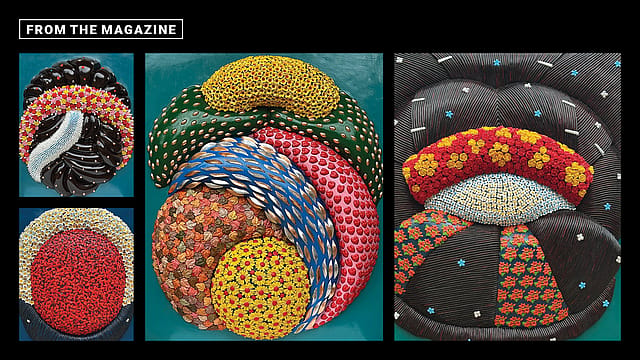
G Ravinder Reddy spent four decades making faces too large to forget. The monumental female head that became his signature—kohl-eyed, brilliantly coloured and elaborately coiffed—has now been flattened into relief. In four reliefs completed over the past year-and-a-half, the face has disappeared altogether. What remains is hair, coiled, heaped, combed into waves, pinned with jasmine and marigold and red hearts, swelling from the frame.
Many viewers first see a beautiful juda. Some see waves, seasons, a snake, the kitschy hair ornaments their daughters wear. Reddy collects such readings and misreadings. When the first heads were shown outside India at the Asia Society in New York in the 1990s, some viewers saw monsters. “For some people it looked like the devil,” Reddy says, still amused. An Indian child who has frequented temples may not find a giant face strange. Someone without that visual inheritance may experience the same face as an intrusion. “It is how you have grown up, what you have encountered,” he says at Gallery Sumukha in Bengaluru, marking its 30th year with an exhibition by Reddy that departs from his usual work. The eight works presented as part of In Search of the Perfect Image span 15 years, from a terracotta head made in 2011—small enough for Reddy to personally carry from his Visakhapatnam studio—to the reliefs completed this year. Between them are Portrait of Parvati, a painted fibreglass head more than five feet tall, a smaller gilded head and a blue nude acquired by Sumukha gallerist Premilla Baid at an earlier Bengaluru exhibition.
Losing Memory
16 Oct 2026 - Vol 05 | Issue 42
The making of a medical and social emergency
The vanishing face is only the beginning. The hair too will become more abstract, invoking flying tendrils, he tells me. Later this year, he plans to show screen prints in Delhi, pressing his imagery flatter still. For an artist associated with the physical encounter of sculpture, with objects that occupy a room almost forcefully, this seems, at first, like a retreat from his own territory. But Reddy is not abandoning the monumental woman. He is testing whether her presence can survive the passage from mass to surface.
When Baid told Reddy she wanted to begin Sumukha’s 30th anniversary year with his show, he demurred. There were senior artists in Bengaluru who had worked with her longer and he did not have a body of new work ready. Baid persisted. “I included the terracotta work, the gilded head and the nude in her collection to present a variety from within my work over the years.” He had produced relief works in the past, but they were all faces. There was another practical reason for turning to the wall. “A lot of people wanted to buy, but they said we don’t have space for three-dimensional work. We have wall space,” he says. Reddy’s heads are famously difficult to house. They require a courtyard, a corporate lobby and the willingness to share a room with a face the size of a refrigerator. The relief offered a way through the collector’s door. “I said okay, I should do reliefs so that I can fill that gap while keeping my own integrity.”
For Reddy, monumentality has never been quite the same thing as size. Size helps, and he has loved it since his years as a student in Maharaja Sayajirao University (MSU) Baroda, when he worked with such appetite that a professor accused him of using up everybody’s clay. He found the money to buy his own. “I was very young and energetic. I wanted to use the entire length of my hands. I wanted to hold it, go around it.” Just like a large Nandi at a temple invites you to circle and touch it, towering over the body and encompassing it, large sculptures can imprint the image in your head more easily, he says. But monumentality, he clarifies, is not a measurement of the object but the size of the space it occupies in memory.

Consider the terracotta head and the Portrait of Parvati. One is 13 inches tall while the other rises above the viewer. Yet the smaller head possesses the same calm, frontal stare, the full cheeks, heavy lids, and the refusal to look away. The large blue head gains ceremony from its scale. Marigolds banked along its hairline become a crown. Its widened eyes meet the viewer from somewhere beyond ordinary portraiture. But each is meant to produce an afterimage larger than itself.
Terracotta breaks. Reddy has had sculptures returned in fragments after a child knocked one over in somebody’s home. He talks about the accident without sentimentality. “The sculpture may break but the image should stay on. When we visit a museum we don’t carry the work, we carry that image in our lives. If we go to Egypt, or to Ajanta, we carry the entire experience with us.” The object belongs to a collector or a museum. The image belongs to whoever has seen it. Once that distinction is understood, Reddy’s movement towards relief and print begins to make sense. He has always been more loyal to the image than to the prestige of the object. It was this loyalty that led him to polyester resin. In Baroda during the 1970s, sculpture meant bronze, stone or wood. The stone was expected to be marble or granite and the wood polished. Conversation clustered around the nobility of the material. “Are you looking at the material or are you looking at the image? Most of them were talking about the material,” he says. “I took up a material which has no aesthetics. Plastic was not considered an art material. It has no colour, no texture, no intrinsic value. I said, I will work on this and I will create an image.”
When he started using gold to paint his fiberglass-and-polyester resin images in the 2000s, it was with the intention of making material serve the image. Gilding enhances volume. Light travels over it differently from matte colours, turning a static surface into something that seems to alter as the viewer moves. It also confers preciousness, allowing the heads to drift towards the sacred without becoming religious objects. Viewers supplied associations Reddy had not consciously placed there. “Indians use turmeric on their skin, and yellow reflects turmeric, people told me. This is how I keep enriching my worldview.”
Portrait of Parvati is not a portrait in the conventional sense, although the name invites familiarity. “One, it is an identifiable name, your wife’s name or your mother’s name. At the same time it is also a goddess’ name. It enlarges interpretation.” The blue skin holds both possibilities. Parvati is dark-skinned in the texts, and darkness is often translated into blue in Indian visual culture.
Sridevi, the blue nude in Baid’s collection, is unclothed rather than undressed. What interests Reddy is not nakedness so much as the prejudice that arrives in the room before the naked body does. “When people look at a bigger unwrapped figure, they have various things in the mind. I presented a work where you don’t come across those prejudices about undressed women.” He harks back to the temples his parents took him to as a child, where bodies without drapery were not furtive or pornographic. “So why are we objectifying unnecessarily? There are ways to present nudes so that society will accept them. That is where the artist’s role is.”
The new reliefs contain a more radical subtraction. The face was the centre of his sculptural authority: the place from which the woman looked back. That authority now migrates into the hair. The coils push out from the wall, crowded with individually modelled buds, leaves, roses and metallic petals. On one panel, hair is combed into ridges so that it resembles wood grain, then gathered into overlapping loops. A crescent of red and yellow flowers rests above a field of jasmine. On another juda, yellow flowers give way to dark green lobes studded with copper leaf, a blue band scaled with metallic petals, a pink rope crowded with red hearts, and a heap of leaves in russet, ochre and grey-green. Viewers see the year turning through it. Reddy did not begin with seasons. “I wanted to do all colours and I wanted to use autumn leaves. It started with that. Then I said, in contrast, I will do spring.” The red hearts came from children’s hair accessories—perhaps his own granddaughter’s.
Hair permits a slippage between the intimate and the abstract. Seen from a distance, it is part of a woman. Enlarged and detached, it becomes a different form. “When you see a woman’s hair and it is flying as she is riding on a scooter, take a close up photo and you will see abstract forms, shapes. So the scope is endless.” Hair is also a record of the time women spend arranging how they will appear before the world. Reddy thinks of the two or three women who work in his studio. “Out of whatever they earn, they take out a little money, they buy flowers. They know they are coming to a place where there is dust, and yet, they make the effort to look their best.”
Everything the face held—composure, abundance, directness—has moved into the hair. Shringar is no longer supplementary to the image. Flatness also makes colour work harder. On the monumental heads, pigment follows and amplifies volume. In the reliefs it must help create volume against the fixed plane of the wall. Reddy retains the primary colours that have defined his work. “In our culture, we have used primary colours extensively: on our saris, in our temples, in our folk art. They are available in oxides and natural dyes, and they are cheap, available in any corner.”
The movement from the head to the juda, and towards the screenprint, is not the sudden turn it might appear to be. Reddy has shown that monumentality can survive reduced scale. The prints will remove projection, shadow, and perhaps even the singularity of the object. And the head will lose the last of its physical weight. “Whatever I make, my only concern is that I should leave behind a work which sustains on its own strength,” he says.
In Search of the Perfect Image is on view at Gallery Sumukha, Bengaluru, till October 3, 2026