Photography to Painting: Sohrab Hura’s Ways of Seeing
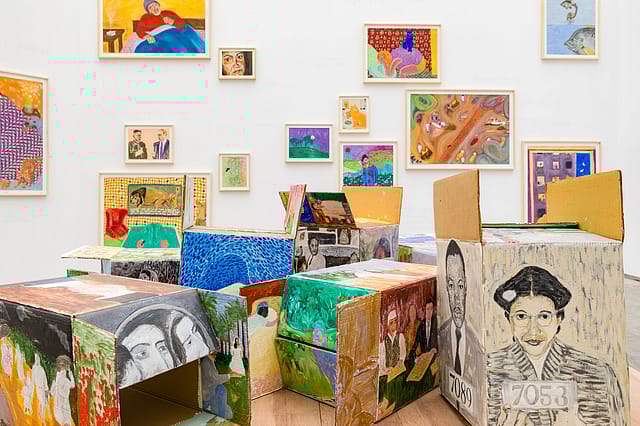
Walking into Sohrab Hura's exhibit, The Forest, in Experimenter art gallery in Kolkata's Ballygunge Place, the first thing I notice are the bursts of colour on the canvas. Every work spills over with character and meaning, though not all are as sombre as that description might suggest. Hura balances moments of intimacy with the viewer's othering gaze, and humour with seriousness, seamlessly blending these supposed juxtapositions in his art.
Hura's third solo in Kolkata, on view until January 3, 2026, The Forest is part of two exhibitions put up by Experimenter; the other, A Winter Summer, concluded in December and showcased the medium via which Hura first made his mark—photography. It marked the India debut of two significant works, Snow and The Song of Sparrows in a Hundred Days of Summer, which show the social, economic and political realitiesin Kashmir and Madhya Pradesh respectively through opposite, changing seasons.
Losing Memory
16 Oct 2026 - Vol 05 | Issue 42
The making of a medical and social emergency
Hura's paintings and drawings, which he started doing during a bout with long Covid, are heavily stylised—the perspective is flat, with dollops of light dotted throughout the works. In The Forest, the paintings are displayed in an almost collage-like framework, stacked on top of one another, each jostling for space with the next. A feast of visuals include private moments with his parents, in sickness and in health; gently humorous memes (a kitten labelled as “a bit fat but otherwise lovely and very talented”); and moments of deadly violence, such as the demolition of the Babri Masjid. It’s almost an approximation of the social media feeds that dominate our lives these days—bits of laughter interspersed by visions of genocidal terror.
Born in Chinsurah in West Bengal to a Bengali mother and a Punjabi father, Hura had a nomadic early childhood, moving around India before finally settling in Delhi, and even spending some time at sea with his father, who was in the merchant navy. Has this patchwork history influenced his art? “I’ve always wondered about this connection because, not having any one place and identity that one embraces proactively, I feel like I always had a lot of distance between me and my life,” says Hura over a Zoom call. “And that distance I feel also allowed for gauging things differently…(it helped to build) that distance which I feel very comfortable looking at things from.”

This is perhaps also why he prefers collage-like arrangement for his artworks. He says he wants to “disarm” the viewer and undercut any preconceived notions they may have come in with. “The history of the way in which you've experienced exhibitions is one where we kind of walk along the walls—there's a linearity to that way of engaging. But I always wanted my exhibitions to make someone move a little differently.” He also captions his paintings longhand. “Writing is a different kind of gesture, and mark-making is important to me,” he explains. “Someone might see that I hesitated to write a word, and I might have scratched it out, and written something else, as opposed to say, having a printout, like a very sort of institutional, perfect, sanitised tag that nothing else can contaminate.”
Illness has punctuated Hura's life; he was a caretaker for his mother, who suffered from schizophrenia and is now looking after his father through chemotherapy. And, it was long Covid that started his tryst with drawing and painting, when he was unable to go out into the field for photography. “I began with just trying to feel visible,” says Hura, recounting how lucky he felt to be able to "express something… as someone who’s able to make work around illness, not just for ourselves but to have someone else come and tell you that you're not alone.” There's something lonely within illness, he says, whether you're caring for someone or going through it yourself. Does Hura's art, then, operate from a place of feeling alone? Certainly, in some of his larger or more pensive works—ones that show two individuals, perhaps lovers, perhaps friends, or something else entirely, wrapped in an embrace; or close-ups of his parents' faces—there is a great sense of isolation: a happy one for the lovers, a quieter one for the others.
But he refutes this immediately. For Hura, isolation is not the impetus for creation. “I think what I’m looking for is to constantly be in touch with the feeling of vulnerability, because I think that keeps me a bit alive,” he says, of his change of artistic mediums relatively later in life. Part of his exploration involves experimentation with different mediums in drawing—many of his works are made with soft pastels, some with gouache, some with acrylic and some with oil paints. He also takes his art outside the canvas—his ongoing work, Timelines, include images created on boxes, each face carrying a different work: a Rubik's cube of artistic expressions.
The choice of medium is often intuitive and intended to carry specific emotions. Hura gives the example of his ongoing series, Things Felt But Not Quite Expressed: “For this specific work, I was looking at softness, I was looking at slowness, I was looking at everyday moments that are very easy to miss.” He used soft pastels for the works, also acknowledging an element of playfulness. Oil and canvas, on the other hand, carries weight, reverence and gravitas. In the works that are part of The Forest showcase, he has used oil to explore melancholy, in fitting with the expectations he feels that come with the medium. The layering of oil, that time that it takes to dry, all of it gives the paintings some breathing space, allowing both the creator and the viewer to really pause and absorb it. Brush-based media, such as oil, acrylic and gouache, also allow him to enter a space of vulnerability. “I don't think I'm very good with the paint brush, so I was just trying to create these obstacles for myself to really focus on the essence of whatever I was trying to get at.”
The medium of drawing also allows Hura to get away from realism and head in a completely different direction from his photographs. “I was tired of the amount of information that a photograph today kind of carries with it,” he says. Hura started painting "more as a way of having fun" around 2022, when he was feeling saturated with the photographic image. Drawing allows him to universalise experiences and emotions in a way he feels that photography can’t. It also allows him to go into certain spaces which photography would not allow, and thus depict intimacy in a closer way without encroaching on others’ lives.
One wonders if drawing, then, allows Hura to also develop a new way of seeing—different from the way he absorbed a scene and reproduced its essence as a photographer. This is especially because many of his artworks revolve around what he calls broken images. He describes it as a “so called non-perfect image, which I feel allows for maybe a second viewing, a little more slowness, because it's a little hazier, it's a little more unclear. It doesn't give you a very comfortable first impression, as opposed to a photograph, which is picture perfect”
His shift to drawing was also inspired by this—an urge to “break the heaviness” that was becoming increasingly visible in his photography. One notices the heaviness in works like Snow and The Song of Sparrows in a Hundred Days of Summer. The latter began out of conversations with farmers in Madhya Pradesh. In the mid 2000s, as an Economics student from Delhi University, Hura first visited a group of villages in the state. His visits could only happen during summers, when the tilling season was done and farmers would be waiting for the rains. They would talk to him about the heat, the deforestation and how the climate was changing. “How does one actually photograph something that is invisible, not just heat, but this element of waiting?" asks Hura. Out of this enquiry emerged not only this work but also multiple films.
Snow, on the other hand, began as a way to explore Kashmir. “I would tell myself that I'm going on a recce, as there were a lot of expenses and so there was a natural urge to get some work out of it.” It wasn't until much later that he drew the contrast, between Madhya Pradesh and Kashmir, and the extremes of weather that show the regions' on-ground reality.
Hura did not return to Kashmir after the 2019 abrogation of Kashmir's statehood, and so Snow remained incomplete. “It makes it meaningful in a different way," he says. He wanted to present the work softly, consciously choosing images—images of fathers and sons for instance, to break through the dehumanisation and Othering of Kashmiri men as dangerous. “I didn't care so much about the photography,” he says. “It's really about the people.”
But Hura has discovered his love of photography anew through his art. “It became a way to look at the world, to see the world, to find meaning in it,” he says. “And I think I do carry with me that way of seeing, and, yeah, so in many ways, it is a photographer who is making these drawings and paintings.”
(A Winter Summer has now been extended till 8 February, 2026)