Inside Zarina’s World: How the artist explored meanings of home through lines, maps and memory
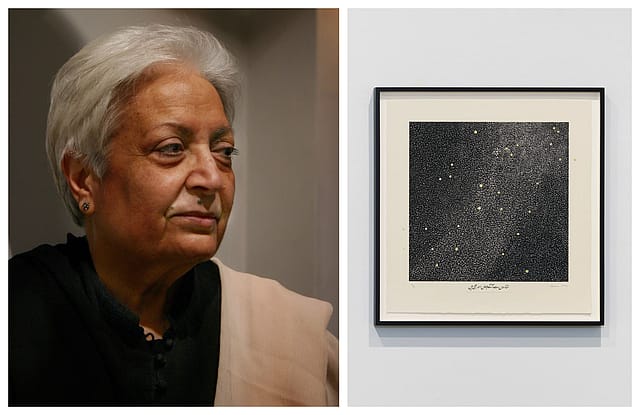
In Home is a Foreign Place (1997–1999), arguably one of her most significant and well-known works of art, Zarina created 36 woodblock prints, each representing a recollection of home—beginning with a floor plan and moving on to the small fixtures—beams, edges, lines, crosses, circles—accompanied by words in the Nastaliq calligraphy. It is a work that feels both intimate and distant, as if saying that it is the small fragments which become magical wormholes when memory is all that remains of a home. Throughout her life, Zarina, who was born in Aligarh in 1937 and died in London in 2020, moved and made homes in different places, distilling her life into her work across printmaking, sculpture and works on paper, which have been showcased at numerous exhibitions around the world. The latest is the Singapore-based STPI, a contemporary art gallery that showcases artistic experiments in print and paper, where Zarina works are on display till August 1. The exhibition, titled Directions to My House, is curated by Sarah Burnery—who was formerly Zarina’s Studio manager—and assembles over 50 works from 12 lenders to present an expansive view of the artist’s practice. In an interview with Open, Burney speaks about her curatorial vision for the showcase, Zarina’s significance for printmaking and her distinct language of minimalism, and her fondest memories of her over tea and conversations.
What were your curatorial goals in putting together the works that comprise Directions to My House, as a distinct showcase following her many major exhibitions in the past?
There have been so many wonderful major exhibitions devoted to Zarina’s art, and I imagine her name will be familiar to many art lovers in Singapore. But I was also very aware that this is her first institutional presentation in Southeast Asia, so I wanted to organize the exhibition in a way that felt focused but still allowed for an expansive view of her practice.
Zeroing In on ECI
09 Oct 2026 - Vol 05 | Issue 41
Constitutional legitimacy versus political opportunism
The exhibition centres on what I see as one of Zarina’s most enduring artistic, philosophical, and personal inquiries: What is home? How do we build it, remember it, and carry it with us? How do we orient ourselves after leaving it?
In many ways, I see this exhibition as continuing a conversation Zarina and I began in 2018, when we were working together on her memoir, also titled Directions to My House. In the memoir, we were charting Zarina’s remarkable biography and reproduced many images of her artwork. But it feels very different (and exciting) to expand on those ideas through the actual works themselves; to move through them physically and experience them in relation to one another.
The phrase Directions to My House comes from a poem Zarina wrote in 2001. It is one of the only poems she wrote that does not accompany an artwork; it is a standalone text that she printed on postcards and gifted to close friends. One of these postcards is included in the exhibition, and it felt like a beautiful point of departure in 2018. And a beautiful point of return today.

In one of her artist statements, Zarina had said: “I do not feel at home anywhere, but the idea of home follows me wherever I go.” How do you think her works illuminates about home, especially in today’s fractured world?
Zarina’s work feels incredibly timely. Even though many of the pieces in this exhibition were made decades ago, they speak so directly to the present. Their continued resonance reminds us what an astute observer she was — not only of her own life, but of the larger forces shaping our world.
Questions of migration, displacement, belonging, memory, and home feel especially urgent today. Many of us are trying to understand what it means to belong somewhere, or to carry a sense of home across borders, languages, and generations. Zarina gave visual form to those questions with extraordinary elegance and restraint. Internal What moves me most is that her work does not offer easy answers. Instead, it offers a way of thinking about home with humanity, empathy, and poetry.
The press release highlights how Zarina’s minimalist vocabulary “redefined what printmaking can hold”. Could you tell me a little more about her significance in context of printmaking?
Zarina’s critical success is unusual for an artist whose primary medium was printmaking. As a specialist of printmaking it pains me to say this but prints have long been treated as secondary to painting or sculpture, and while Zarina did make works on paper and sculptures, printmaking was not secondary for her at all — it was her central language. And a language she used to great poetic effect, capturing both the personal and the political through forms that were simple, precise, and deeply resonant. Her powerful imagery transcends medium, but her devotion to the process uplifts the craft of printmaking itself.
Zarina was also known for minimalism. How do you encourage audiences to engage with such works and the meanings embedded within them?
Zarina’s minimalism is very different from the purely formalist works that often come to mind when people think about capital-M Minimalism. Her work shares a spare visual language, but it is never cold or impersonal. It is layered, emotional, and deeply tied to her life. There is always something that draws the viewer in: a line of Urdu text, the softness of handmade paper, the shimmer of gold leaf, the trace of a hand, or a geometric form that feels both precise and organic. Her work may be minimal, but it is also seductive and inviting. I don’t feel I have to do too much to encourage audiences — Zarina’s work does that work on its own.
One of my curatorial hopes is to help audiences understand the origins of Zarina’s minimalism. She often pushed back against Western-centric readings of her work that suggested she discovered abstraction or minimalism only after arriving in Europe. In fact, she traced those forms much earlier, to her childhood visits to the Mughal complex of Fatehpur Sikri with her father, who was a professor of Indian history. Balance, symmetry, expanses of negative space, geometric forms, and abstraction are all central to Mughal architecture, and they trained Zarina’s eye long before she encountered European modernism. That context is important because it allows us to see her minimalism not as adopted, but as something rooted in her own memory and visual inheritance.
Finally, may I ask about your time with Zarina and what remain your most enduring memories of her? My most enduring memory of Zarina is our tea time. Every day at the studio, after lunch, we would have tea together. Usually it was Zarina, my colleague Yukari, and me, along with whoever else happened to be in the studio that day.
Zarina was very particular about her tea. It could never be made from a tea bag, and it could never be stored in a cardboard box. It had to be tea from India—preferably gifted by her gallerist and dear friend Renu Modi (of the Delhi-based Gallery Espace)—and it had to be kept in a metal canister so it would not absorb the smell of any other tea or food. We always had to have biscuits with tea, and she always made sure to have your favourite biscuits.
We were not allowed to talk about work during tea. Instead, we talked about art we had seen, films we had watched, and most often, books we had read. Zarina was the most well-read person I have ever known, and she was genuinely interested in what the people around her were reading. If you mentioned a book she had not read, she would almost certainly have read it by the next time you saw her.
Of all the things I miss about her, it is drinking tea, eating biscuits, and talking about books that I miss the most. She would always pretend to be annoyed by how long tea time lasted!