Inside Yayoi Kusama’s infinite world and the art of turning obsession into wonder
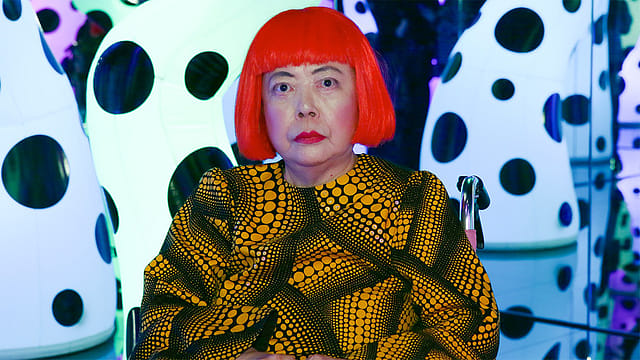
Despite its height and striking concrete-and-glass architecture, the Yayoi Kusama Museum in Tokyo seems to blend into the quiet, residential neighbourhood of Bentencho—tucked between homes, stores and small businesses. One might well expect the streets leading to the building to be filled with an explosions, polka dots and pumpkins—the signatures of the Japanese artist Yayoi Kusama, who died on August 14 at the age of 97 (the announcement of death was made on August 27). Instead, the museum, run by her eponymous foundation and established in 2017, doesn’t clamour for attention until one reaches the door to the building where a small crowd has gathered waiting to be ushered into the galleries according to their pre-booked slots.
Inside, the colours and motifs, the subversion and avant-garde sensibilities that Kusama has come to be associated with, comes alive. Photography is blessedly prohibited in most parts of the museum, so visitors can take their time studying the paintings and sculptures (presented in two exhibitions each year) that not only celebrate the artist’s recognisable signatures but also present the depth of her practice, nurtured over time and space and across varied media.

Zeroing In on ECI
09 Oct 2026 - Vol 05 | Issue 41
Constitutional legitimacy versus political opportunism
Born in 1929, into a family that owned a nursery and farm, Kusama began drawing early beginning with pumpkins and other works drawn from fears and hallucinations that she began to experience as a child. Art also became a means of coping with the physical and emotional abuse in her family life—including instances she has related of her mother sending her to spy on her father’s extramarital affairs which left her with a dual sense of distaste and fascination. These experiences would fuel her future practice, but her decision to pursue art was unusual in Japan at the time and invited objections from her family. Kusama initially studied traditional Nihonga painting before turning to European and American artistic traditions to create her own grammar on the canvas. Her practice became a lifelong engagement with ideas and motifs that she first encountered in childhood.
Take for instance, Flower (D.S.P.S), her 1954 gouache painting on paper. Kusama has said that the idea came from a moment when she had been looking at red floral patterns on a table cloth: “...when I looked up I saw the same pattern covering the ceiling, the windows, and the walls, and finally all over the room, my body and the universe. I felt as if I had begun to self-obliterate, to revolve in the infinity of endless time and the absoluteness of space, and be reduced to nothingness.” Decades later, at her Tokyo museum, we encountered this effect in one of her installations—titled I’m Here, but Nothing—a room installation filled with glowing, fluorescent polka dot stickers and lit by ultraviolet (black) light. It could be the stuff of dreams or nightmares, depending on one’s state of mind. It was also among the few spaces that allowed cameras, and we queued up twice—the first slot had been overrun by a group of visitors intent on photographing themselves in every nook and corner.
Here’s another quality that makes Yayoi Kusama such a rage: for all the grim stories that underpin her practice, Kusama’s works have always been incredibly photogenic. Her art looks tailormade for the age of Instagram and TikTok. Yet, these are signatures enduring from her early days when her soft sculptures coated with phallus-like protrusions, her Mirror/Infinity Room installations and her Infinity Net paintings commanded attention in the US. She had moved to the US at the age of 27 and it wase her that her artistic repute began to grow, for her distinctive work as well as her provocations—anti-war performances in public places (Grand Orgy to Awaken the Dead at the MoMA, 1969) or setting up the Kusama 'Omophile Kompany (KOK), a naked painting studio and homosexual social club. In 1966, when her installation, Narcissus Garden, was on view at Venice Biennale, the artist—famously dressed in a golden kimono—began to sell individual spheres from the installation without authorisation from the organisers. Since then, versions of Narcissus Garden have been exhibited in venues around the world.
Kusama’s artistic life was intertwined with her mental health struggles, which continued in the US and after her return to Japan in the early 1970s. As she continued to work and rebuild her practice, Kusama checked into a psychiatric hospital; she eventually became a permanent resident and worked at her studio close by. From here, Kusama painted the next chapters of her journeys, working her way back into public conscious with retrospectives, exhibitions and new commission in the late 1980s and 1990s. Her yellow Pumpkin sculptures—regarded as an alter-ego—gained popularity as did her Infinity Mirror rooms. Kusama took the fears that overwhelmed her life to create immersive installations that spark joy and wonder. Their otherworldly atmosphere have attracted art connoisseurs as much as selfie-seekers, and her works have looked at home around the world—be it at the Benesse Art Site (Naoshima, Japan), outside the Liverpool Street Station in UK or in the foyer of the Nita Mukesh Ambani Cultural Centre (NMACC) in Mumbai.
What also added to Kusama’s iconic status in pop culture were her projects and collaborations—particularly one with Louis Vuitton. She designed capsules and stores for the French luxury house which in turn made her the face of the collaboration and brought her into the radar of a wider audience. Kusama was an ideal fit for such a brand collaboration—distinct in her blunt bob wigs and outfits with polka dots and other echoes of her art.
The Yayoi Kusama Museum in Tokyo is a celebration of all that made her famous and loved. But it is also a place where once can contemplate Kusama and her practice away from news headlines and social media chatter. Its exhibitions chronicle her life and process; they situate her practice in her state of being as it evolves through the years. In 2018, not long after the museum opened, an exhibition of her early works was titled Here, Now, I have Reached the Grandest Start of My Life. Art gave Kusama life, tethered her to the world and became her means to question creation and existence. Kusama made monumental works but also remembered herself in the polka dot—a speck among millions of others in the universe. Her art explored her obsessions and anxieties and translated it with a sense of wonder. If polka dots and pumpkins, sex and psychological struggles recurred in her works, so did joy, wonder and a desire for connection in a world filled with strife. Continuing to paint into her final years, Kusama had started writing a sentence on the back of her paintings in 2021. The sentence became the title of the exhibition we saw during our visit to the museum. It said simply and with unparalleled poignancy: Everyday I Pray For Love.