Inside the world of Virasat, an ambitious new hyperrealistic stage adaptation of Mahesh Elkunchwar’s Wada Trilogy
At Black Box Okhla, a performing arts space in Delhi, the smell of cooking gas and warm rotis fill the air. The rooms of a decaying manor occupy the stage—home to the Deshpande family, who have just cremated their patriarch, Tatyaji. The women are in the kitchen, literally cooking a meal, while the rest of the atmosphere simmers with resentment. The family’s prickly dialogues reveal the story: There is not enough money for Tatyaji’s last rites. The eldest son, Bhaskar is bitter because he had been taking care of the house while his younger brother Sudhir was studying and now working in Mumbai. Meanwhile, their widowed mother Amma, and Bhaskar and Sudhir’s wives and their sister, Prabha, cook and utter their own concerns.
This is the preview to Virasat, a new hyperrealistic, experimental play premiering in Delhi’s Sunder Nursery from September 24 to 27. Directed by Anuradha Kapur, and commissioned by the Kiran Nadar Museum of Art (KNMA), the three-hour play is an ambitious adaptation of playwright Mahesh Elkunchwar’s Wada Trilogy centred on a titular wada in rural Maharashtra in the 1970s. “The play is about the breakdown of a feudal family, the recognition of agrarian distress, climate change, the way in which the landscape seems to change,” Kapur tells Open. “But more than that, I’m interested in the way the detail of the quotidian is registered in the play.”

Zeroing In on ECI
09 Oct 2026 - Vol 05 | Issue 41
Constitutional legitimacy versus political opportunism

It is reflected in the play where much of the drama unfolds around everyday household work. The women of Virasat keep cooking and serving the men, whose arguments about family property grow tenser by the moment. While the other women utter tearful platitudes, Prabha expresses her anger at not being allowed to go to college in Amravati because the daughters of the Deshpandes “do not live in college hostels”. After dinner, and washing up, the family retire to their rooms, and continue airing their grievances. This is not just a portrait of rural life in post-Independent India. “Virasat is contemporary. It is not about the past, it is being lived in various parts of India in very real ways,” says Kapur.
“I’ve had many people coming up to me in these shows and saying, ‘this is my family in UP’.”
Kapur particularly notes the experience of women as shown in the play, from Amma and Prabha to Ranjo, Bhaskar’s daughter Ranjo, who is as desperate to escape as her aunt and more willing to take risks that endanger her. Kapur notes that these experiences will continue to resonate because women still face the same challenges today. “It has radically changed in cosmopolitan places but not in other places. Labour, in terms of household work, and education for women has not radically changed.”
One of the most distinguishing aspects of Virasat is its immersive stagecraft and architectural detailing. Deepan Sivaraman, the scenographer, observes that the house is a central character in this play as much as the actors themselves, in their act as a family that has “lost everything but the wada.” Sivaraman’s design opens the doors into this house—its rooms and interior space, every object placed so that “it’s an expression of the house.”
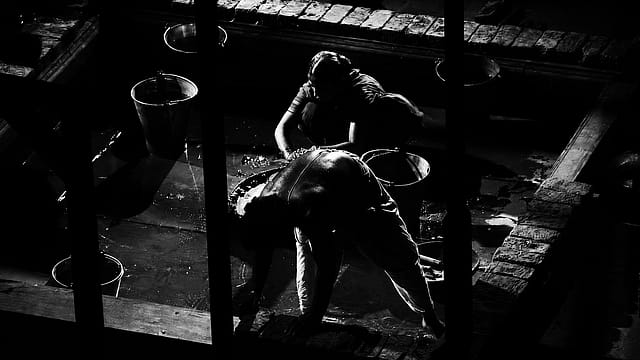
The scenography also keeps in mind Kapur’s vision of hyperrealistic elements. Cooking is, after all, a literal activity here. Water is another element, used in the kitchen and splashed across the spaces. Ranjo wrings the water out of her hair on stage after washing it in one scene; in another, the thwarted Prabha deliberately drops two buckets of water, puddling the stage. Sivraman highlights this as another exciting aspect of working on such a play. “I felt that Anuradha is trying to explore a language that is not just about hyper-realism but also about the materiality of time and space,” he says.
Kapur adds that she wanted to show the story realistically. “There are two aspects to this. One is acting, where you are used to these sorts of objects and actions faked on stage. Working with material as you do in life on stage brings out a physicality of work,” She highlights the actors’ effort in ensuring that activities such as making, serving and eating meals in real time on stage and added to the realism.“If the actress has to cook, she has to have all the alacrity that a woman in the kitchen has to have, doing it quickly, doing it immediately, readily as many times a day as is needed.” For the audience in turn, these actions turn them into witnesses rather than spectators.
Sivarmaman also explains how the experience of the play changes based on the audience’s position. “If you see the play sitting in the seats in front of the kitchen, you will see the female perspective—watching the women of the family spend most of the time there, cooking for the men. But if you watch the play from the balcony you can see Prabha, the young woman who wants to go to college to study but is never allowed to go.”
The three-hour long play marks the passage of time in three acts. Through these acts, and from one milestone moment to another, the characters age and evolve in complex, contradictory ways. Parag, Bhaskar’s son is one example. The responsibilities of managing the land and household gradually embitter him. In some ways, he reproduces his father’s behaviour—ordering his mother and sister around. Yet, he doesn’t object to his wife’s pursuing an MA and tries to correct the previous generation’s mistakes, and has more of an arc than the other characters. Ajeet Singh Palawat first played Parag in 2013 and now returns to the role. “This isn’t a character one finds these days,” he says. “He is action-oriented but his heart is in the right place. He goes beyond his teachings, and applies what he has learnt.”
Virasat begins in the throes of dispute and decay, but eventually this is a production less interested in its disappearance than in what might be rebuilt from its vestiges. Through its intimate staging and insistence on real labour, water, food and objects, Kapur makes a decades-old family drama immediate. Virasat does not simply recreate a vanished world; it asks what remains of it in contemporary India.