Kumik’s Past Gets a Future: Can Heritage Status Help Save Ladakh’s Water-Stressed Village?
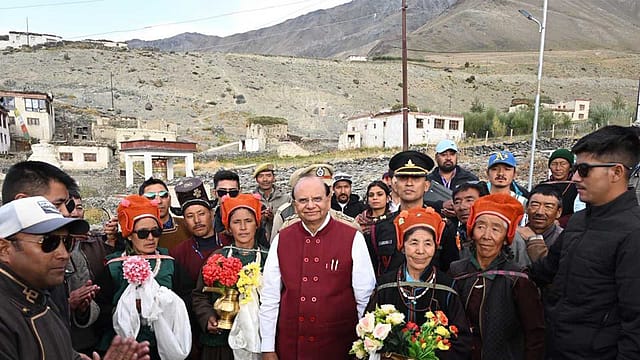
Kumik has safeguarded sacred texts for generations. Safeguarding village life has proved harder.
The Zanskar settlement, declared Ladakh’s first designated Heritage Village on September 15, brings together traditional houses, Buddhist learning, agricultural practices and community customs. Yet years before this recognition, Kumik was making news for a different reason: dwindling water supplies were pushing families to leave their ancestral homes.
The declaration by Lieutenant Governor Vinai Kumar Saxena, coinciding with the opening of the Ladakh Zanskar Festival, brings fresh attention to that inheritance. Ladakh Tourism describes the recognition as encompassing an entire living cultural landscape. Earlier reporting and field research reveal how vulnerable that landscape has become.
What makes Kumik special enough to become a Heritage Village?
Its significance lies in how several forms of heritage survive together.

Zeroing In on ECI
09 Oct 2026 - Vol 05 | Issue 41
Constitutional legitimacy versus political opportunism
The administration’s announcement highlights traditional homes, sacred spaces, farming practices and longstanding customs, alongside Kanjur manuscripts and other Tibetan Buddhist materials. Together, these tell a story of a Himalayan community that preserved knowledge and faith while developing ways to live in a demanding environment.
A house is part of that story. So are the skills needed to maintain it, the fields that sustain its inhabitants and the traditions they pass to their children.
Calling Kumik a Heritage Village recognises those connections. It also shifts attention towards the people who have sustained them.
What are the Kanjur manuscripts—and why do they matter?
Kanjur, also commonly written as Kangyur, refers to the Tibetan Buddhist collection of scriptures traditionally regarded as the Buddha’s words. It encompasses different kinds of teachings, including discourses, monastic discipline and tantric texts.
Many works were translated into Tibetan from Indian sources. The translation organisation 84000 explains that the Tibetan canon preserves a vast body of Buddhist literature, including works that have survived only in Tibetan translation. That makes manuscript preservation a matter of both religious continuity and intellectual history. Such collections can help scholars trace how texts were copied, transmitted and understood across generations. The announcement identifies Kumik’s textual heritage as a reason for its recognition.
How can a small Himalayan village be a keeper of such knowledge?
Because the survival of a manuscript often depends on generations of local custodianship.
The Buddhist Digital Resource Center describes thousands of Himalayan manuscripts that remain in the care of communities. Its account of the University of Vienna’s Tibetan Manuscripts Project documents efforts to photograph and study collections across the western Himalayas, including Zanskar.
These texts continue to have a place in religious and community life. Their survival reflects the work of families, practitioners and institutions that preserved them long before digital archives existed. Kumik’s recognition draws attention to that quieter history of preservation.
Why does water enter a story about heritage?
Because a village’s cultural life depends on whether people can continue living there.
A 2015 report in Yale Environment 360 documented Kumik’s water difficulties and plans for relocation as the glacier-fed supply on which it depended diminished. The report placed its experience within the uneven effects of warming in Zanskar: a longer growing season could offer advantages, while the loss of reliable irrigation threatened farming.
For Kumik, the consequences reach beyond a failed crop. When families move, the maintenance of ancestral houses, shared work and the transmission of local knowledge all become harder. That is the central challenge behind the heritage tag: preserving the conditions that allow a community to endure.
Has Kumik already lost residents to water scarcity?
Yes. Relocation has been documented over several years.
A 2022 report in New Lines Magazine described families moving to Lower Kumik, where a canal offered access to irrigation water. It also recorded continuing difficulties at the new settlement, including winter dependence on water deliveries when natural drinking-water sources froze.
Moving meant constructing homes and establishing livelihoods again. Access to water improved, but resettlement brought its own uncertainties.
More recently, Le Monde reported in July 2025 that much of the historic village had been abandoned. Some residents remained because they could not afford to move; others hoped to preserve the old settlement as a heritage destination. Those observations predate the new designation and should not be treated as a current population count.
What does “living heritage” look like in everyday life?
Sometimes, it looks like neighbours helping with a harvest.
In field notes published in December 2014, the Cambridge Zanskar Expedition described residents working together on harvesting and moving stones for a prayer house. During breaks, they shared bread and chang, the locally brewed barley drink, along with conversation and news.
The researchers saw these gatherings as part of the community’s informal organisation: people exchanged labour, knowledge and assistance. That helps explain the phrase “living heritage”. It includes relationships and practices that cannot simply be restored by repairing a building. They need people, time and opportunities to continue.
Does the new designation guarantee restoration money or a water project?
The announcement supplied does not set out a dedicated budget, a restoration timetable or a funded water-security plan for Kumik.
It establishes recognition and describes the village’s cultural importance. The practical programme will depend on what follows: which buildings and collections are assessed, how residents participate, what resources are committed and how progress is measured.
The questions now are concrete. Who will oversee conservation? Will households receive support to maintain traditional homes? How will manuscript custodians be involved? And how will water needs be addressed? Those details will determine what the designation delivers.
Are there proposals to bring water back to the old village?
Yes. The Mountain Climate Fund describes a proposal developed with the community to capture meltwater from a neighbouring glacier.
Its published plan envisages a canal about 300 yards long at roughly 18,000 feet, directing runoff towards the streambed above Kumik. The organisation says a joint survey by its staff and villagers found the proposed route feasible.
This is the organisation’s account of a proposed intervention. It should not be read as confirmation that the canal is complete, that year-round supply is assured or that the project forms part of the new heritage designation. It nevertheless illustrates why conservation here needs to involve water planning as well as cultural expertise.
Could tourism help residents preserve Kumik?
It could provide income that makes preservation more viable. Locally run stays, guiding, craft sales and carefully managed cultural visits could support households and create reasons to maintain traditional buildings and skills. These are potential benefits, rather than outcomes already established by the declaration.
The design would matter. Visitor accommodation needs water and waste services. Access to sacred spaces and manuscripts requires the consent of their custodians. Residents also need a meaningful share of the income. For Kumik, a useful measure of tourism’s success would be whether it helps people sustain their homes and livelihoods.
Why was the announcement made at the Zanskar Festival?
The setting connected village preservation with a wider effort to promote Zanskar’s identity and tourism. The two-day festival showcases regional culture, crafts and products. According to the administration’s account carried by ANI, the 2026 edition was the first since Zanskar attained district status in April. The festival has also been included in Ladakh’s official tourism calendar. Kumik’s recognition gives that cultural promotion a specific focus: a settlement whose buildings, texts and daily practices embody the traditions being celebrated.
What would success look like beyond the heritage label?
A credible conservation programme would connect manuscript care, building maintenance, water security and residents’ livelihoods. Digitisation could help preserve access to texts, with custodians’ agreement. Repair support could help households maintain traditional homes. Reliable services and locally beneficial tourism could give younger residents more choices about their future. People should be able to preserve their inheritance while improving how they live. Kumik’s new status acknowledges what generations have kept alive. Its next chapter will depend on whether the people who carry that heritage have the means to stay.
With inputs from ANI & agencies