From Couture to Art: How Chanakya Is Reimagining Indian Craft
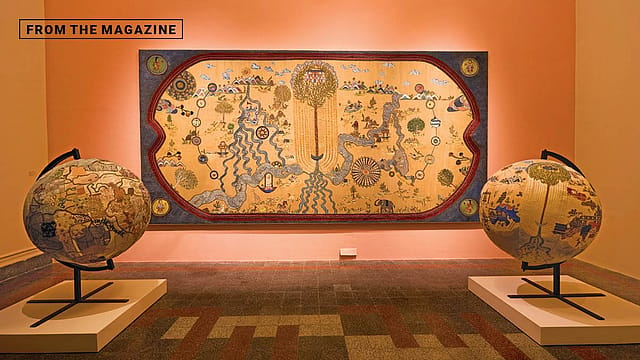
The oldest museum in Mumbai, tucked away in a tranquil green pocket within Byculla’s traffic-clogged streets and buildings, Dr Bhau Daji Lad Museum is a house of treasures—filled with clay models, maps and dioramas, photographs, lithographs and books. Its collection of rare maps is the inspiration for a singular work of textile art that greets visitors as they enter the museum—a map of Mumbai layered with history and stories, from its earliest recorded name as Heptanesia (an ancient Greek term meaning “group of seven islands”) to its present. This is the first glimpse of En Route, an artistic collaboration between Maria Grazia Chiuri—designer and creative director of the Italian luxury house, Fendi—and Karishma Swali and the Mumbai-based Chanakya School spanning a journey from the Vatican to India.


Zeroing In on ECI
09 Oct 2026 - Vol 05 | Issue 41
Constitutional legitimacy versus political opportunism
In early 2025, Swali and Chiuri mounted the first iteration of En Route at the Vatican Apostolic Library. On show were five intricately embroidered maps, narrating stories of six women discovered by the duo in the Vatican archives: Annie Cohen Kopchovsky, the first woman to bicycle around the world; journalists Elizabeth Bisland Wetmore and Elizabeth Cochrane, who circumnavigated the world in 76.5 days and 72 days respectively; Gertrude Bell, explorer and policymaker; and sisters Agnes Smith Lewis and Margaret Dunlop Gibson, who travelled across Europe and mastered a dozen languages. Giving this spirit of exploration another creative spin, women karigars from Chanakya School of Craft—founded by Swali—created two globes, titled Antrik Vishwa, embroidering their own maps with scenes of community lives, temples and trees, mountains and water bodies. These artworks have travelled to Mumbai, and are on display at Dr Bhau Daji Lad Museum until October, with other works of textile art created by Swali and the Chanakya School.
En Route is one of three exhibitions unfolding across Mumbai to mark 40 years of the textile and embroidery house Chanakya, as well as 10 years of the Chanakya Foundation and the Chanakya School of Craft. In early September, Open attended the inauguration of the exhibitions at Dr Bhau Daji Lad Museum, the Chanakya Atelier and the Experimenter art gallery in Colaba, along with guests from around the country and Maria Grazia Chiuri in attendance as well. “Our practice has always looked at craft as a reservoir of culture, as a point of exchange (confluence). We wanted to open it up to the city and create experiences that allow a more intimate immersion into what textiles are—for us as practitioners, and for people,” says Swali, over a conversation a few days after the unveiling. “Textiles reflect our collective identities. Instead of looking at the 40th anniversary as a retrospective, we wanted to have a more future-forward exercise through these three exhibitions.”
Chanakya was founded in 1986 by Vinod Shah, as an atelier that preserved and celebrated the rich crafts traditions of India. In the mid-1990s Swali, Shah’s daughter and her brother, Nehal Shah, joined the business and began working on its international expansion. Over the years, the textile house has become a chosen destination for the world’s top luxury brands—from Fendi to Dior, Gucci and Giorgio Armani, among others—to undertake their embroidery and couture designs. Swali, who serves as the creative director of Chanakya International observes that the atelier has honed in on “an inward focus on excellence” and being able to look at crafts in terms of their historical significance as well as their contemporary potential. “It’s this spirit of curiosity and exchange that continues to guide us today.”
Textiles and crafts have been part of Swali’s life ever since she can remember, from the first trip to the atelier with her father to joining the business, as well as her interest in drawing and sketching, which have led to her artistic practice today. “I’ve personally been exploring it from a very young age, but what made me realise this responsibility to reflect our collective practice was when the (Chanakya) School began in 2016. The curriculum is expansive, looking at art history and craft thinking, and there’s a huge emphasis on collective and personal expression. It felt like a natural next step to have an intimate collective of people who come together to express themselves creatively.”
Following years of research and documenting Indian crafts, Swali founded the Chanakya School of Craft as a non-profit school and foundation, dedicated to empowering women from underprivileged communities with craft and design knowledge and skills. Beginning with a batch of 22 students, the school has trained around 1400 artisans. The school collaborated with brands, non-profits and artists but also found its own artistic calling in a collective led by Swali—major exhibitions include The Cosmic Garden, a collateral event of the 60th International Art Exhibition – La Biennale di Venezia in 2024; Towards Light at India Art Fair, The Sky Below at Mobilier National in Paris and En Route at the Vatican in 2025. Earlier this year, Chanakya School presented its solo debut in India, Trace at Experimenter – Ballygunge Place, Kolkata.
Prateek Raja, co-founder of Experimenter, says that the collective’s approach and deep connection to traditional artistic practice distinguishes it. “At the same time, when you see them work together, there’s an incredible and profound sharing of knowledge—not just across skills but also across generations,” Raja told Open during a preview of Belong in Mumbai which marked Chanakya School’s second solo with the gallery, and first in Mumbai. As textile art has gained immense popularity in the Indian arts ecosystem over the last few years, the collective’s practice stands out for its ability to define the choice of textiles over any other material or medium. “Chanakya’s work has been about textile exploration and, if you look at their archives, often about remaking things that are lost. It is about going back in history to research what can be done to revive certain techniques or manifest them in contemporary possibilities,” he observed, adding the significance of this “continued immersion within textile histories and practices.”
Belong spans wall art and sculptures that contemplate the idea of belonging “as an ongoing negotiation between body, ecology, memory, and inherited systems of knowledge.” Chanakya School’s skills are visible in works like Within, a series of abstract works layering organic cotton and silk threads, glass and recycled seed beads. Nature as a “living presence” emerges in colourful and deeply textured works such as Flowers in Our Forest I, crafted from handwoven textile with cotton thread, or Common Ground in which raffia fibres are layered over and fringed around densely embroidered frames, bringing to mind cultivated terrains—a reminder of the ecosystem from which textiles and natural fibres emerge as much as the idea that cloth itself is an ecosystem. Another major work is the Saptamatrika—a series of large handwoven sculptures drawing upon the iconography and the philosophies of the seven Mother Goddess in Hinduism.
The Saptamatrikas reappear in a similarly monumental scale—drenched in a deep manjistha-red hue and crafted from bamboo, raffia and cotton—at Garden of Gestures, mounted at the Chanakya Atelier in Byculla. Among the three exhibitions, Garden of Gestures is perhaps the one that most clearly showcases the atelier’s intersections between art and fashion. Inspired by gardens as spaces for learning, growth and cultivation, the exhibition is divided into three parts. Upvan, a forest brought closer, showcases the tools, textiles, materials and knowledge systems that inform the atelier’s practices. Tapovan, the “forest of contemplation”, grows from it, displaying archival exhibits and floral and botanical motifs embroidered with lifelike detail. The Saptamatrikas are part of this gallery, and so are a series of mannequins dressed in an exceptional line of garments vividly referencing botanical art and tailored from natural fibres and materials. The Kunj, the exhibition’s final section, is a ‘sacred grove’ crafted from raffia displaying ancient sculptures and artefacts which Swali describes as their “core source of inspiration.” The divine feminine inspiration recurs through the Chanakya atelier and school, a fitting emblem for its large team of women and feminist perspective.
Helming the Chanakya atelier, the school and the foundation, Swali’s success is rooted in her ability to distinguish and further the practice of different arms of the endeavour—fashion, art, crafts education and patronage. “My relationship with fashion critically informs how I look at the body, how I look at drape, at layers, form and function. It greatly informs my artistic practice as well,” she says. Yet, each practice is distinct—the fashion vertical is guided by technical mastery and attention to detail; the atelier has worked hard to achieve the level of perfection that couture demands, a mere millimetre serving as the margin of error. Swali situates the artistic practice at the other end of the spectrum—precision continues to count, but it is much more about “coming together and being able to offer about a shared vision.”
Swali also credits Maria Grazia Chiuri as her “forever mentor”, having worked with her across fashion and artistic projects. Chiuri, who foregrounds feminism and crafts in her designs, has consistently highlighted her relationship with Swali and the women artisans of Chanakya. “We met when we were both young, 30 years ago, and it was an instant connection. She comes from Puglia, in the south of Italy, a region rich in craft traditions. And I come from Gujarat which is also known for its crafts,” she says. “Season after season, we found ourselves exploring together—and it’s very special to have someone that shares your commitment to craft, and also to communities and women’s voices.” Their shared passions have led to multiple collaborations and a sustained patronage for Indian crafts traditions in fashion as well as the arts; in 2023, Dior hosted its first runway show in India (under Chiuri’s creative direction) including Chanakya among its partners. The designer also serves on the advisory board of the Chanakya School of Craft and the Chanakya Foundation.
Handmade crafts and textiles are the seeds and roots of Chanakya’s sprawling tree of creativity whose branches have grown and reached in several directions. One of Swali’s newer ventures, the multidisciplinary atelier titled Chorus, is another expression of this pursuit. Launched in 2025 by Swali, with her daughter Avantika (building on their previous label, Moonray), Chorus encompasses ready-to-wear and made-to-measure fashion, accessories, handmade objects including ceramics, glassware and a wellness line comprising soaps, body oils and candles. At its Mumbai flagship in Kalaghoda, the Chorus café offers a plant-based menu rooted in local, seasonal produce and crafts-inspired presentation. “The very word, Chorus, represents the core value of crafts—many voices coming together,” Swali says. “I’d love for Chorus to represent the textile architectures of the subcontinent and what they mean to us. I founded it with my daughter and the idea of having a generational perspective of crafts. We want to be able to carry these traditions into newer contexts.”
Swali and her team are now planning for an upcoming exhibition at Bihar Museum. Future plans include an international show in the next few years and working with design institutes in India and around the world to include crafts in the curriculum. Swali’s hopes and aspirations are anchored in preservation of crafts and textiles—she has, after all, spent most of her life engaging with these practices. Three decades into the business, her journey is far from over. “With every passing year, I am cognisant of how little I know of this vast universe of crafts and textiles,” she says. “So, I also feel a sense of urgency to learn, and the responsibility to keep these crafts relevant and alive.”