Ecstasy and Excess: Abu Jani-Sandeep Khosla bring maximalism to Mubarak Baug, their new Mumbai flagship
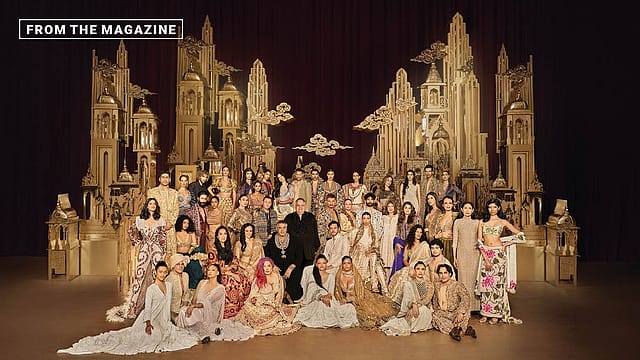
Abu Jani and Sandeep Khosla have always celebrated the art of spectacle. It is visible in the fashion they have designed over four decades—conflating Indian crafts with a head-spinning dose of glamour, which have been worn by the likes of Nita Ambani and Aishwarya Rai-Bachchan, Sonam Kapoor Ahuja and Priyanka Chopra, Judi Dench, Gwen Stefani and Gigi Hadid. It is visible in their ambitious visual imagery, be it the fantastical images that comprised their 2012 tome, India Fantastique or the campaigns mounted in recent years such as ‘The Glory of Giddha’ spotlighting Noor Zora’s all-male gidda group or ‘Beyond the Light’, a fashion film featuring stars like Shantanu Maheshwari and Nora Fatehi. It is visible in their couture runways as much as their personal lives, filled with a love for cinema, art, objects and jewellery. A charged current of maximalism and sheer audacity runs through every creation and collection that bears the Abu Jani-Sandeep Khosla (AJSK) stamp.
Little wonder than that Mubarak Baug, AJSK’s new flagship store in Mumbai is also a gilded showstopper. “Mubarak Baug is purely fantasy,” says Sandeep Khosla, of the space that has turned the city’s Framjee Cawasjee Institute, a 20,000sq ft heritage building that once served as a theatre, into an immersive retail concept. The doors open into an ‘Inverted City’ gleaming with brass installations suspended from the ceilings—their metallic glow offsetting a crystal chandelier. Miniature jharokha, layered mirrorwork and shola adorn the space. A stairway—sprinkled with vintage photographs and framed crafts—leads to the ‘Bombay Skyline Corridor’, in homage to the city the designers call home. Walk through the passage and the heart of the store is revealed. Look up and colossal hand-carved swans float among the clouds. Look around and hand-cut golden screens transform into a labyrinth-like display for the couture on display. The walls are filled with murals as well as production leftovers and swatches from the atelier reimagined as tapestries. A gem-inspired mirror and gilded vault houses the brand’s new fine jewellery collections at one end while a grand staircase on another leads up to the stepwell-inspired museum displaying iconic AJSK creations made over the years. Every wall is coated with crafts and embroidered panels and even meeting rooms continue the dazzling conversation.

Zeroing In on ECI
09 Oct 2026 - Vol 05 | Issue 41
Constitutional legitimacy versus political opportunism

Beyond fashion, Mubarak Bauq is also a first-of-its kind showcase of AJSK’s design vertical, A Wonder Room. Khosla and Jani have been designing spaces almost as long as they have been making clothes. In 1986, the duo opened their first boutique, Mata Hari, in Mumbai—among the earliest generation of fashion designers to emerge from India. Their clothing began to make its mark from the initial years, finding favour among locals as well as international stockists but the duo also explored other designs. When the late gallerist Bina Kilachand created a concept called The Art Wear Show, inviting artists and designers to collaborate, the designers made three long vertical panels based on art by Jani who had been sketching from the time he was a young boy growing up in Mumbai.
In 1993, the designers took their first major stab at interiors with a furniture exhibition. “It gave us a big high. We exhibited at Bajaj Hall in town (Kamalnayan Bajaj Hall and Art Gallery in South Mumbai) and everything sold out in three hours,” recalls Khosla. Jani and Khosla have designed interiors since then though the rigour of building a fashion brand meant that they worked on spaces slowly and selectively. This includes residences for longstanding friends such as the Bachchans as well as Dimple Kapadia, among other clients; the designers have also worked with real estate developers, most notably with Lodha Luxury in 2021, culminating in a 76th-floor sky villa filled with mirrorwork, Art Deco furniture, art and textiles at Mumbai’s Lodha Ciel. Among commercial projects, the duo notable have created the interiors and installations for Terminal 2 (T2) at Mumbai’s Chhatrapati Shivaji Maharaj International Airport and later at Kempegowda International Airport in Bengaluru.
A Wonder Room, which encapsulates this design practice, is named after a friend of Jani and Khosla who had seen their home in Goa and used the expression. “That stayed with us and we thought that whenever we do launch our interior wing, we will call it A Wonder Room,” Khosla says. “We are working in Goa, Hyderabad, Delhi, Karjat and all kinds of places—either homes or show flats. And each one is a version of a wonder room.”
Mubarak Baug—which gets its name from Khosla’s ancestral home in Kapurthala—gives audiences a deeper glimpse into this interiors practice. “The best thing about Mubarak Baug is that it gave us an opportunity and a canvas,” Khosla says. It is an endeavour to realise the unimaginable. “It is not just another store, which is beautiful,” he adds. “You don’t even have to love it. You may hate it but you can’t get over the guts and audacity that these two creatures (describing himself and Jani) have got.”
The décor is also an exercise in collaboration and co-creations. Take for instance the production materials which adorn the walls, designed by Wolf, a Jaipur-based arts collective led by Ritu and Surya Singh. Artist Shilo Shiv Suleman brought to life the metallic panels which give the store its maze-like sensibility while Shine Shivan is the artist behind the murals painted across the walls. The store is as much a brand showcase as a display of the manifold possibilities the two designers can and have brought to living spaces over the years.
The Abu-Sandeep aesthetic is rooted in a reinvention of crafts. In fashion, they combined mirrorwork with resham, experimented with chikankari to create luxe renditions on chiffon and silk, and played with the proportion of embroidery and embellishments. Similar interventions echoed in the homes they designed—from creating walls with Naga panels decades before the crafts became trend and stripping paint of sculptures to let the wood shine to transporting a huge carved installation from a Jaisalmer haveli inside a bedroom. Art speckles their home, particular A Ramachandran—a favourite of the duo’s—and Manjit Bawa. The aim was not merely storytelling, but to derive joy for themselves as much as their clients.
In both work and life, Jani and Khosla are pleasure seekers. “We have always had fun. We are always out to make a statement and we take up projects which allow us to create with freedom,” says Khosla. The AJSK brand is synonymous to maximalism and it is indeed intrinsic to the label. But it is not what drove Jani and Khosla who can easily recall a time when maximalism was hardly the “hip word” it is today. “More than maximalism, we were unapologetic about our design. We believed in what we did and wanted to form a design language that was our own.”
As Mubarak Baug makes its mark, the designers continue to dream bigger. Among their ambitions is a design-forward boutique hotel, creating “larger-than-life pieces which will be remembered forever” and pushing the boundaries of Indian crafts. At its core, AJSK is an India-proud label, working its mythologies and past histories into designs that resonate in the present and future. “Our country is abundant in design,” says Khosla. “We just have to appreciate its nuances.”