Can Fashion Make a Political Statement? Designer Pranav Kirti Tests The Limits with HUEMN’s Runway Showcase
Politics is rarely an easy muse for fashion. Designers may transform the most clichéd of florals to the most radical art into new looks. They may display an alchemist’s flair for turning everything from plastic to metal into wearable objects. But when it comes to fashioning a political ideal, even the most capable design minds tend to teeter. It is not merely a question of design dexterity. Clothing has often served as political statement—slogan T-shirts for instance to designs that questions and contradict the binaries of gender. But fashion—particularly in designerwear and luxury categories—is rooted in aspiration and fantasy, in leisure and indulgence. For a designer to incorporate political awareness of its times in a collection or a show is always challenging and doubly so when the landscape is charged with dissent and conflict.
The political landscape was indeed live wire when designer Pranav Kirti, of the fashion label HUEMN, brought his sartorial politics on to the runway at Lakmé Fashion Week in partnership with FDCI. Fashion week, after all, is ongoing—till October 18—at the Taj Palace, New Delhi—a pocket universe tucked away in a city engulfed by protests. This is the second time this year that a major fashion week in Delhi has had to navigate the situation; the earlier being India Couture Week in July. At that time, designers such as Tarun Tahiliani, Masaba Gupta and Rimzim Dadu expressed a spirit of patriotism—in statements, show direction and tricolour pin on sleeves.

Zeroing In on ECI
09 Oct 2026 - Vol 05 | Issue 41
Constitutional legitimacy versus political opportunism

In comparison, the ongoing fashion week is quieter and decidedly more apolitical. The question of how fashion brands can invoke politics meaningfully is complex from the perspective of makers—especially when if a brand’s creative vocabulary hasn’t conventionally engaged with politics. HUEMN is not one of those brands. Its streetwear and India-proud athleisure is tied to deeply youth culture and contemporary zeitgeist. Yet Pranav is cognisant of business. The label’s collections are executed with a fashion-first sensibility that appeals to industry insiders, buyers, social media algorithms and brand collaborators—be it Pepsi or the fabric company R|Elan which backed the latest showcase.
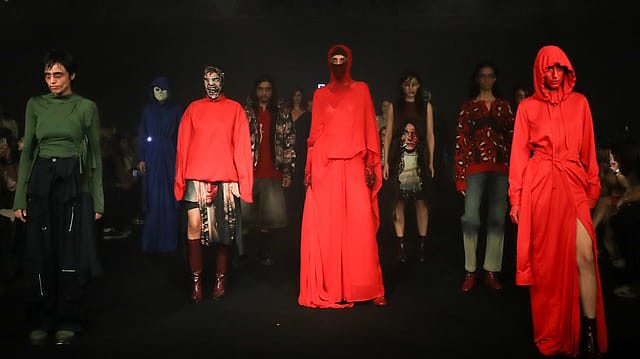
It was not surprising that the label chose to present a political runway act. The collection note described it as “beauty and terror, a recurring duality within HUEMN’s design philosophy. Known for drawing inspiration from the social, political and cultural landscapes of the times, the label translated this contrast into a collection defined by archival craft techniques, original prints, experimental surfaces and contemporary sportswear silhouettes.” If anything, the note underplays the aesthetic of the show—modern athleisure presented with a slash of brutal finishing touches.
The show began with models in head-to-toe white ensembles. Their demeanour seemed constrained and the hoods and veils obscured their vision. One model in particular, dressed in denim and a powder blue hooded top beneath a printed blazer walked slowly down the sparse black runway feeling their way sightlessly through the blank space. It was a sombre statement till the music and energy shifted a few looks later. The masks now transformed—some turned into macabre clay masks while others only partially obscured the faces enabling the wearers to see. They walked more briskly, with a sense of purpose as if hurtling down at any obstacles and barricades that stood in their way.
These hoods and masks were punctuated with a look more violent—models made up to look bloodied and bruised. It was terrifying and, eventually the idea that proved to be the weakest links in the showcase. A real bruise is a mark of survival but situating the violence on the runway instantly aestheticises the violence. Fashion, inherently commercial by nature, rarely achieves the depth of storytelling possible in art forms and literature. This was perhaps Pranav—also a writer and poet—daring to look at reality in the eye but his chosen medium of expression was a fashion show and it struggled to cut the tension between reality and creativity. To put it more simply, all that blood was not a good look.
Yet, Pranav deserves the appreciation of this debate and he certainly deserves credit for conflating his values with the clothing. With brand collaborator R|Elan’s fabrics as base, the collection including “mummy tops” draped and sculpted across the bodies, loads of denim including a jacket with Chikankari embroidery, florals as well as camo on separates, dresses and outerwear. A line of garments featuring a striking portrait of a bloodied, angry smoker—their ‘hair’ flowing like fringe out of the garments—that recalled the irreverence of HUEMN’s Bukowski designs. An ensemble that stood out in particular was a draped number towards the end of the show featuring a skull’s image, from the hood to the trail rendered in dark exquisite detail.
The clothes, created with skill and an eye on the collaboration with R|Elan, were however part of the story. In an Instagram note before the show, Pranav had written that he looked at his brand as a mirror to society. “Years from now when people look back at our work, I would rather have them see who were in this time rather than what we wore.” What did we see? We saw good intention as misplaced execution. We saw fashion as well as idealism.
And during the final walkthrough, we saw one model dressed in white and bruises holding hands and guiding the hooded model who had been walking gingerly in the first half of the show. Together they walked back from the head-ramp to the backstage as the audience got up from their seats. Whether choreographed or simply a practical act, it was that moment that captured for this writer the meaning of such a show: in solidarity lies our humanity.