A Fine Balance
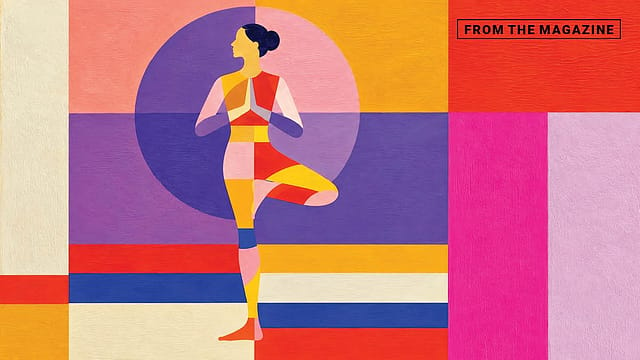
If you go to an Iyengar Yoga class anywhere in the world you will likely find more than a mat. On the walls there will be ropes attached to rings. Somewhere to the side skyscrapers of wooden bricks will be arrayed. There will be bolsters, belts and backless chairs. The yoga, as BKS Iyengar taught and his students teach now, is heavy on the physical aspect but as the years go by in a class, the teachers focus more on using the asana as a medium for pranayama and then meditation. In that it does not deviate from what the traditional textbooks tell you. The postures are mostly in line with the texts, but the way they are taught and the modifications are an Iyengar invention. He learnt yoga from his brother-in-law, T Krishnamacharya, as a young boy. He was sick and spindly with a chest racked by tuberculosis. When he died at 95, it was an extraordinarily healthy life as vigorously lived as possible. Discipline and an obsession with yoga had made it a successful turnaround story.
Some years ago, while doing a story on the prevalence of heart disease in India, I spoke to a businessman who, as a 52-year-old eight years earlier, had woken up in the middle of the night with pain in his chest. He walked down to the hospital nearby where they told him he had just had a massive heart attack. The signs were there earlier. He was over 100kg in weight, led a sedentary lifestyle and his father too had died of a heart attack. He had to undergo bypass surgery. The surprising part was what came after. He joined a gym, started walking on the treadmill. When the Mumbai Marathon happened, he took part in the 7-km run but walked most of the way. This was a year after the attack. Two years later he ran his first half-marathon. When I spoke to him, his yearly quota was four-to-five half-marathons and ten 10-km runs. His weight was 74kg. He was the fittest he had ever been in his life because of an episode that in a different day and age would have meant just waiting for death. A second chance had been fully utilised to effect a turnaround in his life.
Losing Memory
16 Oct 2026 - Vol 05 | Issue 42
The making of a medical and social emergency
This is not uncommon. People who let their body go to seed finally find an unwelcome trigger, like a diagnosis of diabetes, that radically changes how much value they put on their own wellness. That sheen of invulnerability, the idea that we all once carried—death and illness are elsewhere—falls away in an instant. Life becomes a series of make-up actions. Checking the nutrition label of a food product for its fat or sugar content. Walking. Running. Working out. Experimenting with diets to find out what appeals and works. What starts off as an attempt to control the disease brings with it greater bounties, like a radically improved standard of existence.
The human body, on average, starts off strong and then like any machine becomes susceptible to wear and tear. This cannot be reversed, only postponed. And there are many who do it. But the larger numbers are those who simply let time do its thing. Their fallback is not prevention, which requires effort, but medicines which are useful but not enough by themselves for a better life. Wellness is a composite. Many wheels must run together to get to that end. The opportunities for Indians to be fit and healthy have never been as good. Information is freely available online on how to do it. Technology, by way of apps and wearables, is assisting. A gym is never too far away in most places. And yet, this is not a battle being won very easily. India is called the diabetes capital of the world, a disease correlated with obesity. Equally worrying is younger and younger Indians contracting metabolic disorders.

A human being can change his life by making wise choices but how is a nation to do its turnaround? The numbers are both encouraging and discouraging for India. Lifestyle diseases are going up but so are the numbers in the population who are now more particular about nurturing their health. Right now the pendulum swings in the direction of those who are getting unhealthy; the challenge of a country is to invert those numbers. What can be a trigger moment for India to radically review how it approaches health? Covid could have been such an opportunity. An entire nation became aware of how important natural immunity was because there was no medication in the beginning. People thought of health not in terms of what pill to pop but which breathing exercise or dietary regimen most improves chances of survival. But once the vaccines arrived, we leaned once again into pharmaceuticals to keep us going. There is no magic pill for India to get fit; instead, it is the slow grind of awareness. Of making people know that these are the choices before them, the offerings that already exist and which could enrich their lives if only they would take the first step. It doesn’t have to be much. A small meditation practice daily of 10 to 15 minutes has been shown to reduce anxiety and stress. A 30-minute walk after a meal works wonders in keeping the blood sugar of a diabetic under control, almost as much as medicine. As Indians age, strength training is critical if bones must remain strong.
The selection of curated features in this issue captures the changes happening in the health and fitness journey of Indians. How do we meet the metabolic apocalypse looming on the horizon? If prevention is the way to do it, how does one go about it? If the appetite for Ayurveda is growing among the young, what are the forms it is taking? Meditation has had an extraordinary growth in the last hundred years as Indian techniques travelled the world and a long line of scientific research shows its benefits. How does one bring it into one’s own life in an easily accessible manner? What are the latest advances in nutrition science and is there such a thing as an ideal diet and a balanced meal? Where do beauty and luxury fit into the picture of Indian health? How are sexual wellness and mental wellness connected?
The pages that follow touch on these aspects and more, a map to a fuller life. Fine-tuning the self takes time and discipline. Effort is needed to move a system in inertia but once motion sets in, momentum does most of the work. The first walk of a recovering heart patient is a grind. But eventually half-marathons become easy.