With 20,000 seafarers stuck at Hormuz, maritime community warns of risks, hits out at Trump
India-based master mariner Samarth Sinha, who has sailed the seven seas and worked with leading global shipping firms, has criticised Donald Trump for the American President’s naïve and preposterous remarks about the global sailing community. Trump had asked them to “show some guts” and cross the Strait of Hormuz.
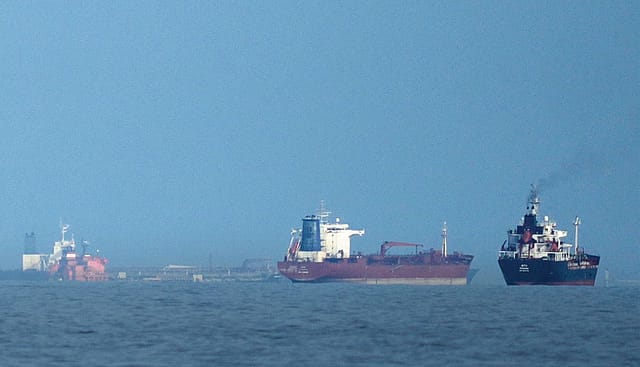
The Noida-based captain, who continues to serve at sea, also explained the dangers faced by merchant navy crews when ships are forced to remain stranded in strategic choke points such as the Strait of Hormuz. The narrow waterway, a critical artery for global oil shipments, has recently been restricted to traffic after Iran moved to tighten control in retaliation for attacks by the United States and Israel, leaving many commercial vessels navigating a tense and uncertain passage. According to reports quoting industry sources, more than 20,000 seafarers, many of whom are Indians, are “operating or stranded” in this region along with the ships and cargo they handle, some of which are expensive and risky assets.
“I have stayed quiet on geopolitics for years, but when I heard that (Trump’s ridicule), I could not, in good conscience, stay silent anymore… I am a ship captain and I know what guts actually look like. Gut is leaving your newborn child at home, watching them grow through a phone screen for months at a time. Guts is missing your father’s funeral because your ship is halfway across the Pacific. Guts is riding 30-degree rolls in a steel box [cargo can cause high instability in rough weather and captains are forced to take crucial decisions to reduce the speed, altering the course, etcetera to save the ship] while the rest of the world sleeps safely in their beds. Guts is keeping an injured or sick crewmate alive for days until we can reach help. Guts is sailing pirate-infested waters with no means to defend yourself. We don’t sail for glory. We sail so that you can have your clothes, your electronics, your fuel and food on your table tonight,” he asserted in a video that has gone viral, sparking widespread righteous indignation among the sailing community over the US president’s frivolous remarks.

Bengal Thriller 2026: The Plot Thickens
17 Apr 2026 - Vol 04 | Issue 67
Mamata Banerjee faces her toughest battle
That the situation around the Strait of Hormuz is grim is an understatement. The maritime situation, according to insiders, has entered what industry monitors describe as a “critical” risk phase. More than 20 maritime incidents have been reported since early March even as the traffic through the narrow waterway dropped dramatically from a historical average of around 138 vessels a day to almost negligible movement in recent advisories.
In fact, the primary concern about congestion or possible blockage has now evolved into a complex risk environment combining security, navigation, humanitarian and commercial threats, industry sources state. Merchant vessels operating in the region, including the Arabian Gulf and the Gulf of Oman, may face missile, drone and projectile attacks, sabotage-style incidents, navigation interference such as GNSS spoofing and Automatic Identification System (AIS) disruptions, as well as the risk of strikes on ports, offshore terminals and energy infrastructure. Ships that remain anchored, adrift or moving on predictable routes are considered particularly vulnerable. GNSS, or Global Navigation Satellite Systems, provide real-time positioning and other services to users worldwide and they include GPS, GLONASS (Russia), Galileo (EU) and BeiDou (China).
In fact, the crisis has also created a significant humanitarian dimension for seafarers, as stated by Captain Sinha and others earlier. According to figures cited by the International Maritime Organization and reported by Reuters, roughly 20,000 seafarers on nearly 2,000 commercial vessels are currently stranded west of the strait. Which means if tensions escalate further, particularly in the event of retaliation by Iran following additional strikes by the United States, crews could face prolonged periods trapped onboard with delayed evacuations, disrupted crew changes and shortages of essential supplies such as fuel, medicines and food. Maritime advisories emphasise that while measures such as naval coordination, avoiding predictable routes, and reducing time spent stationary can reduce exposure, they cannot guarantee safe passage. For many commercial operators, the most practical option at present is simply to avoid or defer transit through the strait unless movement is essential, highlighting the fragile state of one of the world’s most critical shipping corridors.
Samarth Sinha said in another video that vessels in the Strait of Hormuz are now waiting “in the shadow of conflict”. He stressed that the roughly 20,000 seafarers stranded in the region are not merely a statistic but human lives caught in a worsening crisis. “Cooks are stretching out the last of their provisions, ships are running out of drinking water, and crew members are counting the days with no certainty of going home. This is not congestion, this is paralysis,” he said.
Within days of the asymmetric escalation of war following the United States–Israel strikes on Iran on February 28, the strait—through which four out of every ten globally traded barrels of oil pass—has become a focal point of global economic anxiety. Oil prices have already surged with benchmark Brent crude trading at around $112 per barrel, reflecting market concerns over the security of shipments through the corridor, while stock and bond markets have faced extreme volatility. According to the International Energy Agency (IEA), nearly 20 million barrels of oil transited the strait daily in 2023, accounting for almost 30% of global seaborne oil trade. This vital maritime corridor connects major oil producers such as Saudi Arabia, the United Arab Emirates, Kuwait, Qatar, Iraq and Iran with energy-hungry economies including China, India, Japan and South Korea.
Meanwhile, Hareendranath Moolayil, a former chief engineer with decades of experience sailing the seas and currently the technical manager of one of the largest offshore groups in the Gulf region, offers his perspective on the situation. “These large ships cannot manoeuvre or change course quickly in confined waters [like near Hormuz], especially with heavy traffic and external threats around. Extended waiting at anchorage also increases risks such as collision and greater exposure to security incidents. Navigation itself becomes difficult with possible GNSS interference and communication disruptions. Even with experienced crew and proper planning, the risks cannot be fully controlled,” he points out.
The seasoned marine engineer adds, “At the same time, one serious concern is the possibility of a missile or drone attack leading to a hull breach. In the case of a tanker, this can result in an explosion, fire, flooding, or a major oil spill, potentially similar to a disaster like the Exxon Valdez incident in 1989. Such a situation would not only affect the vessel and its crew but could also lead to a large-scale environmental impact. In simple terms, these ships depend on stable and predictable conditions to operate safely, and that stability is clearly missing now.”
He goes on to say, “Just imagine a 200,000-tonne tanker spilling oil in this narrow and critical strait—especially if multiple incidents occur due to any reckless action by the parties involved. The consequences would not be limited to one vessel or one region; it could quickly escalate into a large-scale operational and environmental crisis. The risk is clearly very high.”
For those who work at sea, these are not abstract geopolitical tensions but immediate, technical realities as uncertainty deepens in one of the world’s most strategic maritime corridors.