‘Will Not Hesitate…’: Trump Warns of Massive Retaliation After Iran Strikes Qatar LNG Facilities
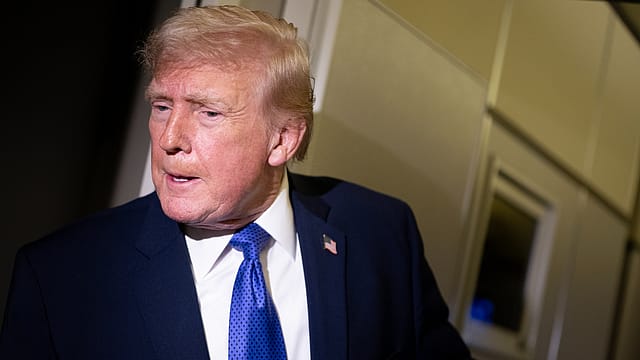
Tensions in the Middle East escalated sharply after missile strikes targeted critical energy infrastructure in both Iran and Qatar, prompting strong warnings from United States President Donald Trump and raising concerns over a widening conflict.
Missile strikes hit the South Pars Gas Field in Iran, the world’s largest liquefaction facility, triggering a chain of retaliatory actions.
In response, Iran launched ballistic missiles at Qatar’s Ras Laffan Industrial City, causing extensive damage, according to Qatar’s Ministry of Defence.

Rise of the Pivotal Power
18 Sep 2026 - Vol 05 | Issue 38
The BRICS declaration is a strategic victory for Modi
The attack marked the second strike within 12 hours on the largest liquefaction facility globally.
In a statement on Truth Social, Trump said the United States had no prior knowledge of the attack on South Pars and attributed the strike to Israel’s reaction to developments in the region.
Why did South Pars Gas Field come under attack and what did Donald Trump say?
"Israel, out of anger for what has taken place in the Middle East, has violently lashed out at a major facility known as South Pars Gas Field in Iran. A relatively small section of the whole has been hit,” he said.
“Unfortunately, Iran did not know this, or any of the pertinent facts pertaining to the South Pars attack, and unjustifiably and unfairly attacked a portion of Qatar's LNG Gas facility. NO MORE ATTACKS WILL BE MADE BY ISRAEL pertaining to this extremely important and valuable South Pars Field unless Iran unwisely decides to attack a very innocent, in this case, Qatar - In which instance the United States of America, with or without the help or consent of Israel, will massively blow up the entirety of the South Pars Gas Field at an amount of strength and power that Iran has never seen or witnessed before,” Trump wrote on Truth Social.
“I do not want to authorize this level of violence and destruction because of the long term implications that it will have on the future of Iran, but if Qatar's LNG is again attacked, I will not hesitate to do so. Thank you for your attention to this matter. President DONALD J. TRUMP,” he added.
"In addition to the previous attack on Ras Laffan Industrial City on Wednesday that resulted in extensive damage to the Pearl GTL (Gas-to-Liquids) facility, QatarEnergy confirms that in the early hours of Thursday, several of its Liquefied Natural Gas (LNG) facilities were the subject of missile attacks, causing sizeable fires and extensive further damage,” the company said.
“Emergency response teams were deployed immediately to contain the resulting damage with no reported casualties,” QatarEnergy added.
Qatar declared military and security attaches at the Iranian Embassy persona non grata and ordered them to leave the country within 24 hours, the Ministry of Foreign Affairs said.
Amid the escalating conflict, the Trump administration is considering deploying thousands of United States troops to the Middle East to reinforce ongoing operations against Iran, according to a US official and multiple sources familiar with the matter.
Could US operations further target Iran’s Kharg Island?
The potential deployments are aimed at expanding operational options, including securing safe passage for oil tankers through the Strait of Hormuz, primarily through air and naval forces.
Sources indicated that such efforts could also involve deploying troops to Iran’s shoreline, as reported by Reuters.
Discussions have also included the possibility of sending ground forces to Kharg Island, which handles 90 percent of Iran’s oil exports.
Officials noted that such an operation would carry significant risks due to Iran’s missile and drone capabilities.
The United States had earlier carried out strikes on military targets on the island on March 13, and Trump has threatened further action against Iran’s oil infrastructure.
Officials are also weighing options to deploy forces to secure Iran’s stockpiles of highly enriched uranium, a task experts describe as complex and risky even for special operations forces.
Sources said no immediate deployment of ground troops is expected, but discussions are ongoing as the conflict enters its third week.
Any such move could pose political risks for Trump amid limited public support in the United States and his prior commitments to avoid new military entanglements in the region.
The United States military has conducted more than 7,800 strikes since launching operations on February 28, targeting Iran’s navy, missile and drone stockpiles, and defence industry.
According to a factsheet released by US Central Command, over 120 Iranian vessels have been damaged or destroyed so far.
(With inputs from ANI)