Watch | Blood-Red Skies Over Western Australia as Cyclone Narelle Triggers Massive Dust Storms
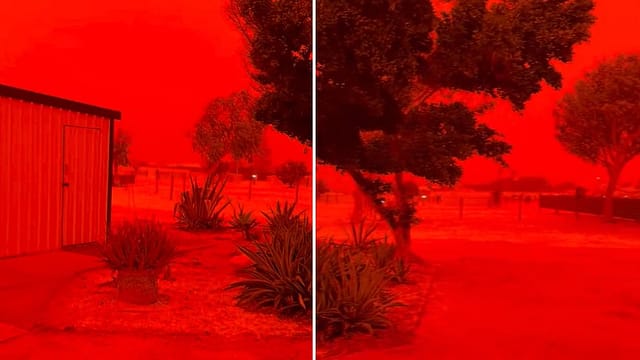
The sky over parts of Western Australia turned a dramatic blood-red as massive dust storms triggered by Tropical Cyclone Narelle swept through the region, creating an eerie spectacle that left residents stunned.
The phenomenon was most visible in Shark Bay and Denham, where the storm carried vast clouds of fine dust into the atmosphere.
Combined with rare atmospheric conditions as Narelle advanced toward the World Heritage-listed Shark Bay, the dust altered the way light passed through the sky.

Look Who's Talking Regime Change
23 Oct 2026 - Vol 05 | Issue 43
The dense concentration of particles scattered shorter blue wavelengths of light, allowing only the longer red wavelengths to pass through.
This resulted in a deep crimson glow that blotted out the sun and cast an otherworldly hue across the landscape.
For many locals, the experience was unsettling. Residents reported daylight being erased within minutes, visibility dropping to near zero, and the air becoming thick with dust.
The striking visuals quickly spread online, but also sparked debate. Some viewers questioned their authenticity, suggesting the scenes appeared too dramatic to be real.
In response, others shared videos labelled “no filter,” while some argued that the colour may have been enhanced.
What damage did Cyclone Narelle cause before weakening into a subtropical storm?
Narelle’s trajectory has been highly unusual. It became the first cyclone in more than two decades to make landfall across three different Australian jurisdictions, marking it as a rare “triple-strike” system.
The storm first hit Queensland’s Cape York Peninsula on March 20 before moving through the Northern Territory. It later regained strength over the Indian Ocean, intensifying into a powerful Category 4 cyclone before reaching Western Australia.
The broader system impacted multiple regions, including the Pilbara coast, with towns such as Exmouth and Karratha affected. At its peak, the cyclone recorded wind gusts exceeding 200 km/h, causing structural damage including roofs being ripped off in Exmouth and Coral Bay.
By Saturday evening, the system began to weaken. The Bureau of Meteorology confirmed that Narelle had lost its tropical characteristics and was downgraded to a subtropical storm as it tracked inland before moving offshore into the Southern Ocean.
While the immediate danger from the cyclone has eased, the situation is far from over.