“War won’t liberate Iran”: Noted Iranian feminist challenges the West’s narrative
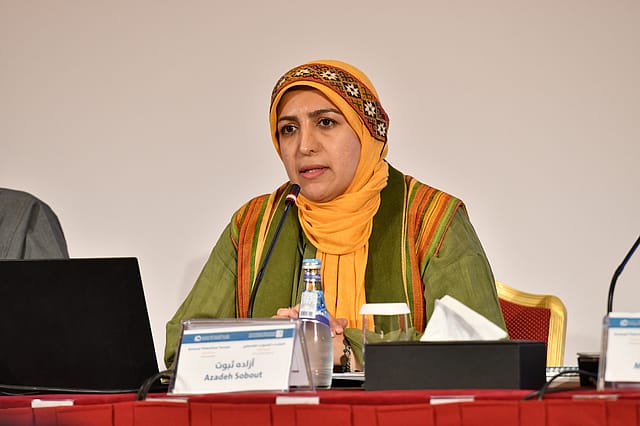
Iran-born, Belfast-based academic and activist Dr Azadeh Sobout is among the sober voices questioning the Western narrative that Iranians must choose between their government and war. Sobout, a postdoctoral research fellow at Queen’s University Belfast, is a feminist researcher whose work spans urban studies, law, post-conflict reconstruction, feminist geopolitics and spatial justice. Her work also examines how cities are destroyed, rebuilt and politically reshaped after war or violent conflict.
Working closely with marginalised communities, she focuses on justice for refugees, Palestinian freedom and racial discrimination. In an interview with Open, she challenges Western-centric assumptions about Iran and the aspirations of its people. She argues that despite the differing styles of Donald Trump and Benjamin Netanyahu in the current conflict--Trump pursuing what she calls a messianic mission and Netanyahu operating more transactionally--their strategies are structurally compatible rather than contradictory.

Zeroing In on ECI
09 Oct 2026 - Vol 05 | Issue 41
Constitutional legitimacy versus political opportunism
“By framing the Iranian Revolution primarily as the beginning of a war against the United States and Israel, the revolution is interpreted not through the aspirations of Iranians themselves but through the lens of Western security concerns,” she says.
Sobout, whose academic interests include countries such as Iran, India, Palestine, Lebanon, Bosnia and Herzegovina, Afghanistan and Ireland, argues that the same war that claims to support Iranian liberation risks delaying justice by destroying the very social conditions that make political change possible.
An alumnus of University College London, where she completed an MSc in Urban Development and Planning, and of Ulster University, where she earned her PhD, Sobout explains Iran’s war strategy, “Iran seeks to demonstrate that American military dominance in the region is vulnerable. Rather than attempting to defeat the United States directly, Iran aims to increase the cost of war to a level that forces political reconsideration in Washington and among regional allies.” Her PhD from Ulster University focuses on transitional justice and post war reconstruction. As a university student in Iran, Sobout was active in the student movement and in campaigns to defend women’s rights. She has also worked closely with grassroots NGOs supporting some of the country’s most vulnerable communities, with a particular emphasis on refugees and the urban poor.
Edited excerpts:
A section of commentators of Iranian origin (for example, Kian Tajbakhsh) support this war on Iran by Israel and the US stating that this is part of an ongoing war "launched by Iran" on the US in 1979 (https://openthemagazine.com/world/i-do-not-expect-mass-uprisings-in-iran-in-the-near-future-iran-born-new-york-university-scholar). Such scholars urge people to forget what had happened in 1953 because, to them, it is "ancient history". What are your thoughts on this?
To analyse this perspective, you must begin by examining the epistemic framework through which his argument interprets Iran and its political history. In his interview, Tajbakhsh suggests that American and Israeli actions are not the beginning of a war but rather the continuation or completion of a conflict that Iran “started in 1979.” This framing appears analytical on the surface, but it reproduces a deeply problematic geopolitical narrative that centres imperial perspectives while marginalising the historical experiences, political agency, and lived realities of Iranian society.
At the core of Tajbakhsh’s argument lies a Western-centric epistemology. By framing the Iranian Revolution primarily as the beginning of a war against the United States and Israel, the revolution is interpreted not through the aspirations of Iranians themselves but through the lens of Western security concerns.
The revolution was not conceived by millions of Iranians as an act of aggression toward Washington. It was a mass uprising against a monarchy sustained through external support and authoritarian repression. When this revolution is reinterpreted as a war against the United States, Iranian political agency is displaced by American geopolitical perception. The implicit question becomes not why Iranians revolted, but how their revolution affected Western interests.
This intellectual move reproduces a colonial hierarchy of knowledge in which the meaning of non-Western political struggles is determined primarily through the standpoint of imperial power.
Such narratives also rely on historicide, the selective erasure of historical events that challenge dominant geopolitical interpretations. The 1979 revolution cannot be understood without the trauma of the 1953 overthrow of Prime Minister Mohammad Mosaddegh, orchestrated by the Central Intelligence Agency and MI6 in Operation Ajax after Mosaddegh nationalised Iran’s oil.

That intervention destroyed a democratic trajectory and reinstalled the rule of Mohammad Reza Pahlavi, whose regime relied on severe repression to maintain power. For many Iranians, the revolution of 1979 was inseparable from this history of foreign intervention and domestic authoritarianism.
When analysts treat 1953 as irrelevant or distant history, they effectively remove the colonial context that shaped the revolution. What remains is a distorted narrative in which Iran appears as the initiator of hostility rather than a society responding to decades of political domination and geopolitical manipulation.
This reality also exposes the deeper analytical problem with arguments advanced by commentators such as Kian Tajbakhsh. When Iranian political life is interpreted primarily through the lens of geopolitical conflict between Iran and the United States, the diverse voices of Iranian society disappear from the picture.
The 1979 revolution itself was not merely an Islamic uprising. It was a broad coalition involving leftists, socialists, secular nationalists, labour organisers, and student movements who mobilised against the US-backed monarchy of Mohammad Reza Pahlavi and its security apparatus. Many of these actors were later repressed by the new Islamic Republic, yet their struggles demonstrate that Iranian political agency has always existed beyond the current regime.
The revolutionary movement also generated numerous local political experiments such as revolutionary councils and grassroots organisations that reflected the diversity of social forces participating in the uprising. Even in peripheral regions, different groups mobilised with distinct political visions, including Kurdish, Turkmen, and Arab movements seeking autonomy and representation in the revolutionary moment.
Reducing this complex revolutionary history to a simple act of anti-American hostility erases the political aspirations of millions of Iranians who mobilised for dignity, justice, and sovereignty.
When analysts reinterpret Iranian history through imperial vantage points, turning a popular revolution into a “war against the United States”, they do more than offer a controversial interpretation. They reproduce a worldview in which the aspirations of millions of people become secondary to the strategic narratives of global power. Underlying this narrative is a deeper worldview structured around hierarchies of power and supremacy, a belief that certain states possess the authority to discipline, punish, or restructure other societies according to their strategic interests.
What makes the argument advanced by commentators such as Kian Tajbakhsh particularly troubling is not simply that it misreads the present conflict, but that it requires a profound erasure of history. To frame the Iranian Revolution as the beginning of a war against the United States while dismissing the 1953 Iranian coup d'état as “ancient history” is to perform what can only be described as historicide-the removal of the historical conditions that made the revolution intelligible. Such framing recentres the imperial gaze, transforming a mass uprising rooted in anti-authoritarian and anti-imperial aspirations into a story about American grievance.
The goal of leaders like Netanyahu (whom even Zbigniew Brzezinski had called "messianic" and whose politics he had called "risky") is to create greater Israel besides reining in Iran. However, that of Trump is to make maximum gains with minimum effort (like in Venezuela). Do you agree?
There is some truth to the idea that Benjamin Netanyahu and Donald Trump approach the war from different strategic logics, but the divergence between them should not be overstated.
Netanyahu’s political project has long been tied to a maximalist regional security doctrine that views the weakening of Iran as essential to Israeli regional dominance. This doctrine extends beyond concerns about Iran’s nuclear program and is linked to a broader ambition to reshape the geopolitical balance of power in West Asia.
Trump’s approach, by contrast, tends to be far more transactional. His political style emphasises quick victories, symbolic demonstrations of strength, and domestic political gains rather than long-term geopolitical restructuring. His handling of crises in places such as Venezuela or North Korea illustrates this pattern: a strategy of maximum pressure combined with minimal sustained commitment. Trump often seeks to project strength while avoiding prolonged entanglements.
Despite these differences, the two strategies are structurally compatible rather than contradictory. Netanyahu requires American military backing to escalate against Iran and reshape the regional balance of power, while Trump benefits domestically from projecting toughness against a geopolitical adversary. This alignment means that the two leaders may disagree tactically but remain strategically interdependent.
In this sense, both approaches treat Iran less as a complex society with internal political dynamics and more as a geopolitical object to be reshaped by force. For that reason, the relationship between Netanyahu and Trump is unlikely to fracture in the short term. Their agendas converge around weakening Iran’s regional influence. Any serious divergence would likely emerge only if the war becomes prolonged and costly. A long war of attrition would undermine Trump’s preference for rapid and decisive outcomes while aligning more closely with Netanyahu’s longer-term strategy of containment and regional restructuring.
What does this war mean for the 90-plus million people of Iran? Do you expect this war to engineer a regime change in the country?
For the more than ninety million people living in Iran, the war represents a profound humanitarian, social, and political crisis. The most immediate reality is mass displacement and social disruption. According to the United Nations High Commissioner for Refugees, up to 3.2 million people have already been displaced inside Iran, representing approximately 600,000 to one million households forced to leave their homes since the escalation of the war. Large numbers of residents have fled major urban centres, including Tehran, moving toward northern provinces and rural areas in search of safety.
Displacement on this scale transforms everyday life. Schools close, workplaces collapse, healthcare systems become overwhelmed, and communities fracture as families scatter across the country. War does not merely destroy infrastructure-it destroys the social infrastructures that sustain political life and collective organisation.
The human toll is already visible. Iranian officials report more than 1,300 civilian deaths and thousands of injuries, while displacement continues to grow as the bombing campaign expands. In other words, this war is not an abstract geopolitical contest; it is an unfolding social catastrophe for ordinary Iranians.
Much of the current war has been sanitised in mainstream media coverage. Public discussion often focuses on geopolitical strategy while neglecting both the human consequences and the historical conditions that made the war possible.
On the ground in Iran, what we are witnessing is the rapid expansion of violence into civilian life. Reports emerging from the country indicate growing civilian casualties and widespread destruction of infrastructure essential to everyday survival.
Recent attacks have targeted facilities that sustain civilian life rather than purely military installations. These include desalination plants on Kish Island, oil refineries near Tehran, and sections of the national power grid. The destruction of such infrastructure has immediate consequences for the civilian population, affecting access to water, electricity, and fuel. Under the Geneva Conventions, attacks on civilian infrastructure that produce predictable harm to non-combatants raise serious legal and ethical concerns.
There have also been reports of so-called “double-tap” attacks-strikes in which a location is bombed and then targeted again after rescue workers arrive. These patterns resemble tactics previously documented in Lebanon and Gaza, where repeated strikes on civilian areas and infrastructure became part of the broader conduct of the Imperial war.
One of the most devastating incidents occurred in the southern city of Minab, where an elementary school was struck during the conflict. The attack killed between 168 and 180 people, most of them children, and injured nearly 95 others.
Environmental damage has also become a major concern. Strikes on oil facilities around Tehran have released large quantities of hydrocarbons and chemical pollutants into the atmosphere. Residents have reported days of toxic rainfall saturated with petroleum residue, and health experts warn that prolonged exposure could significantly increase the risk of respiratory illnesses and cancer. In this sense, the war is producing not only immediate casualties but also long-term public health and environmental crises.
Beyond the humanitarian crisis lies a deeper political consequence: the destruction of civil society. Before the war, Iranian society was already experiencing profound internal political suppression. Waves of protests driven by economic hardship, political repression, and demands for accountability mobilised workers, teachers, students, and feminist movements across the country.
These struggles were fragile but significant. They created micro-spaces of collective political life, labour organising networks, student forums, neighbourhood associations, and feminist mobilisations. War destroys precisely these spaces. Universities close, labour networks collapse, cultural institutions disappear, and neighbourhood solidarity structures dissolve as communities scatter under the pressure of displacement.
When bombs fall, the political horizon narrows dramatically. Civil society actors shift from organising collective action to simply surviving displacement, economic collapse, and insecurity. The immediate priority becomes safety rather than political transformation. This is why the assumption that war will produce democratic regime change is deeply flawed.
Historically, externally imposed regime change rarely produces democratic transitions. Instead, it tends to generate three dynamics: nationalist consolidation around the state, empowerment of security institutions, and fragmentation of civil society. In Iran’s case, this is particularly significant because political power is distributed across multiple institutions, the clerical establishment, elected bodies, and powerful security organisations such as the Islamic Revolutionary Guard Corps.
Under conditions of war, the most militarised institutions almost always gain political authority. External attack allows them to frame dissent as collaboration with foreign enemies and justify further repression in the name of national defence.
In situations where a population perceives an existential threat, internal divisions often become secondary to the need for collective defence. This dynamic is not new in Iran’s political history. The Islamic Republic itself was consolidated during the Iran–Iraq War in the 1980s, when Saddam Hussein invaded Iran shortly after the 1979 revolution. Saddam assumed that the newly established revolutionary government was weak and unstable, and that a military invasion would quickly bring about its collapse.
Instead, the war produced the opposite outcome. The external threat helped consolidate the new political order by mobilizing Iranian society around the defence of the country. What was intended as an opportunity to exploit weakness ultimately strengthened the state. A similar dynamic appears to be unfolding today. When the United States and Israel launched attacks in June, the result was not necessarily the fragmentation of the Iranian political system but rather the reinforcement of certain internal political alignments.
It is true that many Iranians are critical of the government. In fact, supporters of the Islamic Republic likely represent a minority of the population. However, this minority remains politically consequential because it is closely linked to the institutions of the state. For these groups, the attacks have reinforced long-standing beliefs that the United States and Israel cannot be trusted and that negotiations with them are futile. From their perspective, the escalation confirms the view that Western powers are willing to attack Iran regardless of diplomatic engagement. As a result, the war risks strengthening precisely the political forces that external actors claim they seek to weaken.
There is also a deeper ideological problem with the idea that war will “liberate” Iran. This argument relies on a familiar imperial narrative: that external violence can somehow produce democracy. Yet history-from Iraq to Libya-shows that military intervention tends to produce state collapse, civil war, and prolonged instability rather than democratic transformation.
Many Iranian intellectuals and activists have warned that internal struggles for justice are often instrumentalised by external powers to justify intervention. Feminist movements, labour struggles, and democratic protests inside Iran have their own political trajectories rooted in Iranian society. When these struggles are invoked as moral justification for bombing the country, their political meaning is distorted and appropriated.
The result is a cruel paradox: the same war that claims to support Iranian liberation risks delaying justice by destroying the very social conditions that make political change possible.
Indeed, some of the most important voices inside Iranian civil society have explicitly rejected the idea that liberation can be delivered through foreign military intervention. The Syndicate of Workers of the Tehran and Suburbs Bus Company, one of the country’s most prominent independent labour organisations, publicly rejected foreign military intervention and insisted that liberation must come through organised internal struggle.
Student coalitions from leading Iranian universities issued a joint declaration stating: “Neither the Islamic Republic, nor monarchy, nor MEK,” rejecting authoritarianism in every form, whether domestic or externally imposed.
The Association of Iranian Writers condemned killings and enforced disappearances by the Iranian state while rejecting the illusion that freedom could be delivered by missiles.
Even individuals imprisoned by the Iranian state have articulated a similar position. Pakhshan Azizi condemned war, sanctions, and foreign intervention that have inflicted suffering on ordinary Iranians.
These voices represent a political current that is rarely acknowledged in Western political debates. In many discussions in Washington, Iran is reduced to two caricatures: the ruling elite in Tehran and exiled opposition figures who promise that pressure and war will bring about regime change. Yet inside the country, a third current has always existed, one that is simultaneously anti-authoritarian and anti-war. It rejects both domestic repression and foreign intervention and insists that meaningful political change must emerge through self-determination and organised civic struggle.
The geopolitical context further complicates the regime-change narrative. The war is not only about Iran itself but about broader global power competition involving the United States, Russia, and China. Destabilising Iran could reshape regional energy routes, shift global power balances, and affect strategic competition far beyond West Asia.
Under these conditions, regime change is unlikely to emerge as a democratic transformation. More plausible outcomes include prolonged instability, intensified repression, or regional escalation.
Understanding this dynamic is crucial for assessing the broader political consequences of the conflict.
How repressive has been the government of Iran since the Revolution?
The Islamic Republic has undoubtedly developed extensive coercive mechanisms since the Iranian Revolution. Political dissent has frequently been suppressed; journalists, activists, and intellectuals have faced imprisonment; and protest movements have at times been violently repressed. The state has also constructed a powerful institutional network combining clerical authority with security organisations that concentrate significant power around the Supreme Leader.
At the same time, Iranian society has never been politically passive. Over the past four decades the country has witnessed repeated waves of mobilisation, including student protests, labour struggles, reformist electoral movements, and feminist uprisings such as the “Woman, Life, Freedom” movement that emerged after the killing of Jina (Mahsa) Amini. These movements demonstrate that Iranian political life contains vibrant contestation rather than passive submission.
The existence of these movements reveals an enduring contradiction within the Islamic Republic. While the state maintains powerful security institutions and restrictions on political freedoms, Iranian society continues to generate strong democratic aspirations and grassroots activism.
Important differences also exist between the leadership periods of Ayatollah Khomeini and Ayatollah Khamenei. Khomeini presided over the revolutionary consolidation of power and the ideological formation of the Islamic Republic following the overthrow of the monarchy. His leadership shaped the foundational political and theological framework of the new state. Khamenei’s period, by contrast, has been characterised more by institutional entrenchment and consolidation. During his tenure, security institutions-particularly the Islamic Revolutionary Guard Corps-expanded their influence not only within the security apparatus but also across major sectors of the Iranian economy and political system.
Understanding repression in Iran also requires historical perspective. Before the revolution, the monarchy of Mohammad Reza Pahlavi relied heavily on the secret police known as SAVAK. SAVAK became notorious for widespread surveillance, imprisonment of dissidents, torture, and the suppression of opposition movements.
The monarchy itself had been strengthened following the 1953 Iranian coup d'état, which removed the democratically elected prime minister Mohammad Mosaddegh after he nationalised Iran’s oil industry. The coup, orchestrated by the Central Intelligence Agency and Britain’s MI6 during Operation Ajax, restored the Shah’s authority and deepened the alliance between the monarchy and Western powers.
This historical experience profoundly shaped the political consciousness that produced the revolution. For many Iranians, the struggle against the Shah was not only a fight against authoritarian rule but also against foreign intervention and political subordination.
Recognising repression under the Islamic Republic therefore should not erase the repression that preceded it. Both periods illustrate a broader pattern in modern Iranian history: the tension between authoritarian state structures and persistent social movements seeking political participation, sovereignty, and social justice.
What do you think is Iran's grand strategy in this war?
The Imperial war on Iran reflects deeper structural tensions within the international system. The war cannot be understood solely as a bilateral confrontation between Iran and Israel. Rather, it forms part of a broader transformation of the global order involving shifting power relations between the United States, China, Russia, and regional actors.
The war also represents a critical moment in the transformation of the global system, linking energy security, financial markets, military logistics, and geopolitical alliances. In this context, Iran becomes both a regional actor and a strategic node within a wider geopolitical network connecting the Persian Gulf, Central Asia, and global energy markets. The disruption of energy flows through the Strait of Hormuz, the escalation of missile exchanges, and the potential involvement of additional regional actors all illustrate how a regional war can quickly acquire global consequences.
Iran’s decision to extend the battlefield across the Gulf and target American military bases in countries such as the United Arab Emirates, Qatar, Saudi Arabia, Jordan, Iraq, and Bahrain can be understood less as a purely expansionist strategy and more as a form of asymmetric deterrence within a deeply unequal geopolitical order.
In military terms, Iran is confronting a coalition with overwhelming technological superiority. The United States and Israel possess extensive airpower, global strike capabilities, and a vast network of bases across the Middle East. When U.S. and Israeli strikes began hitting targets across Iran, Tehran responded by targeting American military infrastructure throughout the region. These attacks have struck installations such as Al Udeid Air Base in Qatar, Al Dhafra Air Base in the UAE, and facilities linked to the U.S. Fifth Fleet in Bahrain.
Many of these governments host extensive American military infrastructure and allow their territory to be used as operational platforms for U.S. power projection in the region. In that sense, their involvement in the conflict predates any Iranian strikes. When American bases located in these countries are used to launch or support military operations against Iran, the distinction between “American assets” and the territory of host states becomes politically blurred. Therefore, it is important to note that these installations are not neutral spaces but part of the military architecture through which the war is being conducted.
The strategic logic is relatively clear: by expanding the battlefield geographically, Iran seeks to demonstrate that American military dominance in the region is vulnerable. Rather than attempting to defeat the United States directly, Iran aims to increase the cost of war to a level that forces political reconsideration in Washington and among regional allies.
In other words, Iran’s strategy operates through deterrence by vulnerability. If Iranian missiles and drones can strike American bases across the Gulf, the message is that the United States cannot wage war against Iran without exposing its own regional infrastructure to attack. This logic also explains why Iran has repeatedly framed its strikes as targeting American military assets rather than the Gulf states themselves, even though those bases operate within their territories.
This dynamic exposes the broader architecture of power in the region. West Asia hosts one of the densest concentrations of foreign military bases in the world. These installations are not merely defensive structures; they are part of a global system of military projection that has shaped regional politics for decades.
From this perspective, Iran’s strategy cannot be understood solely as a calculation about territorial control or military victory. It is also a political message directed at the regional order itself. By striking American bases across the Gulf, Iran is challenging the assumption that the United States can project power in the region without facing retaliation.
It is however necessary that we examine how such geopolitical architectures affect everyday life. Military bases, sanctions regimes, and war economies produce highly gendered and unequal consequences. The humanitarian effects of the current conflict, including mass displacement and economic collapse, are borne primarily by civilians rather than by political elites.
At the same time, we must also acknowledge the moral and political limits of this strategy. Expanding the battlefield inevitably increases the risk to civilian populations and threatens to entrench cycles of militarization that harm societies across the region. Indeed, the war has already caused enormous human suffering. The conflict has spread across the region with missile attacks, infrastructure damage, and severe disruptions to global energy markets. These consequences reveal how wars fought between states often translate into social crises for ordinary populations.
Moreover, the strategy unfolds within a global system that already marginalizes the voices of those most affected by war. Workers, women’s movements, students, and grassroots organizations inside Iran have repeatedly emphasized that political transformation must emerge through internal struggle rather than external intervention.
Ultimately, Iran’s strategy reflects the structural conditions of a region shaped by decades of intervention, alliance politics, and militarization. The expansion of the battlefield across the Gulf is not simply a tactical decision; it is also a symptom of a broader geopolitical order in which smaller or weaker states attempt to resist overwhelming power through asymmetric means.
What do you think of the projection of the death toll of “30,000” in the January 2026 protests? Many people, including independent journalists, say that it was a ‘plant’ or fake news by a section of the media that gave platforms to compromised reporters to manufacture a consent for this war. How do you react to this?
The number of people killed during the protests has become central to international narratives about Iran, yet the figures vary widely depending on the source and the politics of documentation.
Iranian state officials have claimed that roughly 3,000–5,000 people were killed, including both protesters and members of the security forces. The Human Rights Activists News Agency (HRANA) has confirmed over 7,000 identified deaths with names and details while noting that thousands of additional cases remain under investigation. HRANA provides crucial documentation of state violence and repression, documenting the first fifty days of the uprising and compiling lists of victims across Iran’s provinces while carefully distinguishing between protesters, civilians, and security personnel. However, it must be noted that the organisation operates within a broader network that has received funding from the National Endowment for Democracy, a US government–funded institution often described by critics as a public-facing instrument of American foreign policy that historically replaced certain overt activities previously associated with the CIA (Central Intelligence Agency). This context does not automatically invalidate HRANA’s documentation, but it does illustrate how casualty statistics circulate within highly politicised information ecosystems.
At the same time, media outlets such as Iran International circulated much higher numbers-sometimes above 30,000 deaths- without transparent documentation methods or verifiable datasets. The circulation of these narratives is also shaped by complex media ecosystems within the Iranian diaspora. For example, the Persian-language broadcaster Iran International, which has played a significant role in shaping international narratives about Iran, has faced scrutiny regarding its financial backing. Investigations reported by The Guardian revealed links between the channel’s funding structures and a Saudi businessman connected to Crown Prince Mohammed bin Salman.
Particularly since the Gaza genocide, we have seen Iran International increasingly align its editorial framing with pro-Israeli narratives. This tendency became especially visible during the June 2025 war on Iran. During that period, the Persian-language broadcaster frequently amplified Israeli and pro-Western narratives about the conflict while providing a platform for Israeli officials and commentators.
The discrepancy in numbers is therefore not only a technical question about the scale of repression. It is also about how casualty figures are mobilised politically. The issue is not simply whether atrocities occurred, they did, but how the documentation of those tragedies can become entangled with broader geopolitical agendas.
Within regime-change discourse, particularly among some diaspora monarchist networks advocating the restoration of the Pahlavi monarchy-large casualty figures have frequently been mobilised to support arguments in favour of external intervention. The rhetorical pattern is familiar. Whenever critics oppose bombing campaigns, sanctions, or military escalation, they are confronted with a moral counter-argument:
“The Islamic Republic has already killed more.”
This argument operates as a form of moral arithmetic. The deaths of protesters are used to justify the deaths that external warfare will inevitably produce. Once that narrative is established, a powerful discursive mechanism emerges. Whenever someone opposes war or bombing campaigns, the response becomes predictable: “Why oppose the war? The Islamic Republic has already killed more.”
This rhetorical move effectively normalises the killing of Iranians by Israeli-US war machines. The argument transforms the deaths of protesters into a justification for foreign military violence rather than a call for solidarity with Iranian society.
In other words, the suffering of Iranian citizens becomes politically instrumentalised. Instead of protecting Iranian lives, the narrative begins to function as a moral licence for additional violence against them. Instead of mobilising international solidarity with Iranian civil society, the deaths of protesters become discursive tools for legitimising foreign military violence.
This dynamic risks transforming the suffering of Iranian citizens into a geopolitical instrument. The result is a tragic paradox: the deaths of protesters-who risked their lives demanding dignity and political rights-can become transformed into discursive weapons within geopolitical struggles that ultimately produce even more violence.
Recognising this dynamic does not mean dismissing the reality of repression inside Iran. The killings, arrests, and executions documented by human rights organisations are deeply serious and demand international attention but opposing authoritarian violence should never require accepting the logic that foreign military intervention is a legitimate or effective solution. For this reason, many Iranian activists argue that the issue is not choosing between two forms of violence but rejecting both. A principled position must therefore hold two truths simultaneously: the Iranian state has committed serious human rights abuses, and external military violence against Iran will not liberate Iranian society. The challenge is to defend Iranian lives without allowing those lives to become instruments in the geopolitical calculus of war.