USS Spruance Forces Iranian Cargo Vessel to Turn Back Amid Gulf Blockade
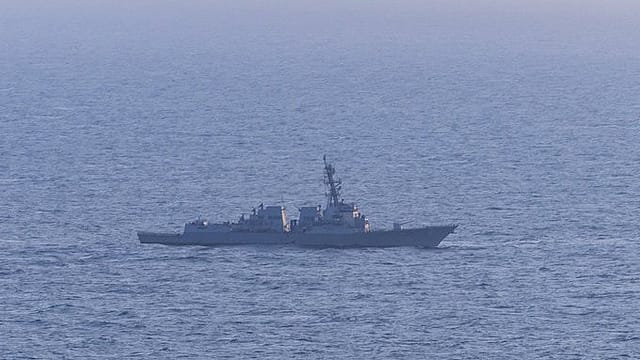
The United States Central Command (CENTCOM) on Wednesday (US time) said the USS Spruance, an Aegis guided-missile destroyer, forced an Iranian-flagged cargo vessel to turn back to Iran, marking the latest enforcement action under the ongoing naval blockade in the region.
In a post on X, CENTCOM said the incident took place after the vessel attempted to evade restrictions imposed since the blockade began earlier this week.
"Yesterday, an Iranian-flagged cargo vessel tried to evade the U.S. blockade after leaving Bandar Abbas, exiting the Strait of Hormuz, and transiting along the Iranian coastline," the statement said.
"The guided-missile destroyer USS Spruance (DDG 111) successfully redirected the vessel, which is heading back to Iran," it added.
CENTCOM further noted the scale of enforcement since the operation began.
"Ten vessels have now been turned around and ZERO ships have broken through since the start of the U.S. blockade on Monday," it added.
What is the objective of the US blockade?
Meanwhile, the blockade, which entered its third day, has already led to multiple merchant vessels being turned away, with US forces claiming full control over maritime traffic entering and leaving Iranian ports.

Open Minds 2026
26 Jun 2026 - Vol 05 | Issue 26
The power of ideas and arguments in 50 portraits
The blockade is designed to isolate the Iranian economy by severing its primary maritime trade routes.
According to official military communications, US forces are maintaining a high state of readiness to ensure total compliance with the embargo.
The escalation comes at a delicate moment.
While President Trump has hinted that a "great deal" could be on the horizon, the presence of heavy naval hardware in the Gulf of Oman suggests that the US is prepared to maintain the squeeze until a definitive agreement is reached.
What impact has the US blockade had on maritime trade through the Strait of Hormuz?
The United States Central Command (CENTCOM) earlier today announced that a full blockade of Iran's ports has been successfully implemented, with US forces asserting maritime dominance across key regional waterways, particularly the Strait of Hormuz.
In a statement, CENTCOM Commander Admiral Brad Cooper stated that within just 36 hours of initiating the blockade, US forces had effectively stopped all maritime trade flowing in and out of Iran.
The blockade extends across all Iranian ports along the Persian Gulf and the Gulf of Oman, with US forces maintaining strict enforcement measures.
CENTCOM further noted that while the blockade restricts access to Iranian ports, US forces continue to support freedom of navigation for vessels transiting the Strait of Hormuz to and from non-Iranian ports.
The development marks a significant escalation in US-Iran tensions, with potential implications for global trade and regional stability.
(With inputs from ANI)