Trump Warns Iran of “One Big Glow” as Ceasefire Faces Fresh Strait of Hormuz Clash
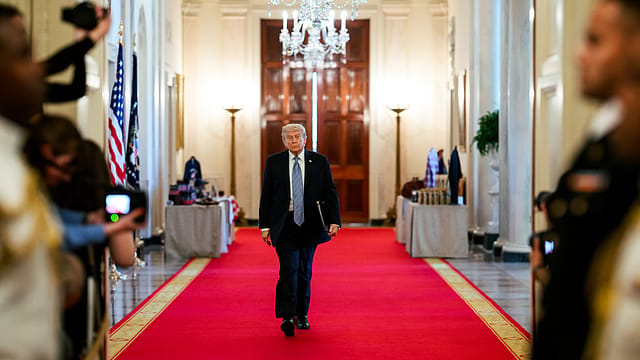
US President Donald Trump has insisted that the ceasefire between Washington and Tehran remains operational, even after a fresh military confrontation involving US Navy destroyers in the Strait of Hormuz.
Speaking during an unannounced appearance at the Lincoln Memorial Reflecting Pool, Trump suggested that any real collapse of the truce would be impossible to miss.
“You won't have to know if there's no ceasefire,” Trump stated. “You'll just have to look at one big glow coming out of Iran,” he added.
The remarks came shortly after the United States Central Command confirmed that American forces had carried out retaliatory strikes against Iranian military infrastructure following what it described as attacks on US naval assets.
According to CENTCOM, Iranian missiles, drones and small boats targeted three guided-missile destroyers — the USS Truxtun (DDG 103), USS Rafael Peralta (DDG 115) and USS Mason (DDG 87) — as they moved through the strategic waterway toward the Gulf of Oman.
CENTCOM said, “US forces intercepted unprovoked Iranian attacks and responded with self-defense strikes as US Navy guided-missile destroyers transited the Strait of Hormuz to the Gulf of Oman.”
The military command further stated that “No US assets were struck” despite facing “multiple missiles, drones, and small boats.”
Trump Downplays Escalation While Warning Iran
Even as the confrontation marked one of the most serious direct encounters between US and Iranian forces in recent months, Trump attempted to minimise the scale of the escalation.

Exclusive: To the Heavens and Back
19 Jun 2026 - Vol 04 | Issue 76
Shubhanshu Shukla relives the space odyssey that put India into orbit
“They trifled with us today,” Trump said. “We blew them away. They trifled. I call that a trifle.”
The US President later praised the American naval response in a Truth Social post.
“Three World Class American Destroyers just transited, very successfully, out of the Strait of Hormuz, under fire. There was no damage done to the three Destroyers, but great damage done to the Iranian attackers,” he wrote.
Trump claimed the Iranian units “were completely destroyed along with numerous small boats, which are being used to take the place of their fully decapitated Navy.”
Describing the engagement further, he added, “Missiles were shot at our Destroyers, and were easily knocked down. Likewise, drones came and were incinerated while in the air. They dropped ever so beautifully down to the Ocean, very much like a butterfly dropping to its grave!”
The President also sharply criticised Iran’s leadership, saying, “A normal Country would have allowed these Destroyers to pass, but Iran is not a normal Country. They are led by LUNATICS.”
He warned that “we'll knock them out a lot harder, and a lot more violently, in the future, if they don't get their Deal signed, FAST!”
Iran Offers A Different Version of Events
Iranian state-linked media, however, presented a very different account of the confrontation.
The IRGC-affiliated Tasnim News Agency claimed Iranian naval forces had successfully targeted the American vessels using “missiles and suicide drones.”
The outlet alleged that “The destroyers of the US terror force are fleeing towards the Sea of Oman.”
The precise timeline and extent of the damage remain independently unverified.
Trump Pushes Aggressively for Nuclear Agreement
Alongside the military tensions, Trump also claimed that diplomatic negotiations with Iran were progressing toward a possible nuclear deal.
Addressing reports that Washington had sent Tehran a “one-page proposal,” Trump dismissed the characterisation as misleading.
“Well, it's more than a one-page offer. It's an offer that basically said they will not have nuclear weapons, they are going to hand us the nuclear dust and many other things that we want,” Trump informed reporters.
The US President also suggested that Iran had broadly accepted the proposal, though he quickly expressed scepticism about Tehran’s reliability.
“They have agreed. When they agree, it doesn't mean much because the next day they forgot they agreed,” he said.
“And you know, we're dealing with different sets of leaders,” he added.
Trump reiterated the administration’s core objective during a later White House briefing, declaring, “The plan is very simple. Iran cannot have a nuclear weapon.”
Pakistan Emerges as Key Mediator?
Reports from Iranian media indicate that Tehran is still reviewing messages transmitted by the United States through Pakistani intermediaries.
According to IRNA, an Iranian Foreign Ministry spokesperson confirmed that discussions are ongoing and no formal response has yet been sent to Washington.
The spokesperson reportedly said that the main focus of the talks remains a ceasefire and “stability in the region.”
Meanwhile, Al Jazeera reported that Iranian Foreign Minister Abbas Araqchi held a phone conversation with Pakistani Foreign Minister Ishaq Dar as Islamabad deepened its role in mediation efforts.
Trump has continued to publicly project optimism about a breakthrough.
“They want to make a deal... it's very possible,” he said, before adding that the conflict “will be over quickly.”
Fresh Sanctions Signal Continuing Pressure Campaign?
Despite the apparent diplomatic momentum and a ceasefire largely holding since April, Washington has continued to intensify economic pressure on Tehran.
The United States imposed new sanctions on Iraq’s deputy oil minister and three militia-linked figures, accusing them of supporting Iran-backed operations in the region.
The move underlines the dual-track strategy currently being pursued by Washington — combining diplomacy with military deterrence and economic coercion.
The latest developments leave the region balancing uneasily between a fragile ceasefire and the possibility of renewed confrontation, as negotiations over Iran’s nuclear ambitions continue behind the scenes.
(With inputs from ANI)