Trump shortens US-South Korea drills, Seoul says it got no advance notice: What happens next?
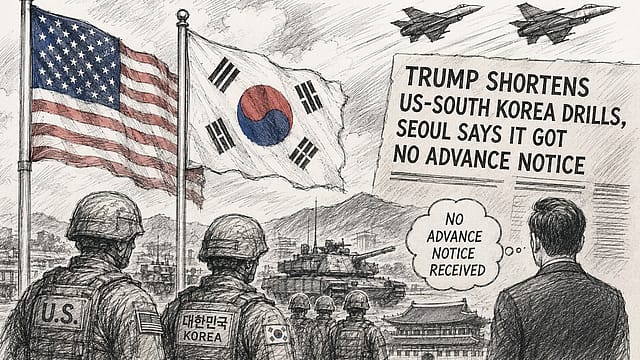
For South Korea, the most uncomfortable part of Donald Trump's decision to cut a major military exercise may not be the six days that disappeared from the calendar.
It may be the fact that Seoul says it did not know the cut was coming.
The annual Ulchi Freedom Shield (UFS) exercise began on August 17 and was originally scheduled to run until August 27. It will now end on August 21, while some field-training elements are also being scaled back. The allies have said the changes preserve essential readiness and training objectives.
But South Korean Foreign Minister Cho Hyun told parliament on Wednesday that neither Seoul nor US officials had been informed in advance about Trump's directive. “Neither our government nor US officials knew what President Trump wrote on his Truth Social,” Cho told the National Assembly Committee on Foreign Affairs and Unification. “We were not notified in advance,” he said.

Losing Memory
16 Oct 2026 - Vol 05 | Issue 42
The making of a medical and social emergency
So, what does the shortened drill actually mean for Seoul?
First, it is a test of the alliance
Ulchi Freedom Shield is not just another military exercise.
The annual drills are designed to strengthen interoperability and command coordination between the South Korean and US militaries and prepare for potential threats from North Korea. This year's exercise was also designed around newer threats such as drones, cyberattacks and GPS disruption. Around 18,000 South Korean troops were expected to participate.
That is why the manner of the announcement matters. South Korea's defence minister, Ahn Gyu-back, was involved in discussions with his US counterparts. Cho therefore stopped short of calling Trump's decision a unilateral notification.
“Since our defence minister was involved in the discussions, I do not think it amounts to a unilateral notification,” he said.
For Seoul, that distinction is important. The military relationship remains active. But the episode has exposed a potentially uncomfortable question: how much consultation can South Korea expect when Washington decides to change the shape of its military commitment?
Then there is Kim Jong-un
Trump has made no secret of his desire to reopen dialogue with North Korea. His order to reduce US participation in the drills came after he said he had a “very good relationship” with Kim Jong-un and that Kim had responded to his outreach. North Korea has routinely condemned the exercises as rehearsals for invasion, although Washington and Seoul insist they are defensive.
For Seoul, that creates a delicate balancing act.
South Korea wants lower tensions with Pyongyang. President Lee Jae Myung has also stressed stronger independent defence capabilities while maintaining the US alliance. Seoul's national security adviser has said it hopes Trump's outreach could help restart meaningful dialogue with North Korea.
In other words, Seoul may welcome the possibility of diplomacy. But it does not want diplomacy to come at the cost of deterrence.
And what about wartime command?
This is where the six-day cut becomes much more significant.
South Korea has been pushing for the transfer of wartime operational control, or OPCON, from the US-led command structure to Seoul. President Lee has backed moving ahead with the planned transfer during his term, alongside efforts to strengthen South Korea's own defence capabilities.
Cho made the Seoul government's position clear.
Washington “should not be able to use the reduction as a reason to further delay the transfer as the drills are being scaled back at the US' request,” he said.
There is an intriguing contradiction here. If the US is reducing its role in the exercises, South Korea could argue that it should have more, not less, responsibility for its own defence.
But reduced joint training could also make questions about readiness and command integration more complicated. The Pentagon has said the changes will preserve essential training aims, so it would be premature to conclude that the shortened exercise itself will derail the OPCON process.
Is this only about North Korea?
Not necessarily. This is where the story gets bigger than the Korean Peninsula.
Trump's decision comes amid broader disagreements between Washington and Seoul over burden-sharing, Iran and a South Korean investment commitment in the United States. Reuters reported that Foreign Minister Cho believed Trump's message included pressure on Seoul over several pending issues, including its support for US efforts in the Iran war and a $350 billion US investment commitment linked to the two countries' trade deal.
That means Seoul may be reading the drill reduction in several ways at once.
A signal to Kim. A message to Seoul. And a reminder that Trump sees alliances partly through the lens of what partners contribute.
So, is South Korea becoming less secure?
Not necessarily.
The US has not abandoned the alliance, and the allies have stressed that the revised exercise will retain core readiness objectives. The two countries also have a cost-sharing agreement covering 2026-2030.
But the episode does expose a vulnerability for Seoul: its security depends heavily on an ally whose priorities can change quickly.
Trump has taken a different approach to the alliance before. During his first presidency, he suspended major US-South Korea exercises after his 2018 summit with Kim, calling them expensive and provocative. The drills later resumed after diplomacy with Pyongyang stalled.
This time, however, North Korea is operating with a larger nuclear and missile capability and deeper military ties with Russia than during Trump's first-term diplomacy.
That makes Seoul's calculation harder.
What does Seoul want now?
Probably not a choice between war games and peace talks. It wants both deterrence and diplomacy. Cho said Seoul is preparing channels for dialogue with North Korea and wants close coordination with Washington if Trump and Kim meet again.
“The (South Korean) government has been making thorough preparations to open channels for dialogue with North Korea, and we will closely consult with the US side not to miss this opportunity,” he said.
But Seoul has already conveyed its intentions to Washington and, according to Cho, has yet to receive a response. He also said South Korea had sought details about the recent exchange Trump has described between Washington and Pyongyang.
That may be the real story behind the shortened drill. South Korea does not necessarily object to Trump talking to Kim. It wants to make sure it is not talked around while the two superpowers — one its ally, the other its neighbour and adversary — negotiate its security future.
The missing six days are therefore only the visible part of the story.
The bigger question for Seoul is who gets to decide what comes next: Washington, Pyongyang — or Seoul itself?
(With inputs from ANI)