Trump Rejects Iran’s Seven-Day Ceasefire Plan, Eyes Post-Midterm Strikes: Report
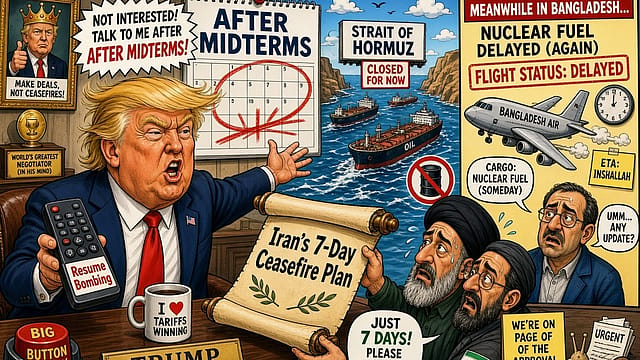
US President Donald Trump has rejected Iran’s proposed seven-day ceasefire and told aides he expects to resume bombing the country after November’s midterm elections, The Wall Street Journal reported, citing US officials.
The report casts uncertainty over Tehran’s latest diplomatic initiative, which envisaged reopening the Strait of Hormuz and restarting nuclear negotiations if specified conditions were met.
It also follows Trump’s September 22 address to the United Nations General Assembly, where he threatened to “annihilate the Islamic Republic” while predicting that an agreement could follow the elections.
“But I believe we’ll make a deal right after the election, because it doesn’t make sense for them not to,” Trump told the Assembly.

Zeroing In on ECI
09 Oct 2026 - Vol 05 | Issue 41
Constitutional legitimacy versus political opportunism
The reported discussions with aides suggest renewed military action remains under consideration alongside his public talk of a deal. The account did not provide a date for any strikes.
What Iran Put on the Table
Iranian Foreign Minister Abbas Araghchi said on Thursday that Tehran had sent Washington a seven-day proposal through intermediaries.
Under the plan, the Strait of Hormuz would reopen at the end of the seventh day and talks would resume, provided certain conditions were fulfilled. Araghchi described the proposal as similar to a memorandum of understanding that he said Iran and the United States had reached in June.
“We have introduced a plan to the United States through the intermediators that if certain conditions are met, the Strait of Hormuz would be open on the end of the seventh day and talks would restart,” he said.
Araghchi suggested that reaching an agreement before the US midterm elections would be preferable. The conditions attached to the proposal were not detailed in the reported remarks.
In a meeting with German Foreign Minister Johann Wadephul, he said Tehran had conveyed its requirements for diplomacy to Washington. He argued that regional security depended on ending what he described as US intervention and aggression against Iran.
Tehran Says an Earlier Agreement Was Undermined
Iranian President Masoud Pezeshkian, meanwhile, blamed Washington for failing to implement the framework he said the two sides had agreed in June.
“We did reach an agreement with your president, that agreement was signed, and based on that, we are willing and still wish to move forward,” he told Fox News.
Pezeshkian accused the United States of attacking Iran and blocking dialogue. He also alleged that US attacks had killed Iran’s supreme leader, scientists, military commanders and government figures.
His argument was that Tehran remained willing to negotiate on the basis of the earlier framework. Trump’s reported rejection of the latest proposal leaves the timing and terms of any renewed negotiations uncertain.
Separately, Bangladesh Signs US Nuclear Cooperation Agreement
In a separate development, Bangladesh and the United States signed an agreement on the peaceful uses of nuclear energy, according to a statement issued by the BNP media cell on Saturday.
The statement identified the signatories as Rehan Asad, adviser to Bangladesh’s prime minister on science and technology, and US official Jacob Helberg.
It described the agreement as a continuation of a cooperation initiative dating to 1981, during Ziaur Rahman’s presidency, but did not disclose its scope, implementation timetable or specific commitments.
Russian Fuel Shipment Held Up by Airspace Clearance
The announcement came as Bangladesh awaited a delayed uranium fuel shipment for Unit 2 of its Rooppur Nuclear Power Plant, which is being built with support from Russia’s Rosatom.
The shipment had been expected on Thursday. Sheikh Mohammed Tauhidul Islam, joint secretary in Bangladesh’s Ministry of Science and Technology, said preparations had been completed at the receiving airport when officials were informed of an airspace problem.
“We had completed all the preparations at the airport and were waiting, but the liaison officer from Rosatom told us that the airspace was not clear. So we couldn’t send it. It may need to be rescheduled,” he told ANI.
Officials could not identify which country’s airspace was involved. The reported information did not establish a connection between the delay, the US-Bangladesh agreement or developments involving Iran.
Rooppur, Bangladesh’s first nuclear power facility, is being constructed beside the Padma River in Pabna district. Its two VVER-1200 reactor units are designed to generate a combined 2,400 megawatts of electricity.
The first fuel shipment for Unit 1 arrived from Russia in 2023, with an official handover ceremony held that October. The immediate uncertainty now concerns when the delayed Unit 2 consignment can be delivered.
With inputs from ANI