Trump Backs Jensen Huang. Nvidia Still Lost $190 Billion in a Day
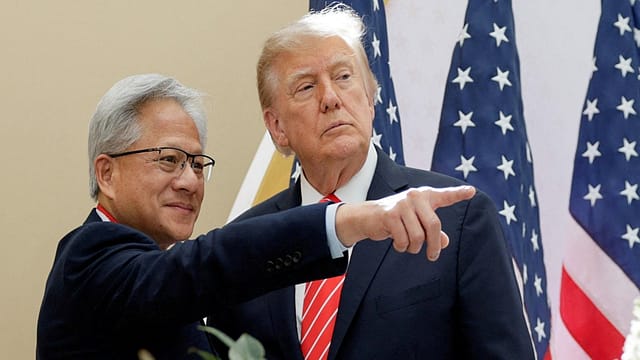
On Monday, the Philadelphia Semiconductor Index jumped 6.9%. Just one of its constituents fell. Nvidia closed at $178.67, down 4.3%, wiping about $190 billion off its market value. Donald Trump had spoken to Jensen Huang, said he believed the Nvidia chief executive and called him an honourable man. The president also told reporters that the FBI was looking into the matter. Investors had to weigh both pieces of news on a day when almost everyone else in chips was making money.
Nvidia finished Friday at $186.64 and Monday at $178.67, a loss of $7.97 a share. Multiply that by the 24.1 billion shares Nvidia disclosed as outstanding in August and the estimated close-to-close loss comes to $192 billion, in line with Reuters’ rounded figure of $190 billion. On the same basis, Nvidia ended Monday worth about $4.31 trillion, down from about $4.50 trillion on Friday. The stock traded as low as $170.24 on Monday, implying a loss of roughly $395 billion at the session low before it recovered some ground.

The Era of Forever Wars
30 Oct 2026 - Vol 05 | Issue 44
Coping with an explosive Middle East
Trump Believes Huang. The FBI Hasn’t Commented.
Trump said he phoned Huang on Monday to see how he was doing and asked whether he knew about the woman’s alleged intelligence ties. Trump recounted Huang’s answer as, “I had no idea that she was a spy,” and said he believed him. Asked when he first learned about the relationship, Trump said he had been informed “over a period of time”. He gave no date. He also gave no details about the scope or timing of the FBI inquiry, and the bureau declined to comment to the BBC.
Huang has acknowledged being unfaithful to his wife and apologised for hurting her and their children. In his message to employees, he took responsibility and said he would cooperate with Nvidia’s inquiry. He did not name Alice Huang, the former Megaspeed executive at the centre of the reports. The two are unrelated. The account of what Jensen Huang knew about her alleged intelligence ties comes from Trump’s retelling of their call.
The New York Times, citing US intelligence officials, reported that they believed Alice Huang, also known as Huang Le, had provided intelligence to Beijing. The newspaper also reported that Secretary of State Marco Rubio circulated a memo to senior officials in the spring warning about the relationship. Reuters said it could not independently verify the espionage allegations. China’s foreign ministry rejected them as groundless and described the reports as a smear.
Why Megaspeed Matters
Alice Huang was a managing director at Megaspeed, a Singapore cloud computing company that has done business with Nvidia. US authorities have been examining whether Megaspeed helped China obtain Nvidia chips restricted under US export controls, Reuters reported. That scrutiny gives Washington a concrete business question to pursue alongside the intelligence allegations: what access did a customer and its executives have to people, information and decisions inside Nvidia?
Brian Mast, John Moolenaar and Rick Crawford, the Republican chairs of three House committees, requested a joint closed-door briefing on November 18. Their letter asks about Huang’s interactions with Alice Huang and Nvidia’s safeguards against foreign espionage. The request is on the record. Huang’s attendance had yet to be confirmed.
Nvidia sits at the point where a commercial decision about which customer gets an advanced chip can become a policy decision about what China is allowed to buy. Washington treats access to that computing power as a security issue. For Nvidia’s board, the practical questions go beyond whether a document or a chip changed hands. They include who knew of any security concerns, how those concerns were escalated, and whether anyone independent of the chief executive could intervene if the circumstances called for it.
The Board and Shareholders Want Different Answers
Nvidia’s board said on Sunday that a committee of independent directors, assisted by outside counsel, would oversee its investigation. It said it had no reason to believe US national security or Nvidia’s secrets had been compromised and expressed confidence in Huang and his leadership team. That is the board’s position at the start of the review. The committee has been asked to examine the available information.
On Monday, shortly after the closing bell, shareholders led by Mark Kistenmacher filed a proposed class action in federal court in San Jose, California. They allege that Nvidia and Huang misled investors about the reported relationship and withheld national security concerns that could hurt the company’s reputation and business. The plaintiffs seek unspecified damages. Nvidia did not immediately comment on the suit, Reuters reported.
The shareholder case introduces a question of timing. The board can investigate whether anyone obtained sensitive information. Investors can still ask when management learned of a potential risk and whether it should have told them sooner. Monday’s price drop gives the plaintiffs a number to point to. A one-day fall, even one this large, cannot by itself settle whether investors were misled or which disclosure moved the stock.
The Company Huang Built Has Never Had Another CEO
Huang co-founded Nvidia in 1993 and has been its chief executive ever since. The company started with graphics chips and grew into the dominant supplier of the processors used to train and run AI models. Its valuation went from about $420 billion in late 2022 to roughly $4.5 trillion before Monday’s sell-off, Reuters reported. Huang spent decades making the technical and commercial case for that shift. He now has to answer questions from his own board and may have to do so before Congress.
The distinction investors have to make is between the strength of Nvidia’s business and the risk of depending on Huang. A customer that has built its AI systems around Nvidia’s chips and software has reasons to keep buying them. That same customer may still want to know who can make commitments on supply, product schedules and long-term partnerships if Huang has to step back. A senior executive could run the company in an emergency. Reproducing the authority Huang carries with customers, engineers and governments would be a different assignment.
There is no obvious public successor. Axios reported that Huang’s unusually large number of direct reports gives him a view across the company that no single deputy shares. That structure can make decisions faster while the founder is at the centre of them. It also leaves the board with more to work out if it ever has to transfer his responsibilities. A company can have an internal succession plan even when investors cannot see who is in line. Nvidia’s problem, for now, is how much the market has to take on trust.
Monday’s trading made the distinction unusually visible. Investors were willing to buy the semiconductor rally while selling Nvidia. The board has said it backs Huang, and the president has said he believes him. The next answers investors need are more specific: what the company’s safeguards caught, when directors learned of the concerns, and who had the authority to act.