Tim Cook’s Legacy: How He Transformed Apple Beyond Steve Jobs’ Vision and Built a $4.6-Trillion Giant
“Sending lots of love to the Apple community on my last day as CEO.”
Tim Cook posted the sentence on August 31, hours before one of corporate history’s most scrutinised tenures came to an end.
There was no product photograph. No Apple Park sunrise. No professionally edited farewell film. No graph showing revenue, market capitalisation, installed devices or shareholder returns.
Just love.
“My title changes tomorrow, but the love I have for the Apple community never will,” Cook wrote on X. “Thank you for being a constant source of inspiration.”
At midnight, the title changed.
John Ternus, Apple’s 50-year-old hardware engineering chief, became chief executive. Cook moved upstairs as executive chairman, where he will continue advising the company and dealing with policymakers around the world. Apple’s board had unanimously approved the transition and announced it in April.

Zeroing In on ECI
09 Oct 2026 - Vol 05 | Issue 41
Constitutional legitimacy versus political opportunism
The office changed hands. The argument about Tim Cook did not.
For 15 years, Cook was measured against a dead genius who had become impossible to defeat. Every Apple product was compared with the iPhone. Every presentation was compared with Steve Jobs. Every incremental improvement generated the same complaint.
Apple had stopped innovating.
Meanwhile, the supposedly diminished company travelled from a market value of about $350 billion when Cook took charge in August 2011 to approximately $4.6 trillion at the end of his tenure. Revenue grew from around $108 billion to more than $400 billion. Apple’s services business crossed $100 billion in annual sales. Its shares rose more than twentyfold.
The quiet man from Alabama did not become Steve Jobs. He made the comparison financially irrelevant.
The Email He Opened Every Morning
Cook revealed something intimate about his routine in the letter announcing his succession.
For almost every morning of his 15 years as CEO, he opened his email and read messages sent by Apple users.
They told him about an Apple Watch alert that saved a mother’s life. A photograph captured at the top of a mountain. A Mac that changed someone’s work. A feature that had stopped functioning and made the customer furious.
Tiny pieces of lives arrived inside the inbox of one of the world’s most powerful executives.
The ritual explains Cook better than the product launches do.
Jobs imagined technology as an instrument through which Apple could challenge human behaviour. Cook converted the relationship into a community extending across devices, stores, developers, subscriptions, health data and personal memory.
Under Cook, buying an iPhone increasingly became the beginning of a commercial relationship.
The phone connected to an Apple Watch, AirPods, Mac, iPad, iCloud account, App Store purchases, Apple Music, TV+, Pay, Fitness+ and a growing range of services. The company did not need to persuade the same customer to return from the beginning each year.
It had to make leaving feel inconvenient. Cook’s Apple became extraordinarily good at constructing that gravity.
The Man Who Walked into a Sick Company
Cook’s road to Cupertino began thousands of kilometres from Silicon Valley.
He was born in Mobile and raised in Robertsdale, a small Alabama town. His father worked in a shipyard. His mother worked at a pharmacy. Cook studied industrial engineering at Auburn University and later earned an MBA from Duke.
He did not emerge from the counterculture that shaped Jobs. He emerged from systems.
Industrial engineers study how materials, labour, information and time travel through complex organisations. They identify waste, reduce delay and make processes repeatable. It is a discipline built around the belief that a brilliant product is only as powerful as the machinery capable of delivering it.
Cook spent 12 years at IBM, eventually managing manufacturing and distribution for its personal-computer business across North and Latin America. He later worked at Intelligent Electronics and joined Compaq as vice-president for corporate materials.
Then Steve Jobs called.
It was 1998. Apple had recently approached the edge of extinction. Its product line was confused, its supply chain bloated and its relevance uncertain. Compaq looked like the rational career choice.
Cook accepted Apple.
He later said that within minutes of meeting Jobs, intuition told him he had encountered the opportunity of a lifetime.
The decision appeared reckless. It became one of the most consequential appointments in business history.
First, He Killed the Inventory
Cook did not begin by designing a translucent computer.
He attacked warehouses.
Technology inventory decays with unusual speed. A component sitting unsold for weeks can lose value as processors improve, prices fall and demand shifts. Excess inventory traps cash and increases the danger that yesterday’s technology will remain in a warehouse when tomorrow’s product arrives.
Cook treated inventory as something close to contamination.
Apple reduced the time products and components sat idle. Manufacturing was increasingly outsourced. Suppliers were integrated into a tightly managed network. Apple used its purchasing power to secure components, reserve manufacturing capacity and push risk deeper into the chain.
Factories made products closer to demand. Planes moved them around the world. Apple Stores and online channels provided rapid information about what customers were buying.
Jobs produced desire.
Cook ensured desire did not encounter an empty shelf.
The operational transformation mattered before Cook became CEO. The iMac, iPod, iPhone and iPad generated the headlines. Cook built the machinery that allowed Apple to manufacture them by the tens and eventually hundreds of millions.
In 2005, he became chief operating officer. Steve Jobs said Cook had already been doing the job for years. When Jobs’ health deteriorated, Cook repeatedly handled daily operations. By the time Apple formally appointed him CEO on August 24, 2011, he had already learned to run the company while its founder remained its soul.
Jobs died six weeks later. Cook inherited the office and the grief.
The Impossible Succession
No chief executive wants to follow a founder who has altered several industries. Cook followed one who had become mythology.
Jobs had returned to a failing Apple, simplified its product line and presided over the iMac, iPod, iTunes, iPhone and iPad. His keynote presentations turned product specifications into drama. His obsession with design created devotion and fear in almost equal quantities.
Cook looked like the opposite type of leader.
He was methodical, soft-spoken, operationally rigorous and less interested in occupying the centre of the stage. His presentations contained fewer flourishes. His management style relied more heavily on collaboration and accountability than creative combat.
The market initially wondered whether Apple’s invention engine had died with Jobs.
Cook’s response was not to imitate him.
Steve Jobs had warned him against doing precisely that. Jobs reportedly invoked Disney’s paralysis after Walt Disney’s death, when executives repeatedly asked what Walt would have done.
Apple could not become a corporate séance. Cook had to lead the living company.
The Watch That Escaped the iPhone’s Shadow
The Apple Watch became the first major new hardware category launched under Cook. It arrived in 2015 amid uncertainty about its purpose. Was it jewellery, a notification screen, a fitness tracker or a small computer attached to the wrist?
Over successive generations, the answer sharpened.
The Watch became a health device capable of recording heart rhythms, detecting falls, issuing emergency alerts and tracking workouts. It created a commercial bridge between consumer technology and personal medicine.
Cook frequently returned to health when asked what Apple’s greatest contribution might ultimately be.
The ambition made strategic sense. A phone is frequently replaced. Health monitoring can become a daily dependency.
AirPods followed in 2016.
Their white stems were mocked. Then they became a cultural uniform and helped turn wireless earbuds into a vast global category. Apple Watch and AirPods demonstrated Cook’s preferred method: enter once the underlying technologies and consumer behaviour are sufficiently mature, integrate the device tightly with the ecosystem and scale it faster than rivals can imitate the complete experience.
The products did not equal the iPhone’s historical impact. Very few products ever will. They proved that Apple could create major businesses after Jobs.
Apple Learnt to Design Its Own Brain
Cook’s most important product decision may be largely invisible to ordinary users.
Apple began moving Macs away from Intel processors in 2020 and towards chips designed internally around ARM architecture. Apple Silicon brought the company’s computers and mobile devices closer together technologically.
The shift improved performance and battery efficiency while giving Apple greater control over the relationship between hardware and software.
It also reduced dependence upon another company’s processor roadmap.
This was Cook’s Apple at its most effective: bold engineering concealed beneath a calm consumer proposition. Users did not need to understand semiconductor architecture. They experienced laptops that became faster without becoming hotter or exhausting the battery as quickly.
The Mac, a product older than much of Apple’s customer base, felt newly competitive.
John Ternus helped lead that hardware resurgence.
His promotion suggests Apple believes the next era will again require engineering depth, particularly as devices begin adapting to artificial intelligence, new form factors and changing interfaces.
The Recurring-Revenue Orchard
Cook expanded Apple beyond hardware through services.
The App Store had launched before he became CEO, but under his leadership it became part of a much larger recurring-revenue machine. Apple added Music, TV+, Arcade, News+, Fitness+, expanded iCloud, developed Apple Pay and constructed bundles through Apple One.
The strategy reduced dependence upon the annual iPhone upgrade cycle.
A user might delay buying a new phone while continuing to pay Apple every month for storage, music, entertainment and applications. Services also carried attractive margins and helped monetise Apple’s enormous installed base.
By 2025, annual services revenue had moved beyond $100 billion.
The strategic achievement came with controversy.
Developers accused Apple of controlling access to iPhone customers, forcing purchases through its payment system and collecting commissions that could reach 30 per cent. Epic Games turned the dispute into a prolonged legal battle. Regulators in the United States, European Union and elsewhere attacked Apple’s App Store practices.
In 2025, a US judge found Apple in civil contempt for violating an injunction intended to permit developers to direct users towards alternative payment options. In May 2026, the US Supreme Court declined to pause that ruling while Apple continued its legal challenge. Reuters reported the setback.
Cook had transformed Apple’s ecosystem into a fortress. Governments increasingly wanted gates in the walls.
Privacy Became a Product
Cook rarely generated Jobsian theatre onstage.
In February 2016, he produced it through a letter.
The FBI wanted Apple to help unlock an iPhone used by one of the attackers in the San Bernardino mass shooting. Apple had supplied data in its possession and assisted investigators, but the government wanted software that could bypass security protections and facilitate repeated passcode attempts.
Cook refused.
He argued that creating such a tool would amount to building a backdoor and that no guarantee could restrict its use to one phone. Once created, the technique could become a master key capable of weakening the security of millions of devices.
“The contents of your iPhone are none of our business,” Apple’s customer letter declared.
The confrontation elevated privacy from a technical feature into a central component of Apple’s identity.
Apple later introduced measures restricting cross-application tracking and expanded on-device processing. The company positioned its business model against advertising platforms whose profits depended more directly upon harvesting user behaviour.
The claim was never perfectly clean. Apple accepted billions from Google to make its search engine the default on Safari. It complied with lawful data requests and made compromises in countries where political power could threaten its access.
Yet Cook drew a public line that many technology leaders had avoided. He made privacy marketable.
The Brick He Placed in the Road
Cook guarded his personal life with extraordinary discipline.
Then, in October 2014, he wrote an essay for Bloomberg Businessweek and became the first openly gay chief executive of a Fortune 500 company.
He described being gay as one of God’s greatest gifts and explained that it had helped him understand what it meant to belong to a minority. His desire for privacy, he concluded, was preventing him from doing something more important.
The announcement carried particular force because Cook was a son of Alabama, a state he had criticised for moving too slowly on equality.
He was running the world’s most valuable company while publicly entering a category in which no other Fortune 500 CEO stood.
Cook did not pretend the essay made him a civil-rights hero. He described it as one brick placed on the sunlit path towards justice.
The brick mattered.
Young LGBTQ people could see a man occupying corporate America’s most unforgiving job without treating his identity as an apology or secret.
Cook’s Apple also became more vocal on racial justice, immigration, accessibility, environmental policy and LGBTQ rights. Critics accused the company of selective courage, particularly when its commercial interests encountered authoritarian governments.
That tension became most visible in China.
The China Machine Became a China Trap
Cook helped construct one of history’s most sophisticated manufacturing networks. Its centre of gravity lay in China.
Apple’s suppliers assembled enormous quantities of iPhones, Macs and accessories through a production ecosystem combining factories, skilled labour, component makers, logistics infrastructure and government support.
China gave Apple scale, speed and cost control that would have been exceedingly difficult to reproduce elsewhere.
It also became a major consumer market.
Cook developed relationships with Chinese officials, visited the country repeatedly and protected Apple’s access through years of political tension between Beijing and Washington. The diplomacy was operational brilliance applied to geopolitics.
But the concentration created danger.
Covid disruptions exposed how heavily Apple depended upon Chinese production. Rising US-China tensions transformed supply chains into instruments of national policy. Apple faced criticism for removing applications from its Chinese App Store and accommodating restrictions that would have been fiercely resisted in the United States.
The company began diversifying.
Vietnam acquired more production. India became central to the next manufacturing map.
India Moved From Market to Factory
Cook’s India story began slowly and then accelerated.
Apple was long constrained by the country’s price-sensitive smartphone market, import duties and small premium segment. Its phones carried aspirational power but limited volume.
Under Cook, India became commercially and strategically important.
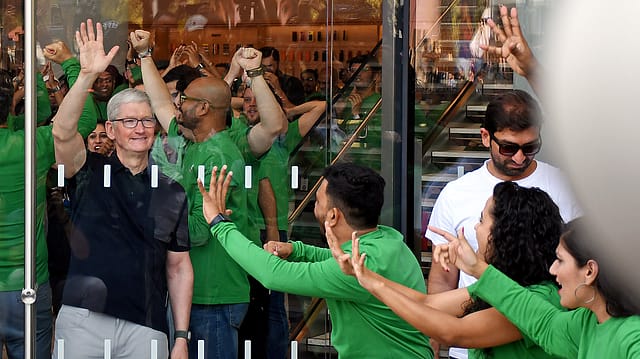
Apple opened its first company-owned Indian stores in Mumbai and Delhi in 2023, with Cook greeting customers personally. The stores represented more than retail expansion. They announced that India had graduated from an emerging possibility to a core Apple market.
Manufacturing followed.
Foxconn expanded iPhone assembly in India. Tata Group entered Apple’s production network. The company increased local sourcing and exports as it attempted to reduce its China concentration. India lowered import duties on mobile phones and key components in 2024, a move expected to benefit Apple as domestic production expanded. Reuters reported that the duty fell from 20 to 15 per cent.
Cook understood India’s dual promise. Its growing affluent population could buy Apple products. Its factories could build them.
John Ternus inherits both the opportunity and the unfinished task. Moving final assembly is easier than reconstructing an entire component ecosystem. China’s role cannot be replaced through announcements alone.
Cook leaves Apple less concentrated than it was. He does not leave it independent of China.
The Revolution He Arrived Late For
The sharpest criticism of Cook’s final years concerns artificial intelligence.
Apple introduced Siri in 2011, giving it an early position in voice computing. The assistant then stagnated as large language models reshaped what users expected from software.
OpenAI’s ChatGPT, Google’s Gemini, Anthropic’s Claude and Microsoft’s Copilot transformed generative AI into the technology industry’s dominant contest. Apple responded with Apple Intelligence, promising writing assistance, summaries, image tools and a more personal Siri capable of understanding context and acting across applications.
The rollout stumbled.
Some major Siri improvements were delayed after Apple acknowledged they would take longer than expected. The company explored using external models from firms including OpenAI and Anthropic, according to reports carried by Reuters.
The hesitation could ultimately look disciplined. Apple controls more than a billion sensitive devices and has reason to avoid rushing unfinished AI into private data.
It could also become Cook’s largest strategic miss.
His greatest strength was waiting until a technology could be refined, integrated and distributed at scale. Generative AI may reward companies that build models, attract developers and establish behaviour before the category settles.
Apple waited successfully on watches and wireless earbuds.
It may have waited too long on intelligence.
The Expensive Face Computer
Vision Pro captured Cook’s innovation dilemma.
Launched in 2024 at $3,499, the headset displayed extraordinary engineering. Its screens, cameras, eye tracking and interface offered a glimpse of spatial computing in which digital objects could occupy the user’s environment.
It was also heavy, expensive and uncertain of its daily purpose. Reviewers admired it. Most consumers did not buy it.
Vision Pro became evidence for both sides of the Cook argument. Supporters saw Apple investing patiently in a post-iPhone platform whose importance would take years to emerge. Critics saw an engineering marvel unable to locate a mass market.
Jobs had often persuaded consumers that they wanted something before they understood it.
Cook required the use case to become clearer. That difference defined the tenure.
The Diplomat in the Room
Cook developed another skill rarely celebrated in product videos. He learnt how to speak with power.
He maintained relationships with Democratic and Republican administrations, met Donald Trump repeatedly and navigated tariffs, antitrust scrutiny, China policy, privacy disputes and global regulation.
Cook could defend immigration and LGBTQ rights while keeping a line open to politicians whose policies Apple opposed. Critics sometimes interpreted the engagement as accommodation. Apple interpreted it as the work required to protect a company operating in nearly every major market.
His new executive-chairman role formalises that value.
Apple’s April announcement said Cook would remain involved in selected areas, including engagement with policymakers worldwide. Apple described the succession as the outcome of a long and carefully planned process.
Cook has left the chief executive’s office. He has not left the political battlefield.
What Exactly Did Tim Cook Build?
Cook did not create Apple’s foundational mythology. He inherited it. He did something equally rare: he prevented mythology from becoming a museum.
Founder-led companies often struggle after the founder disappears. Vision becomes doctrine. Employees imitate old decisions. The organisation monetises yesterday’s breakthrough while telling itself that repetition is innovation.
Apple avoided that collapse.
Cook broadened the hardware family, developed custom processors, built a huge services business, expanded retail, moved into health, protected the brand’s premium positioning and returned extraordinary sums to shareholders through dividends and buybacks.
He also made Apple more dependent upon recurring fees, more exposed to regulatory attack and still dangerously reliant upon a single product family. The iPhone remains the commercial sun around which much of the ecosystem travels.
The company did not produce another invention with the cultural force of the iPhone.
Expecting one every decade misunderstands how rarely such products appear. Excusing every missed shift misunderstands why Apple commands its valuation.
Cook leaves Ternus an institution of staggering strength and uncomfortable expectations.
Apple has money, chips, engineers, stores, customers and one of the world’s most trusted consumer brands. It also faces a technology transition in which screens may become less important, AI assistants may mediate user behaviour and competitors may control the models beneath the experience.
Ternus receives the best job in the world. He also receives Cook’s impossible succession in a new form.
The Morning After the Last Email
Tim Cook joined Apple in 1998. He leaves the CEO’s office 28 years later.
At the beginning, he managed materials, factories, inventory and distribution. Eventually, he managed grief, privacy, civil rights, governments, pandemics, trade wars, angry developers, demanding shareholders and a community carrying several billion Apple devices.
His public manner rarely revealed the burden.
Cook woke early, exercised, read customer emails and returned to work. The repetition became a leadership philosophy. Grand invention mattered. Relentless execution made invention durable.
He was accused of lacking Jobs’ magic. He responded with arithmetic.
Apple’s market value increased by more than $4 trillion. Revenue almost quadrupled. Services became a $100-billion business. The Apple Watch became the world’s dominant smartwatch. AirPods became a category symbol. Apple-designed chips revived the Mac. India entered the manufacturing map.
The criticisms belong beside those achievements.
China remains embedded deep within Apple’s machinery. The App Store fortress invited regulatory assault. Vision Pro remains stranded between technological wonder and commercial purpose. Siri allowed an enormous head start to dissolve. Apple begins the AI era as a rich pursuer, not the leader.
Cook’s legacy contains all of it. The operations genius and the late mover. The privacy advocate and the China diplomat. The deeply private man who made a profoundly public declaration. The caretaker who became one of corporate history’s greatest wealth creators. On his last evening as chief executive, Cook could have posted the numbers. He returned to the people whose messages he had opened almost every morning for 15 years.
“My title changes tomorrow, but the love I have for the Apple community never will,” he wrote.
Then came the final line from the man who had inherited an impossible chapter, written 15 years of his own and left the next one open: “My gratitude is endless, and I’m excited for the next chapter.”
(With inputs from ANI & agencies)