The School Bell That Saved 1,600 Children Before the Nepal Flood Swept Their School Away
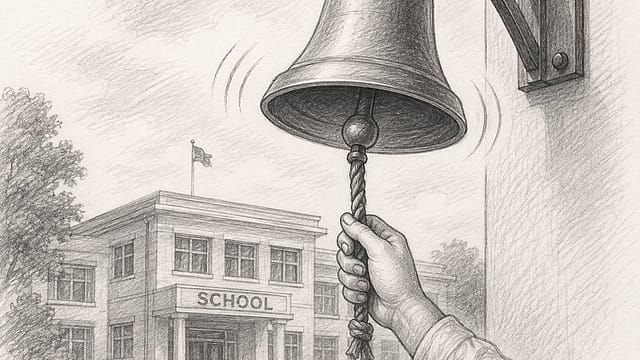
The bell rang at Tribhuvan Trishuli Secondary School while lessons were underway.
On an ordinary morning, it would have announced the end of a period, the beginning of another class or a brief escape into the playground.
On August 26, it meant only one thing: Run.
Principal Rajendra Dawadi was inside a classroom when the warning reached him. A flash flood was racing towards Trishuli Bazar in Nepal’s Nuwakot district, where the school stood perilously close to the river.
There was no time for an elaborate evacuation plan. No time to assemble the children and explain what was happening. Dawadi summoned the teachers, made a hurried decision and ordered the school bell to be rung.
“We rang the school bell to alert,” he reportedly told a news agency.
Nearly 900 students were inside the campus. Hundreds of others belonging to the school were still on their way. Dawadi and his staff began moving the children uphill while simultaneously contacting the drivers of school buses approaching the area.

Zeroing In on ECI
09 Oct 2026 - Vol 05 | Issue 41
Constitutional legitimacy versus political opportunism
The buses were told to stop. One had only just crossed the new bridge when the old bridge collapsed behind it. Children and teachers scrambled towards higher ground. Then they turned around. The school was gone.
“We all climbed uphill, and when we looked back, we saw the whole school was washed away,” Dawadi recalled.
A bell that had regulated the routines of school life had become an alarm. A principal accustomed to managing classrooms had been forced to outrun a river. A campus that had held generations of lessons vanished within minutes.
“The devastation is beyond imagination,” he said.
Tribhuvan Trishuli Secondary School had approximately 1,600 students on its rolls. Around 900 were present when the evacuation began, while the decision to turn back approaching buses helped protect those who had not yet reached the campus.
Reports from the area suggest the margin between escape and catastrophe may have been measured in seconds. The flood tore through buildings, bridges and roads along the Trishuli corridor, carrying people and debris far downstream. At least 69 schools were reportedly destroyed or damaged across the affected region, disrupting the education of nearly 19,000 children.
The students of Tribhuvan Trishuli survived. Not everyone from their school did. Teacher Santosh Parihar remained missing, according to Dawadi. Now the principal who saved his students must confront another question: where will they study when the immediate danger passes? “Education is very important, and we need to re-establish the school at a safe site,” Dawadi said, appealing for donations.
The site will have to be safer. The memories will be harder to relocate.
After the Bell, the Lists
Far from the vanished classrooms, another ritual was unfolding in Bidur.
Families moved between help centres, repeatedly examining lists of the dead and missing. They carried photographs, phone numbers and fragments of information from the final moments before contact was lost.
Sunita Kayastha was searching for her husband, Prakash. She said he had been travelling in a car when the flood arrived. Instead of escaping immediately, he tried to save another passenger. The water swept both men and the vehicle away.
“My husband was in the car... while trying to save others, he got caught in it,” she told ANI.
His phone had remained switched off since the disaster. “I hope the authorities will do something... my children are still young,” she said.
Dev Prasad Ghosh had travelled from Ranchi in Jharkhand to search for his younger brother. The last sign of activity on his brother’s WhatsApp account was at 8.37 am on the morning of the disaster.
Survivors reportedly told the family that the missing man had tried to flee but failed to reach the hill where others found safety. Ghosh feared he might be injured, trapped in mud or hidden beneath the forest canopy.
That was why, he argued, helicopters alone would not be enough.
“If they rescue by helicopter, he won’t be visible if he’s stuck inside a forest. A foot rescue is important,” Ghosh told ANI, appealing to the Indian and Nepal armies to send search teams into the area.
Ashraf Ali Khan arrived from Birtamod in eastern Nepal looking for five members of his family, including his daughter and grandson.
Six days had passed without contact. He continued to imagine possibilities that would keep them alive. Perhaps their house was still standing. Perhaps they had escaped and taken shelter somewhere. Perhaps they simply had no way of calling.
“No contact. It’s been six days now,” he said.
Across Bidur, hope was increasingly being measured against lists that kept growing.
More Than 900 Dead, Thousands Missing
Nepal’s National Disaster Risk Reduction and Management Authority said on Monday that 903 people had died and approximately 4,247 remained missing after the flash floods. More than 10,400 people had been rescued.
Chitwan reported the largest number of confirmed deaths, followed by Nawalparasi East, Nawalparasi West, Nuwakot, Gorkha, Dhading, Tanahun and Rasuwa.
The missing included members of the Nepal Police, Nepal Army, Armed Police Force, Customs Office and Immigration Office. Nearly 600 foreign nationals were also unaccounted for, while hundreds of workers were believed to be trapped or missing around damaged hydropower projects.
Rescue operations were continuing through the air and on the ground. Nearly 20,000 security personnel had been deployed, and helicopters had evacuated stranded Nepalis and foreign nationals from areas cut off by collapsed bridges, landslides and debris.
Teams were also attempting to reach workers feared trapped inside hydropower tunnels. Mud, rocks and unstable terrain were slowing the operation, while continuing rainfall raised fears of further landslides and flooding. International reports said Indian and Chinese specialists were assisting Nepal’s rescue effort. Reuters
When the Morgues Ran Out of Room
The flood had travelled far beyond the communities it first destroyed. Bodies swept into the Trishuli and Narayani river systems were being recovered many kilometres downstream. Chitwan, which received the largest number, soon ran out of mortuary space.
Authorities began burying unidentified victims in a forested area near Devghat after collecting DNA samples, taking photographs and assigning each body an identification number. Officials said the records would allow families to identify and reclaim remains later.
The temporary burials have caused anguish among families who fear their relatives may disappear into the ground before they can be found. Authorities have said the measure became unavoidable as bodies continued to arrive and decomposition accelerated. The Kathmandu Post
In Bidur, families continued to study the lists. In Chitwan, officials continued to number the dead. And in Nuwakot, the children of Tribhuvan Trishuli Secondary School were alive because their principal understood, within minutes, that the most familiar sound in their day had to mean something entirely different.
The bell did not call them to class. It told them there was still time to live.
(With inputs from ANI and agencies)