The $1 Trillion AI Bet: Spending Is Soaring, Profits Are Still Playing Catch-Up
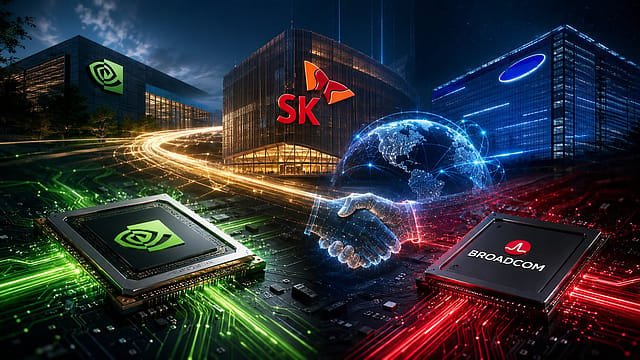
The world is preparing to spend $1 trillion on artificial intelligence this year. The machines are arriving. The data centres are expanding. Corporate budgets are being rewritten.
The profits, however, are not spreading quite as quickly.
Two Goldman Sachs reports capture the central tension inside the AI boom. Investment in the technology is accelerating across countries and companies, creating an immediate windfall for chipmakers, hyperscalers and other infrastructure providers. Across the wider corporate sector, measurable productivity and earnings gains remain limited.
Global AI-related investment is projected to reach around $1 trillion in 2026, equivalent to 0.9 per cent of global GDP, according to Goldman Sachs Research. That share could rise to 1.3 per cent in 2027 and 1.4 per cent in 2028 as companies continue pouring money into computing infrastructure, hardware and enterprise adoption.

Rise of the Pivotal Power
18 Sep 2026 - Vol 05 | Issue 38
The BRICS declaration is a strategic victory for Modi
The US alone is expected to account for $581 billion of AI investment this year. By Goldman Sachs’ estimate, American AI spending could rise from 1.8 per cent of GDP in 2026 to 2.5 per cent next year and 2.8 per cent by 2028.
Cumulative global investment since 2022 could reach $1.8 trillion by the end of this year.
The estimate is wider than the frequently cited projection of approximately $794 billion in capital expenditure by US hyperscalers. Goldman Sachs also includes spending by private businesses, companies outside the hyperscaler ecosystem and firms beyond the US.
The scale is enormous, but it is not unprecedented. Previous buildouts involving general-purpose technologies produced investment peaks of around 2 to 5 per cent of GDP. On that yardstick, Goldman Sachs believes AI still has room to grow. It also suggests current estimates for 2027 may be conservative and could be revised upwards.
Near-term signals support that view. Semiconductor manufacturing equipment imports in Taiwan and South Korea, memory prices, purchasing managers’ indices and GPU rental rates are all close to the upper end of their ranges since 2022. Together, they point towards continued strength in AI capital expenditure.
But while money is flooding into AI, the financial rewards are heavily concentrated among the companies selling the infrastructure.
Goldman Sachs’ analysis of S&P 500 earnings for the second quarter of 2026 found that hyperscalers and AI infrastructure companies recorded earnings growth of 54 per cent year-on-year. Those businesses alone contributed around half of the index’s earnings growth during the quarter.
Overall S&P 500 earnings growth was tracking at 31 per cent after excluding “other income” associated with certain private investment stakes. Earnings among the wider group of companies, excluding the energy sector, grew by a healthy 14 per cent.
For corporate users of AI, however, the promised productivity revolution remains difficult to find in the numbers.
Only 11 per cent of S&P 500 companies quantified productivity gains from a specific AI use case, such as software coding or customer support. A mere 2 per cent put a number on AI’s contribution to earnings.
Even among companies reporting measurable productivity improvements, Goldman Sachs found no statistically significant difference in earnings growth compared with their peers.
The spending appetite is nevertheless rising rapidly.
Median monthly AI expenditure per employee increased from $5 at the beginning of 2026 to $12 in July. Among the top 10 per cent of corporate AI spenders, the figure surged from $240 to $650 per employee.
For now, companies appear capable of absorbing the bill. AI inference costs account for less than 0.5 per cent of S&P 500 revenues. Around two-thirds of businesses are financing their AI investments by reallocating existing budgets, including money previously earmarked for software and labour.
That shift may prove consequential. If businesses fund AI by trimming labour budgets, the technology could change hiring and workforce structures before it produces an easily measurable boost to profits.
Goldman Sachs expects the earnings impact to become clearer as companies move from experimentation to large-scale deployment. The current divide, however, explains investor behaviour.
AI infrastructure companies are selling the picks and shovels of the boom. Their revenues are immediate, their order books are visible and their earnings are already responding.
The companies buying those tools face a harder task: turning access to AI into lower costs, faster output and sustainable profit growth.
There are also caveats around the headline investment estimate. Goldman Sachs acknowledged the possibility of double-counting, particularly when companies do not separately disclose financial leases and hardware expenditure. The bank cross-checked its calculations against corporate earnings revisions, government investment figures and global trade data, with each approach producing a broadly similar estimate of approximately $1 trillion.
The AI investment cycle, therefore, still appears to have momentum. What remains uncertain is how high the spending will climb, when it will begin to slow and whether the eventual returns can justify the money being committed.
The first phase of the AI boom belonged to those building the infrastructure. The next will depend on whether the companies buying it can finally make the numbers work.
(With inputs from ANI)