Tariff War or Poll Meddling? Why the US Is Accusing Canada Ahead of the Midterms
A tariff can hit a factory. It can also hurt the politician whose voters work there.
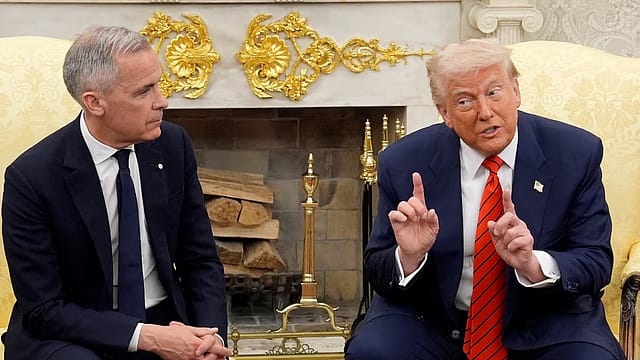
That overlap is now fuelling another confrontation between the United States and Canada. Ahead of America’s November 3 midterm elections, Washington has accused Canadian politicians of trying to influence US politics through trade retaliation, public messaging and political meetings.
Canada rejects the suggestion of improper interference. The dispute turns on a consequential question: when does pressure to change another country’s policies become interference in its elections?
WHAT EXACTLY HAS WASHINGTON ALLEGED?
In an October 21 factsheet titled Monitoring Canadian Activities in U.S. Politics, the US Embassy in Ottawa assembled statements and activities that it presented as evidence of Canadian efforts to influence American politics.

Losing Memory
16 Oct 2026 - Vol 05 | Issue 42
The making of a medical and social emergency
According to the embassy document, these included Industry Minister Mélanie Joly’s discussions about targeting politically sensitive American states with retaliatory tariffs, her meetings with Democratic officials, and Ontario Premier Doug Ford’s anti-tariff campaign.
The embassy’s warning was sweeping: “Americans decide America’s elections.” The allegation is serious. But an embassy factsheet records the administration’s position; it does not, by itself, establish an election-law violation.
WHY ARE TARIFFS AT THE CENTRE OF AN ELECTION DISPUTE?
Because trade retaliation can be designed to generate political pain.
Consider the mechanism. A government taxes imports from an American industry. Producers lose orders or become less competitive. Businesses and workers then pressure their representatives to seek relief from Washington.
The immediate economic target is a product. The intended political audience may be a governor, senator or president.
The embassy’s case draws heavily on Canadian officials openly discussing that pressure. The question is whether those statements establish an attempt to change US trade policy, an effort to influence electoral outcomes, or conduct that crosses a specific legal boundary. Those are related questions, but they require different evidence.
WHAT HAS CANADA SAID?
Prime Minister Mark Carney has defended Canada’s actions as a response to American trade measures.
According to The Canadian Press’s October 21 report, Carney said Washington initiated the trade actions and that Canada’s subsequent decisions served Canadian workers and families. Ford said he had no interest in interfering in American elections.
Joly had already rejected the interference allegation the previous week, saying her American engagements focused on attracting investment, according to The Canadian Press.
Ottawa’s defence therefore rests on purpose: it says it is protecting Canadian economic interests. Washington is questioning the political methods used to pursue them.
HOW DID RONALD REAGAN GET DRAGGED INTO THIS?
Through an Ontario advertising campaign that used the former Republican president’s criticism of tariffs to challenge the current Republican president’s trade policy.
According to Associated Press, Trump called off trade talks after the advertisement aired during the World Series in October 2025. The embassy has now cited the campaign in its interference allegations. Its political appeal is easy to understand: a Republican icon could make the argument against tariffs more persuasive to Republican audiences.
But judging an advertisement’s legality requires examining its content, funding, timing and connection to an election. Its ability to embarrass an administration does not settle those questions.
DOES US LAW BAN ALL POLITICAL ACTIVITY BY FOREIGNERS?
No. The rules are more specific than the embassy’s broad warning might suggest.
The Federal Election Commission says foreign nationals are prohibited from making election-related contributions and expenditures, including independent expenditures. They also cannot direct or participate in decisions concerning election-related activities. Foreign governments fall within the prohibition.
However, FEC guidance also recognises political activity outside elections and permits certain uncompensated personal volunteer services, subject to restrictions. Foreign nationals cannot use that volunteer exemption to manage campaign decisions.
That distinction matters because the embassy also cited Canadian MP Anthony Housefather’s reported campaigning for Democratic Representative Debbie Wasserman Schultz. The word “campaigning” alone cannot establish a violation. The relevant questions include what he did, whether anyone compensated him, whether resources were provided and whether he participated in campaign decision-making.
WHAT ABOUT THE CANADIANS ACCUSED OF VOTING ILLEGALLY?
The embassy also cited individual Canadians charged or sentenced in cases involving unlawful voting in previous American elections.
Those cases require their own scrutiny. Charges must be distinguished from convictions, and individual conduct must be distinguished from government direction.
Associated Press reported that the embassy did not link the cited voting cases to Canada’s government. Consequently, their inclusion does not establish an Ottawa-directed operation. Putting separate allegations in the same document does not supply the missing connection between them.
WHY DOES THE NOVEMBER 3 VOTE MATTER SO MUCH?
The midterms will determine control of Congress during Trump’s second term. All 435 House seats are contested, alongside roughly one-third of the Senate, whose members serve staggered six-year terms.
The outcome can strengthen or weaken an administration’s ability to advance legislation and determine how aggressively Congress scrutinises its decisions.
For Canada, American political relationships matter because US policies affect its businesses and workers. For Washington, Canadian efforts aimed at politically sensitive constituencies become especially contentious close to polling day. That creates an incentive for both sides to argue over intent: economic self-defence for one, electoral pressure for the other.
WHAT SHOULD INDIAN READERS TAKE FROM THIS?
The distinction matters wherever diplomacy, diaspora activity and electoral politics overlap.
An Indian-origin American citizen, an Indian citizen temporarily living in the US and an Indian government representative have different legal positions. Ancestry alone does not determine what someone may do.
FEC guidance excludes US citizens, including dual citizens, from its foreign-national category and recognises an exception for lawful permanent residents in campaign-finance rules. That exception should not be confused with eligibility to vote.
The wider lesson is about evidence. A government’s criticism of foreign policy, a citizen’s political activity and a state-directed election operation must each be assessed on their own facts.
SO, HAS CANADIAN ELECTION INTERFERENCE BEEN PROVED?
The public material described here establishes that Canadian politicians sought political leverage over American trade policy. Whether particular actions breached election rules requires a more specific examination.
The central unresolved issue is the connection between applying economic pressure and unlawfully participating in an election. Washington has made an accusation. Canada has offered a defence. Establishing a violation requires evidence that bridges that gap.