Taiwan Could Ignite US-China Conflict If Mishandled: Xi Warns Trump
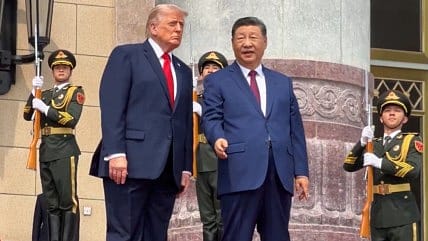
Chinese President Xi Jinping on Thursday warned that the Taiwan issue could push China and the United States towards "clashes and even conflicts" if not handled properly, during talks with US President Donald Trump in Beijing, Xinhua News Agency reported.
According to China's state-run news agency, Xi said safeguarding peace and stability across the Taiwan Strait was the "biggest common denominator" between the two countries.
The Chinese President added that Taiwan remained the most important issue in China-US relations, and stable ties between the two powers depended on how the matter was handled.
Flood and Fury
04 Sep 2026 - Vol 05 | Issue 36
Devighat, Nepal, August 29, 2026
Xinhua, further quoting the Chinese President, stated that "Taiwan independence" and peace across the Taiwan Strait were "as irreconcilable as fire and water".
Can US-China relations avoid conflict as Xi pushes cooperation over confrontation?
The remarks came during Trump's two-day visit to China, where both leaders held high-level discussions amid continuing tensions over trade, technology, regional security and geopolitical competition.
During the meeting, Xi also called for "cooperation" instead of "confrontation" between the world's two largest economies and said China and the United States "should be partners, not rivals".
"The whole world is watching our meeting. Currently, a transformation not seen in a century is accelerating across the globe, and the international situation is fluid and turbulent. The world has come to a new crossroads," Xi said.
Raising broader concerns over future ties between Beijing and Washington, Xi questioned whether both countries could avoid what he called the "Thucydides trap" and build a new model of major power relations.
"Can China and the United States overcome the Thucydides trap and create a new paradigm of major country relations? Can we meet global challenges together and provide more stability for the world?" Xi asked.
The "Thucydides trap", a term popularised by Harvard scholar Graham Allison, refers to the risk of conflict when a rising power challenges an established global power.
Xi said both nations stood to gain through cooperation and lose through confrontation.
"I always believe that our two countries have more common interests than differences. Success in one is an opportunity for the other. And a stable bilateral relationship is good for the world. China and the United States both stand to gain from cooperation and lose from confrontation," he said.
(With inputs from ANI)