Russia-India Rail Link? Moscow Floats a New Route to the Indian Ocean
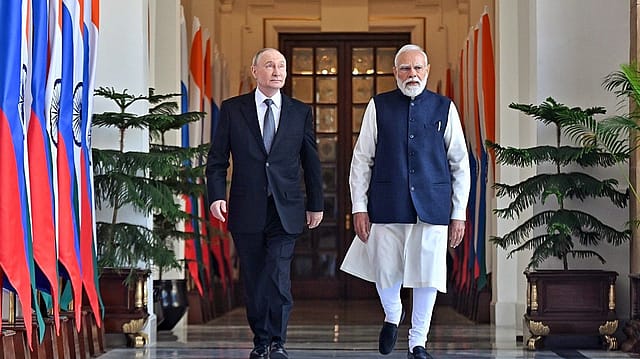
Russia is looking beyond the sea to keep its trade routes moving.
Deputy Prime Minister Marat Khusnullin has proposed exploring a rail link from Russia to the Indian Ocean, arguing that alternative routes could help reduce the risks posed by major maritime chokepoints such as the Bosphorus and Strait of Hormuz.
In an interview with Russia's state news agency TASS, Khusnullin said a potential corridor could run through Turkmenistan, Iran, Afghanistan and Pakistan, eventually connecting Russia with India.
"A rail link to the Indian Ocean should also be explored," Khusnullin said, adding that any route capable of providing access to India would be worth considering.
Rise of the Pivotal Power
18 Sep 2026 - Vol 05 | Issue 38
The BRICS declaration is a strategic victory for Modi
The idea comes as disruption around the Strait of Hormuz has injected fresh uncertainty into global trade and energy flows. The waterway is one of the world's most important maritime chokepoints, carrying a significant share of global oil and LNG shipments.
For Russia, the attraction of an overland route is obvious: less dependence on vulnerable maritime passages and a potentially faster, more resilient trade connection with South Asia.
But the proposed route is hardly straightforward.
A corridor crossing Turkmenistan, Iran, Afghanistan and Pakistan would have to navigate difficult geography, infrastructure gaps and complex geopolitical relationships before reaching India. The statement also does not provide a detailed construction plan, cost estimate or timeline.
For now, therefore, this is an idea to be explored rather than a railway under construction.
But it fits into a much bigger push to rethink Eurasian trade routes as geopolitical tensions make traditional shipping corridors less predictable.
And if the idea ever moves beyond the drawing board, the prize would be significant: a new land bridge linking Russia and India through Central and South Asia, offering an alternative to a world of increasingly vulnerable seas.
(With inputs from ANI)